The winners of the 1945 Retro Hugos have been announced as well as the winners of the 2020 Sir Julius Vogel Awards. The indefatigable Nicholas Whyte also shares some additional information about the Retro Hugos as well as the full voting and nominations breakdown. Also check out the comments at File 770, where there is a lively discussion going on.
So let's take a look at the individual categories:
That said, I had expected that Sirius by Olaf Stapledon would win, because it is better known. But I guess Stapledon is too Marmite to win. I'm a bit surprised that The Wind on the Moon by Eric Linklater finished in last place, because it is a charming story - unlike the tedious Winged Man.
That said, it's a pity that "A God Named Kroo" only barely beat "No Award", coming in fifth after the unreadable "Trog" and the Van Vogt novella I didn't get around to reviewing, because I can only tolerate so much Van Vogt.
That said, this was not the category I wanted to see Simak win. In fact, I was hoping that C.L. Moore, either with or without Henry Kuttner, would win Best Novelette, because both "No Woman Born" (which finished second) and "The Children's Hour" (which finished unfairly in sixth place) are great stories.
Though I'm glad that "Arena" by Fredric Brown with its "Genocide is good" message didn't win, because I feared that it might.
There were some complaints about the renown racist H.P. Lovecraft winning a Retro Hugo in 2020. And while I didn't put the Cthulhu Mythos in first or even second place - my number one was Captain Future who was one of my entry drugs into science fiction - I'm not surprised that it won. Because of all the nominated series, the Cthulhu Mythos is the only one which is still going strong - 83 years after the death of the original author. Also, I don't view this solely as a win for H.P. Lovecraft, but for everybody who ever wrote a story in the world he created. And this includes authors as diverse as Victor LaValle, Silvia Moreno-Garcia, Ruthanna Emrys, Matt Ruff, Neil Gaiman, Robert Bloch, Fritz Leiber and many, many others, some of whom would have horrified Lovecraft.
So while Lovecraft was undoubtedly a racist, he also created a universe in which many writers have played over the years, often subverting Lovecraft's ideas. So I think we should view this as a vote for the universe and everybody who ever wrote in it in the past ninety year. Cthulhu is an icon - more than the Shadow or Doc Savage, who are damned iconic in themselves - and has his own plush toy, so doesn't he deserve a Hugo?
The essay was originally published in Writer's Digest and isn't available online anywhere. The best way to get it is via Windy City Pulp Stories No. 13, which reprinted it a few years ago. I suspect that the publisher of Windy City Pulp Stories was very surprised about the sudden uptick in interest in his magazine.
That said, it is an interesting essay that offers insight both into Leigh Brackett's writing process and the SFF field as it was in 1944. Who would have guessed that Planet Stories was considered one of the more scientifically accurate publications? There's also a nice jab against John W. Campbell, whom Brackett famously didn't get along with, as well as another jab against Weird Tales and their infamously bad payment practice.
This is one case where I have no idea what the Retro Hugo voters were thinking. Yes, Superman is an iconic character beloved by many and even Mr. Mxyztplk is apparently a popular character, but have the voters looked at the actual comic? For while it's not as bad as the racist Wonder Woman comic which won last year (and if you voted for that one, don't complain about Campbell and Cthulhu?) it's no more than competent.
My first choice was Flash Gordon, because Alex Raymond was probably the best artist working during the Golden Age and this would have been our last chance to honour him. Instead, the to Flash Gordon strips finished last, even lower than Buck Rogers, which was really, really bad.
Looking at the nominations, it seems as if us Mandrake fans need to settle on one story and we might lift Mandrake and Lothar (who was the first black comic hero 30 years before Black Panther) on the ballot next time. And if the Phantom fans would like to rally to the cause as well, we might still get the full Defenders of the Earth on the ballot.
But while I agree that it's not a good idea to name an award for the best new writer of 2020 after a (very problematic) man who died almost fifty years ago, Campbell was the leading figure in the field in the 1940s. And Astounding Science Fiction is still considered the best magazine of the era, even though I for one found that other magazines offered more consistent quality than Astounding, which when it was good, was very good indeed, but which was also truly dreadful, when it was bad.
And indeed, I ranked Dorothy McIlwraith of Weird Tales, W. Scott Peacock of Planet Stories and Raymond Palmer of Amazing Stories above Campbell. Nonetheless, for better or worse, Campbell was one of the most influential figures of our genre, which is why people keep voting for him.
I also suspect that the wins for the Cthulhu Mythos and Campbell prompted the slightly cringeworthy intro by the CoNZealand chairs, in which they talk about how these are works of their time, which may be reactionary today.
However, people should also note that Ackerman wasn't even on the ballot for Best Fan Writer this year, a category he used to dominate at the Retro Hugos.
Which brings us to...
If we take a look at the full nomination data, I see a couple of other places where the spreadsheet and Retro Reviews had an impact. Would Allison V. Harding have made the novelette longlist with two stories, if I hadn't enjoyed "Ride the EL to Doom" so much and shouted about it to the world?
Which brings me to the wailing and gnashing of teeth, which is really just focussed on three winners - Campbell, Cthulhu and Ackerman. And yes, I'm not happy with those wins either.
However, after a few years of complaining about bad Retro Hugo finalists and winners, I decided to do something about it. And so I created the spreadsheet and started Retro Reviews to make it easier for voters/nominators to make informed choices and point them at good works that might otherwise be overlooked. I had a lot of fun, too, and discovered stories I might never have read otherwise. It wasn’t just me either. N helped to track down elusive dramatic presentation and related work finalists. Steve J. Wright, Paul Fraser, Don Briago and others reviewed lots of stories, novels and whole magazines.
So in short, several of us got together to put the information out there about what is eligible (obviously not Dave Langford nine years before he was born), what is worth checking out and shared our thoughts on the finalists. And yes, I wish more people would have looked at our work before voting/nominating, because if you look at the nomination data, you'll see lots of examples of nominations for people and works, which are flat out ineligible. If the voters and nominators don’t pay attention to this in sufficient numbers, there’s little we can do about it.
As for the people complaining about Retro Hugos for Campbell, Cthulhu and Forrest J. Ackerman, did you nominate and vote? Did you point out better choices? Did you point people to unjustly forgotten authors/editors/fan writers? If not, then don’t complain.
So let's take a look at the individual categories:
Best Novel
Shadow Over Mars a.k.a. The Nemesis from Terra by Leigh Brackett wins Best Novel. I'm really happy about this, because Leigh Brackett is one of the greats of our genre and was never recognised by the Hugos in her lifetime, though she did win a posthumous Best Dramatic Presentation Hugo for The Empire Strikes Back.
That said, I had expected that Sirius by Olaf Stapledon would win, because it is better known. But I guess Stapledon is too Marmite to win. I'm a bit surprised that The Wind on the Moon by Eric Linklater finished in last place, because it is a charming story - unlike the tedious Winged Man.
Best Novella
"Killdozer" by Theodore Sturgeon wins Best Novella. This isn't a big surprise, because "Killdozer" is the best known story nominated, though it's not the best story, because "The Jewel of Bas" by Leigh Brackett and "A God Named Kroo" by Henry Kuttner were both better. However, the Retro Hugos are still often determined by name recognition and nostalgia and the efforts of myself and others to change this have only met with mixed success.
That said, it's a pity that "A God Named Kroo" only barely beat "No Award", coming in fifth after the unreadable "Trog" and the Van Vogt novella I didn't get around to reviewing, because I can only tolerate so much Van Vogt.
Best Novelette
The 1945 Retro Hugo for Best Novelette goes to "City" by Clifford D. Simak. This isn't a huge surprise, because the City cycle is well regarded, still in print and Clifford D. Simak was one of the best writers of the Golden Age. "City" is a pretty good story, too, though not the best City story of 1944 or even the best City novelette, because "Census", which didn't make the ballot, is better.
That said, this was not the category I wanted to see Simak win. In fact, I was hoping that C.L. Moore, either with or without Henry Kuttner, would win Best Novelette, because both "No Woman Born" (which finished second) and "The Children's Hour" (which finished unfairly in sixth place) are great stories.
Though I'm glad that "Arena" by Fredric Brown with its "Genocide is good" message didn't win, because I feared that it might.
Best Short Story
The winner of the 1945 Retro Hugo for Best Short Story is "I, Rocket" by Ray Bradbury. I have to confess that this win surprised me, because not only was "I, Rocket" not the best story on the ballot - it's a fine story, but "Desertion" by Clifford D. Simak is much better - it's not even the best Ray Bradbury story of 1944, because both "The Lake" (which is a classic that has been reprinted lots of times) and the vastly underrated "Morgue Ship" are better. I also have no idea why Retro Hugo voters nominated "I, Rocket" over "The Lake", though I have no illusions that anybody except me nominated "Morgue Ship". I'm a bit surprised that "Far Centaurus" by A.E. van Vogt finished in last place, because this is the one van Vogt story on the ballot that's actually good.
Best Series
The Retro Hugo for Best Series goes to the Cthulhu Mythos by H.P. Lovecraft, August Derleth (via whose stories the mythos qualified seven years after Lovecraft's death) and many, many others.
There were some complaints about the renown racist H.P. Lovecraft winning a Retro Hugo in 2020. And while I didn't put the Cthulhu Mythos in first or even second place - my number one was Captain Future who was one of my entry drugs into science fiction - I'm not surprised that it won. Because of all the nominated series, the Cthulhu Mythos is the only one which is still going strong - 83 years after the death of the original author. Also, I don't view this solely as a win for H.P. Lovecraft, but for everybody who ever wrote a story in the world he created. And this includes authors as diverse as Victor LaValle, Silvia Moreno-Garcia, Ruthanna Emrys, Matt Ruff, Neil Gaiman, Robert Bloch, Fritz Leiber and many, many others, some of whom would have horrified Lovecraft.
So while Lovecraft was undoubtedly a racist, he also created a universe in which many writers have played over the years, often subverting Lovecraft's ideas. So I think we should view this as a vote for the universe and everybody who ever wrote in it in the past ninety year. Cthulhu is an icon - more than the Shadow or Doc Savage, who are damned iconic in themselves - and has his own plush toy, so doesn't he deserve a Hugo?
Best Related Work
The winner of the 1945 Retro Hugo for Best Related Work is "The Science-Fiction Field" by Leigh Brackett. I'm happy that the Retro Hugos have recognised Leigh Brackett not once but twice this year, but I'm still surprised that it won, because "The Science Fiction Field" is probably the most elusive Retro Hugo finalist of 1945.
The essay was originally published in Writer's Digest and isn't available online anywhere. The best way to get it is via Windy City Pulp Stories No. 13, which reprinted it a few years ago. I suspect that the publisher of Windy City Pulp Stories was very surprised about the sudden uptick in interest in his magazine.
That said, it is an interesting essay that offers insight both into Leigh Brackett's writing process and the SFF field as it was in 1944. Who would have guessed that Planet Stories was considered one of the more scientifically accurate publications? There's also a nice jab against John W. Campbell, whom Brackett famously didn't get along with, as well as another jab against Weird Tales and their infamously bad payment practice.
Best Graphic Story or Comic
The winner of the 1945 Retro Hugo Award for Best Graphic Story is the Superman comic “The Mysterious Mr. Mxyztplk” by Jerry Siegel and Joe Shuster.
This is one case where I have no idea what the Retro Hugo voters were thinking. Yes, Superman is an iconic character beloved by many and even Mr. Mxyztplk is apparently a popular character, but have the voters looked at the actual comic? For while it's not as bad as the racist Wonder Woman comic which won last year (and if you voted for that one, don't complain about Campbell and Cthulhu?) it's no more than competent.
My first choice was Flash Gordon, because Alex Raymond was probably the best artist working during the Golden Age and this would have been our last chance to honour him. Instead, the to Flash Gordon strips finished last, even lower than Buck Rogers, which was really, really bad.
Looking at the nominations, it seems as if us Mandrake fans need to settle on one story and we might lift Mandrake and Lothar (who was the first black comic hero 30 years before Black Panther) on the ballot next time. And if the Phantom fans would like to rally to the cause as well, we might still get the full Defenders of the Earth on the ballot.
Best Dramatic Presentation Short
We have two winners in the Best Dramatic Presentation category, The Curse of the Cat People and The Canterville Ghost. Both are fine winners and were my number one and two choices in this category. The Canterville Ghost is only the only Retro Hugo finalist, where someone involved with the production is still alive, namely former child actress Margaret O'Brien, then seven years old. The actress who played the little girl in The Curse of the Cat People unfortunately passed away a few years ago.
Best Editor
The winner of the 1945 Retro Hugo for Best Editor is John W. Campbell, which is not exactly a surprise, even though it did cause some wailing and gnashing of teeth, how people can still vote for Campbell after his name was removed from the Not-a-Hugo for Best New Writer, which is now known as the Astounding Award?
But while I agree that it's not a good idea to name an award for the best new writer of 2020 after a (very problematic) man who died almost fifty years ago, Campbell was the leading figure in the field in the 1940s. And Astounding Science Fiction is still considered the best magazine of the era, even though I for one found that other magazines offered more consistent quality than Astounding, which when it was good, was very good indeed, but which was also truly dreadful, when it was bad.
And indeed, I ranked Dorothy McIlwraith of Weird Tales, W. Scott Peacock of Planet Stories and Raymond Palmer of Amazing Stories above Campbell. Nonetheless, for better or worse, Campbell was one of the most influential figures of our genre, which is why people keep voting for him.
I also suspect that the wins for the Cthulhu Mythos and Campbell prompted the slightly cringeworthy intro by the CoNZealand chairs, in which they talk about how these are works of their time, which may be reactionary today.
Best Professional Artist
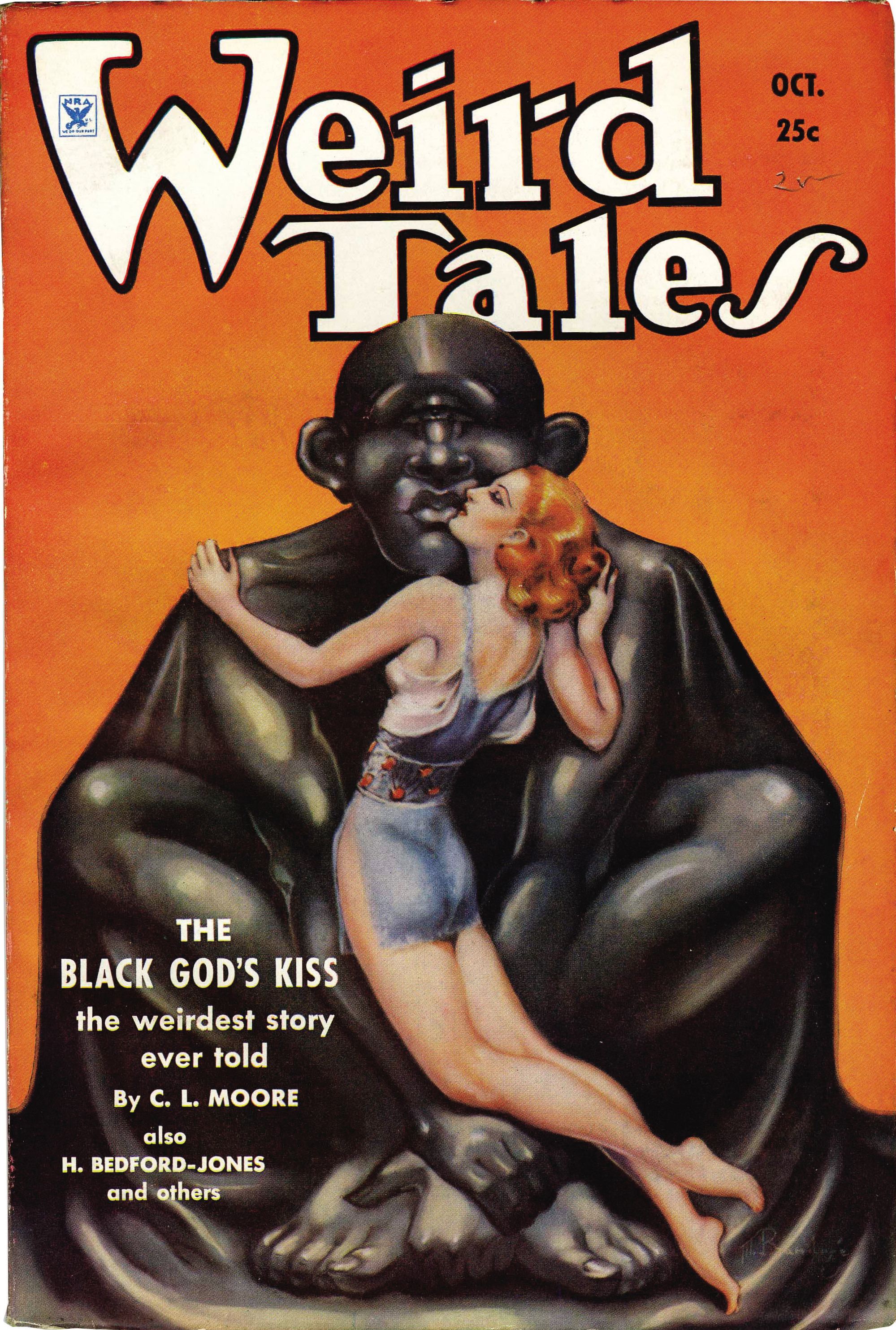
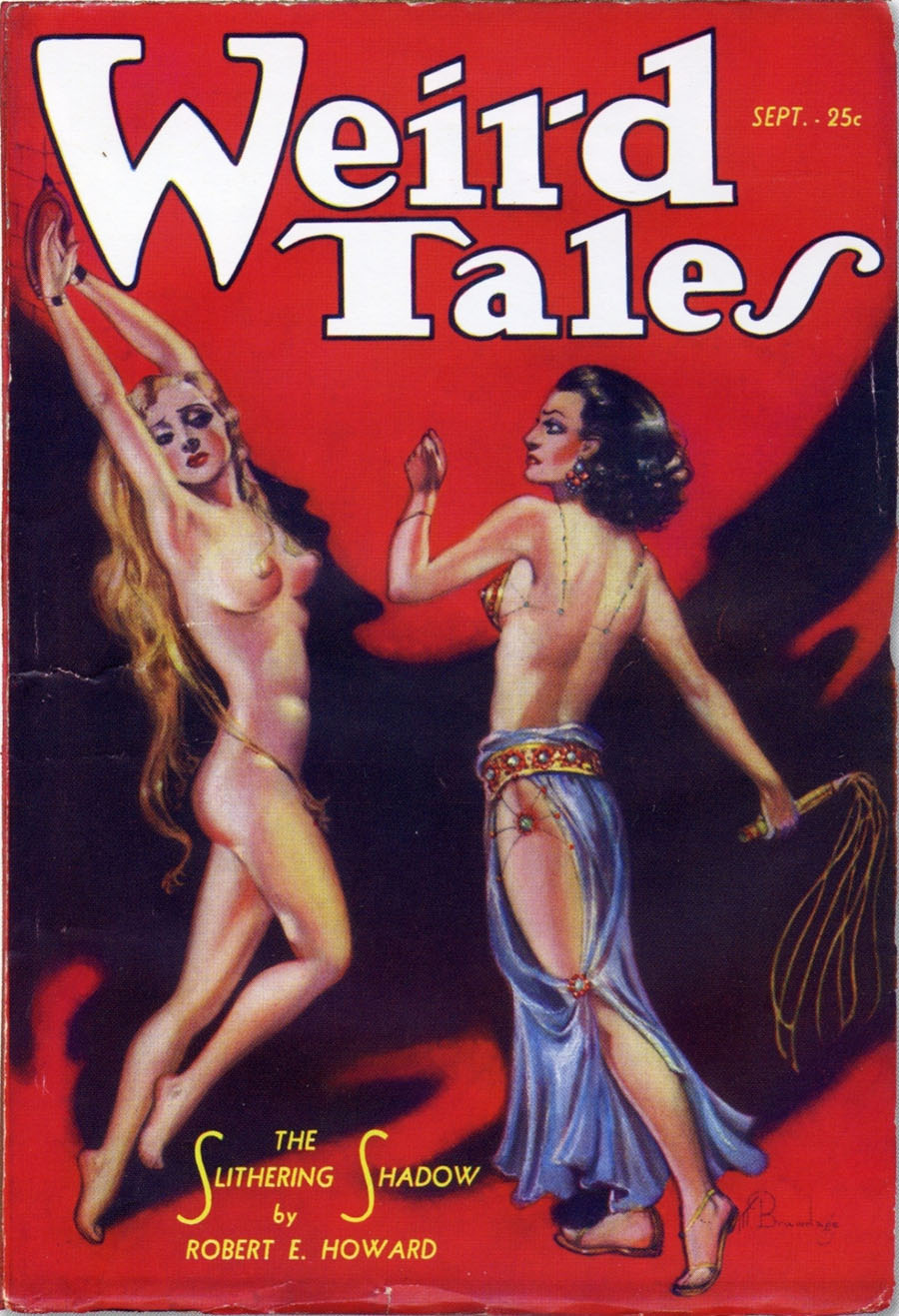
The winner of the 1945 Retro Hugo for Best Professional Artist is Margaret Brundage. Now this is one win I'm thrilled about, because Margaret Brundage was not just one of the very few woman artists working during the Golden Age, but also created some absolutely iconic covers for Weird Tales. Margaret Brundage was the first person to picture Conan and Jirel of Joiry (who wears armour rather than lingerie in the story) and who gave us Puritan executions in haute couture gowns (not actually a Solomon Kane cover, though I always assumed it was) as well as the highest selling Weird Tales cover ever. She was also a political radical, taught black children and she was very likely LGBTQ. It's long overdue that the Hugos recognise her work.
Best Fanzine
The 1945 Retro Hugo winner for Best Fanzine is Voice of the Imagi-Nation, edited by Forrest J. Ackerman and Myrtle R. Douglas. This win prompted another round of wailing and gnashing of teeth, because Forrest J. Ackerman was a sexual harrasser. I didn't vote for it either - not just because I prefer to vote for people who are not sexual harrassers, but also because I don't find Voice of the Imagi-Nation very good. There were definitely better fanzines out there in 1944, which were not edited by sexual harrassers.
However, people should also note that Ackerman wasn't even on the ballot for Best Fan Writer this year, a category he used to dominate at the Retro Hugos.
Which brings us to...
Best Fan Writer
The 1945 Best Fan Writer Hugo goes to Fritz Leiber for his contributions to the Lovecraft fanzine The Acolyte. This is the one win where I really think that my Retro Hugo Recommendation Spreadsheet made a difference. Because if I hadn't found a Fritz Leiber short story, an critical essay about Lovecraft and a poem about the Gray Mouser in The Acolyte, following a trail from ISFDB, and had put his name on the spreadsheet, I doubt that many people would have been aware that Leiber was even eligible.
If we take a look at the full nomination data, I see a couple of other places where the spreadsheet and Retro Reviews had an impact. Would Allison V. Harding have made the novelette longlist with two stories, if I hadn't enjoyed "Ride the EL to Doom" so much and shouted about it to the world?
Which brings me to the wailing and gnashing of teeth, which is really just focussed on three winners - Campbell, Cthulhu and Ackerman. And yes, I'm not happy with those wins either.
However, after a few years of complaining about bad Retro Hugo finalists and winners, I decided to do something about it. And so I created the spreadsheet and started Retro Reviews to make it easier for voters/nominators to make informed choices and point them at good works that might otherwise be overlooked. I had a lot of fun, too, and discovered stories I might never have read otherwise. It wasn’t just me either. N helped to track down elusive dramatic presentation and related work finalists. Steve J. Wright, Paul Fraser, Don Briago and others reviewed lots of stories, novels and whole magazines.
So in short, several of us got together to put the information out there about what is eligible (obviously not Dave Langford nine years before he was born), what is worth checking out and shared our thoughts on the finalists. And yes, I wish more people would have looked at our work before voting/nominating, because if you look at the nomination data, you'll see lots of examples of nominations for people and works, which are flat out ineligible. If the voters and nominators don’t pay attention to this in sufficient numbers, there’s little we can do about it.
As for the people complaining about Retro Hugos for Campbell, Cthulhu and Forrest J. Ackerman, did you nominate and vote? Did you point out better choices? Did you point people to unjustly forgotten authors/editors/fan writers? If not, then don’t complain.