Showing posts with label horror. Show all posts

Saturday, 26 November 2022

Retro Review: "The Hanging of Alfred Wadham" by E.F. Benson


Weird Tales August 1929


"The Hanging of Alfred Wadham" is a short story by E.F. Benson, which was first published in the December 1928 issue of the magazine Britannia and reprinted in the August 1929 issue of Weird Tales. The story may be found online here. This review will also be crossposted to Retro Science Fiction Reviews.

This story is another one which caught my eye via Hugh Rankin's striking interior art under his Doak pseudonym (Doak was Rankin's middle name). For some reason, Rankin did several drawings of hangings and executions under the Doak name, such as the interior art for "In a Dead Man's Shoes", which I reviewed recently. As before, Rankin also supplied to striking Art Deco cover art for this issue, illustrating the The Inn of Terror by Gaston LeRoux.

Hugh Rankin's interior art for "The Hanging of Alfred Wadham"

Though the standout story in this issue is not the cover story, but "The Shadow Kingdom" by Robert E. Howard, the story which introduced Kull of Atlantis as well as the Serpent Men to the world and is widely considered to be the first sword and sorcery story. I should probably do a Retro Review of that story eventually, especially since it's also a very good story.

Many authors who published in the pulps are completely forgotten these days and we know little to nothing about them. I feared this might be the case with E.F. Benson, but on the contrary, Benson was actually a very well-known British writer from a family of well-known people. His father was the Archbishop of Canterbury, one of his brothers wrote the words to "Land of Hope and Glory", another brother was also a writer as well as a priest and his sister was a writer and Egyptologist. To make matters even more impressive, E.F. Benson was a member of the Order of the British Empire. He was also gay and by necessity, given the time during which he lived, closeted.
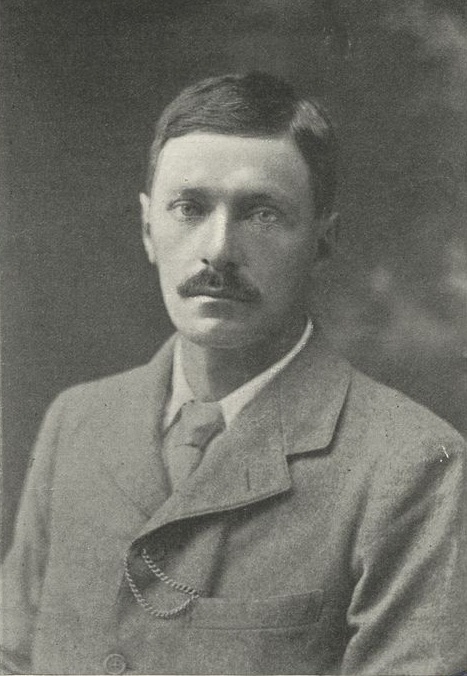
E.F. Benson

Benson's most famous work is the Mapp and Lucia series, a series of satirical novels about upper class people in a small town and their petty rivalries. I have to admit that I have never heard of those books, even though they spawned several sequels by other authors, two TV-adaptations, including one as late as 2014, and a lobster dish.

In addition to satirical novels about upper class people being jerks, Benson also wrote a lot of ghost stories and this is what brought him to the attention of H.P. Lovecraft, who wrote admiringly about Benson's work in "Supernatural Horror in Literature", and finally to Weird Tales.

But enough about the man. Let's talk about the story.

Warning! Spoilers beyond this point!

Compared to the other 1929 Weird Tales story featuring a hanging and interior art by Hugh Rankin, "The Hanging of Alfred Wadham" starts off slow with the unnamed first person narrator discussing a séance he attended with one Father Denys Hanbury. The medium conveyed some messages from a recently deceased friend of the narrator and the narrator is certain that the séance proves something, though whether it is communication with the dead or telepathy he is not sure. Father Denys, true to his profession, believes communication with the dead and impossible or demonic, though he is remarkably open-minded with regard to telepathy.

The narrator then explains that the medium talked about something that she could not have gotten from his mind, because the narrator did not know about it, but which was later confirmed by the dead friend's diary. Father Denys, however, still believes that communication with the dead is dangerous and shares a story of his own.

Such "take within a tale" framing devices were very common in the nineteenth and early twentieth century and pop up quite often in Weird Tales. What is notable about this one is that it's not only dull – we only ever get vague details about séance and what the medium said – but also written in a very stilted style. The (male) narrator also spends two paragraphs describing the beautiful hands of Father Denys. Even if I didn't know by this point that E.F. Benson was gay, that paragraph pretty much confirms it.
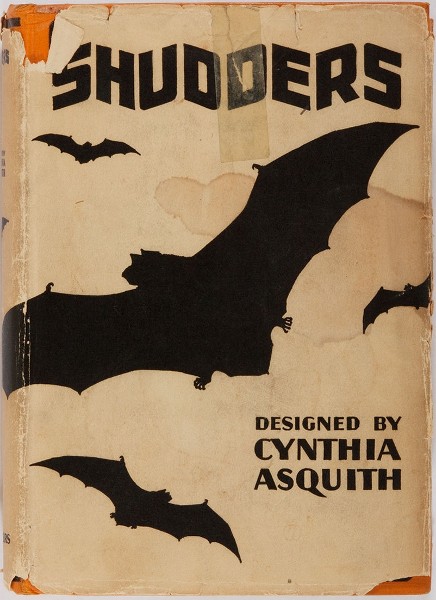
Shudders, edited by Cynthia Asquith

Once Father Denys of the beautiful hands starts his story, I hoped things were finally about to get good. Alas, Father Denys, who is a Catholic priest by the way, starts rambling on about the sacrament of confession, why it is important and why a priest may never ever repeat anything he heard in confession, even if remaining silent will have terrible consequences.

Next, we get an description of the crime allegedly committed by the titular Alfred Wadham. Alfred Wadham was the manservant of a "man of loose life" named Gerald Selfe. That "loose life" was the fact that Selfe was having an affair with a married woman. Someone found out about the affair and started blackmailing Selfe. Selfe went to the police, who investigated the case and quickly zeroed in on Alfred Wadham as a suspect.

The police have set a trap for Wadham, when Selfe is found with his throat slit one morning. Wadham is gone, but stains of human blood are found in his room. The police quickly apprehend him. Wadham proclaims his innocence of the murder, though he does admit to the blackmailing. Wadham declares that he realised that Selfe and the police were on to him and therefore fled. Alas, the judge and jury don't believe him and so Wadham is sentenced to death for murder.

Wadham is Catholic and so he meets Father Denys, who just happens to be the prison chaplain. True to his profession, Father Denys urges Wadham to confess to the murder and repent, but Wadham keeps insisting that he didn't do it. Since Wadham confesses plenty of other sins and crimes, Father Denys starts to believe him.

Father Denys is troubled by this case – not because an innocent man is about to be executed, but because he is not sure whether he should grant Wadham absolution for his other sins, since Wadham flat out refuses to confess to the murder.

More Spook Stories by E.F. Benson

Now it's worth remembering that E.F. Benson's father was an Anglican clergyman and Archbishop of Canterbury and that one of his brothers was an Anglican priest who converted to Catholicism, became a Catholic priest and wrote religious texts, so I probably shouldn't be surprised to see a theological argument in a story written by someone from such a background. However, as I've repeatedly said, I'm not religious, I dislike too much religion in my fiction and theological arguments literally make my eyes glaze over. And in this particular case, I had even less patience for theological arguments, because Alfred Wadham is about to be hanged for a crime he probably didn't commit, so who cares whether a priest absolves him from his sins or not? Never mind that granting absolution for sins is part of Father Denys' job.

On the night before the execution of Wadham, an former acquaintance named Horace Kennion visits Father Denys. Father Denys wants nothing to do with Kennion, because Kennion is a wicked man – more wicked than usual, because Father Denys reminds us that all humans are wicked and that "the life of us all is a tissue of misdeeds". Father Denys' hands must be very beautiful indeed for the narrator to willingly hang out with such a killjoy.

However, Kennion is very insistent to speak to Father Denys, because he needs to make a confession right now and his usual priest is not available. So Father Denys reluctantly hears his confession. Surprise: Kennion is the one who killed Gerald Selfe over a quarrel about a game of cards (though there was no mention of cards or a card table in the earlier description of the crime scene). After stabbing Selfe, Kennion went up to Wadham's room (Selfe had rung for Wadham earlier, but Wadham had already left, so Kennion knew the room would be empty) to wash off the blood – that's how the blood stains came to be found in Wadham's room.

Father Denys of course immediately entreats Kennion to go to the police and confess, so Wadham can be saved. However, Kennion has no intention of going to the police. And when Father Denys threatens that he will call the police, Kennion just grins and points out that he can't, because his faith forbids it. And besides, who would believe a priest who violated to sacrament of confession?

Father Denys now demands why Kennion felt the need to confess his sins at all and why to him specifically. Once again Kennion grins and tells Father Denys that he was very hurt when Father Denys broke off all contact with Kennion. And so he decided to get revenge by putting Father Denys in a terrible situation where there are no good choices. "I daresay I've got Sadie tastes, too, and they are being wonderfully indulged," Kennion says.

The Benson brothers
These are not actually the characters from this story, but E.F. Benson (on the right) and his brothers Arthur Christopher Benson (on the left, wrote the lyrics to "Land of Hope and Glory") and Robert Hugh Benson (the priest).

Now the vibes that I get from this exchange is that Father Denys and Kennion were lovers and that there may well have been some kink involved. But then Father Denys broke off the relationship and Kennion wants revenge. It's also notable that Kennion calls Father Denys by his first name, something which was extremely uncommon among upper class British men in the early twentieth century. Even Kennion's disdain for the doomed Alfred Wadham and his claim that Wadham has it coming for his other crimes – "Blackmail is a disgusting offence" – fits in with this, because gay men were often the target of blackmailers, back when gay relationships were still illegal. In fact, I wonder whether Kennion and his victim Gerald Selfe did not have a relationship, too. After all, it is explicitly stated that Kennion went up to Selfe's room.

I have to admit that though he is a murderer (double murderer to be exact) and generally horrible person, Horace Kennion is the most interesting character in this story. The narrator is a cypher, the victim Gerald Selfe is merely a prop required to get the story going and Alfred Wadham is more moral dilemma than character. As for Father Denys, he is an insufferably sanctimonious prick.

Case in point: Father Denys spends a few paragraphs detailing the terrible torment and suffering he experiences – a suffering that is not even "a needful and salutary experience to burn his sins away", but empty torment. Meanwhile, the actual victim here is not the moping priest with a crisis of conscience, but Alfred Wadham who is about to be executed for a crime he did not commit.

Though at least Father Denys does take some action rather than just sit around feeling sorry for himself. First, he goes to see the Cardinal, who basically tells him that he cannot violate the seal of confession. Then he goes to see the Home Secretary and tells him that Wadham is innocent, because the real murderer just confessed to him.

The Home Secretary is sympathetic, but tells Father Denys that he cannot pardon Wadham without more evidence. He also tells Father Denys to put the fear of God into the real murder to get him to confess and also gives the priest his phone number, just in case.

However, Father Denys doesn't need the phone number, because instead of putting the heat on Kennion, he goes straight to the prison, tells Wadham that he believes in his innocence and finally grants him absolution for all his other sins. Then we learn that Wadham went without flinching to his death. There is also a brief one sentence description of the trapdoor opening and the rope jumping and creaking. But otherwise, the hanging that Hugh Rankin drew so evocatively happens mostly off page.

This is rather disappointing, particularly compared to the visceral description of a hanging in Harold Markham's story "In a Dead Man's Shoes", published a few months before in the April 1929 issue of Weird Tales. Of course, Markham was describing a public hanging in the eighteenth century rather than a prison hanging in the early twentieth century, but there are plenty of much more evocative descriptions of twentieth century prison hanging than the single sentence that Benson gives us.

But then, the story isn't really about the hanging of Alfred Wadham at all, in spite of the title. It is about Father Denys and his moral dilemma. And now Father Denys finally comes to the point of his tale, namely why séances are bad and do not convey messages from the dead, but from some "evil and awful power impersonating them".

 After the execution, Father Denys goes home and Benson gives us more description of the weather than of the actual execution. However, mostly we get yet more musings from Father Denys. Even though he has just watched a man been hanged for a crime he did not commit, Father Denys feels serene and peaceful. After all, in Father Denys' view, it doesn't much matter that Alfred Wadham was hanged. After all, he had all his sins forgiven and still has his immortal soul and getting hanged for a crime he didn't commit is just like martyrdom.

Meanwhile, Father Denys makes it clear that the most important thing to him is that he kept his precious vow and did not commit the worst crime a Catholic priest can commit. This was the moment where I went from, "What sanctimonious bore" to "What a fucking arsehole – I hope something awful happens to him." Thankfully, something does.

Once he gets home, Father Denys lies down for a nap – after all, he has been up all night. He has a bad dream of Wadham screaming at him and begging him to save him. He wakes up to the sound of someone calling his name in Wadham's voice. Yes, apparently Wadham has returned to haunt Father Denys and highly deserved it is, too. Honestly, Wadham, haunt the shit out of that jerk of a priest.

Father Denys now keeps hearing Wadham calling his name, he feels Wadham's presence. he sees him on the street and once sees Wadham's body swinging in the wind outside his window, which is the scene Hugh Rankin's interior actually illustrates.

The haunting of Father Denys – which would be a much better title for this story, come to think of it – culminates when he sees Wadham – with the noose round his neck, face purple and eyes protruding – sitting in a pew at the front of the church, while Father Denys is preaching. However, Father Denys is still convinced that he made the right choice and concludes that the one sending the apparitions is the devil rather than one very pissed off ghost.

The story ends with the ghost of Alfred Wadham – or the devil pretending to be the ghost of Alfred Wadham – reappearing in front of the narrator's and Father Denys' eyes. We get some nice, if conventional description of a ghostly apparition such as the room growing chill and the lights turning dim and then we get a manifestation of Alfred Wadham's hanged body, complete with swollen and purple face and lolling tongue. Alas, Father Denys wards off the evil spirit with his crucifix and appears radiant as he has never seen another human being before to the smitten narrator.

Finally, almost as an afterthought, almost as if Benson had forgotten that Father Denys couldn't possibly tell this whole story to the narrator without breaking his vow, Father Denys reveals that Horace Kennion committed suicide that morning and that he left a full confession behind, which is why Father Denys is no longer bound by the seal of confession and can share his story with the narrator.
 

I have read a lot of stories from Weird Tales over the years, both for the Retro Reviews project or in general. But "The Hanging of Alfred Wadham" is definitely the worst Weird Tales story I have read to date.

This is a pity, because the seeds for a good story are all here. The scenario of a priest who hears about a crime during confession and struggles to find a way to expose the criminal or prevent the crime without violating the seal of confession is a well-worn one, but it can work, when done correctly. The fact that Alfred Wadham will be executed, if Father Denys can't find a way to bring Kennion to justice adds a ticking clock to the proceedings. This scenario might have made for a neat thriller – and indeed there have been many thrillers with this exact premise. Alfred Hitchcock's 1953 movie I Confess, which in turn is based on a French play from 1902, is probably the most famous example, but there are several others.

However, this isn't the story that Benson told. Of course, the story of a priest haunted by the ghost of an executed man he could have saved by breaking the seal of confession, but didn't, might have made for a compelling ghost story as well, but that's not really the story Benson tells either. Or at least, he doesn't tell it very well.

Instead, we get what appears to be a theological argument in the form of a short story. Which is probably my least favourite type of fiction, because as I said above, I'm not religious and theological debates make my eyes glaze over. Plus, I come from a majority Lutheran-Protestant area. And Lutherans, at least in Germany, have massive issues with the Catholic sacrament of confession, which they view as hypocrisy, because you can literally commit a murder and then be forgiven your sins, just because you confessed and said a few prayers. It all goes back to the sales of indulgences, which were one of the issues that caused Martin Luther to nail the ninety-five theses to the door of the Wittenberg castle church.

Of course, it's quite possible that Benson intended "The Hanging of Alfred Wadham" as a critique of the Catholic sacrament of confession and its inherent issues. After all, Benson's father was Archbishop of Canterbury and therefore Anglican, even though one brother converted to Catholicism. And Father Denys is not a likeable character. However, if criticising the issues inherent in the sacrament of confession was Benson's intention, he doesn't do it very well either.

Because "The Hanging of Alfred Wadham" also has massive craft issues. The framing device and the unnamed narrator are completely unnecessary – just let Father Denys narrate the story and maybe end with him seeing Alfred Wadham's executed corpse in the church pew. It would certainly have made for a stronger story.

The murder mystery is also sloppily executed (pun fully intended), because it seems the police ignored crucial clues such as the fact that Selfe and Kennion had played cards and that there was a card table set up, which would suggest that Selfe had a visitor on the night he was killed. The blood stains found in Wadham's room also don't add up. For starters, they're explicitly described as human blood stains, though I have no idea if 1920s forensic science could tell the difference between human and animal blood from a few traces. Also, there are any number of ways the blood could have gotten into Wadham's room such as Wadham accidentally cutting himself while shaving. This may sound nitpicky, but by 1928/29, the so-called Golden Age of Mystery was in full swing, most mysteries were so-called fair play mysteries and plenty of predominantly British authors knew how to plant clues and red herrings. So there is really no excuse for Benson's sloppiness. Read some Agatha Christie or Dorothy Sayers, will you.

The writing style is also stilted, ponderous and dull throughout. "The Hanging of Alfred Wadham" is short, only nine pages, but it feels much longer. Benson also has the tendency to overfocus on Father Denys' internal conflict and underdescribe the murder, the execution and the supernatural events, i.e. the sort of thing Weird Tales readers were probably far more interested in than in a theological argument and a priest's mental torment.

Furthermore, the story also feels very old-fashioned, more like something that might have appeared in the nineteenth century alongside a Sherlock Holmes or Edgar Allan Poe story than something that appeared alongside Robert E. Howard's "The Shadow Kingdom". Of course, Benson was not a young man, but already 61 when this story was published and so his style and sensibilities likely were more Victorian.

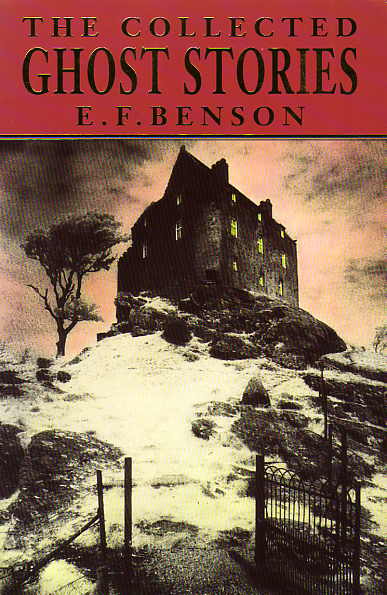
The cover of this fairly recent edition of E.F. Benson's collected ghost stories actually illustrates "The Hanging of Alfed Wadham"

The one thing about this story that is interesting is the glimpse into closeted gay life in the early twentieth century. Because make no mistake, this is a very gay story. Father Denys, the narrator, murderer Horace Kennion and his victim Gerald Selfe are implied to be closeted gay man, while wrongful execution victim turned vengeful ghost Alfred Wadham was a blackmailer who blackmailed men about their indiscretions. And yes, Gerald Selfe's sexual indiscretions are said to have been with a married woman, but I suspect Benson just added that tidbit to make the story more palatable in a world, where LGBTQ themes could only be hinted at.

Another thing that's notable is that this is a fairly rare example of a pulp story that's explicitly religious. Because contrary to what certain folks say, religion in general and Christianity in particular do not play a big role in pulp SFF and pulp fiction in general. Especially in pulp SFF, religion is either a scam or for aliens or it involves sacrificing nubile virgins to Cthulhu. Yes, there are exceptions such as Robert E. Howard's Solomon Kane, but they are few and far between.

And come to think of it, Solomon Kane, Howard's fanatical Puritan avenger and scourge of all that is evil, is a much more interesting and compelling portrait of an intensely religious person in moral distress, though in Kane's case is moral dilemma is that he is a violent man who kills a lot of people, believing himself to be on a mission from God. Only that both Kane's religious and moral  dilemma and his adventures are a lot more exciting and better written than "The Hanging of Alfred Wadham". This is particularly interesting since three Solomon Kane stories, "Red Shadows", "Skulls in the Stars" and "Rattle of Bones" had already been published by the time this story was published. So Weird Tales had already published much variations on the theme of "An intensely religious person is confronted by the supernatural and has their faith tested".

In fact, if you come across explicitly religious SFF from the 1930s and 1940s, it usually hails from Britain and was published outside the pulp magazine ecosystem. C.S. Lewis is probably the best known example, though E.F. Benson also fits the bill. Now I make no secret of the fact that I intensely dislike C.S. Lewis' fiction, but much as Lewis' religious blathering annoys me, there is no doubt that Lewis could write. E.F. Benson, at least based on this example, couldn't.

"The Hanging of Alfred Wadham" was my first exposure to E.F. Benson's work, but based on this story, I certainly won't go seeking out more of his work. In fact, I am baffled that Benson is famous enough to have a Wikipedia entry, plenty of reprints of his work and film and TV adaptations. Maybe his satirical small town tales are better or maybe this story is just a dud. It definitely is proof that even Weird Tales did publish duds on occasion, though they are still a lot more consistent than other pulp magazines.

If you want a Weird Tales story featuring an execution, read the much superior "In a Dead Man's Shoes" by Harold Markham. If you want a story about an intensely religious person having their faith and personal morality tested by encounters with the supernatural, read Robert E. Howard's Solomon Kane stories. If you want religious blathering but well written, read C.S. Lewis. If you want to read a great story from the August 1929 issue of Weird Tales, read "The Shadow Kingdom" by Robert E. Howard.

But don't bother with "The Hanging of Alfred Wadham", unless you are a fan of E.F. Benson's or really like religious blathering and theological arguments in your fiction or are doing a study of early LGBTQ speculative fiction.

Thursday, 26 August 2021

Retro Review: "More Than Shadow" by Dorothy Quick

If the cover seems familiar, that's probably because the artwork by Harold De Lay was originally used on the cover of the January 1944 issue of Weird Tales.

"More Than Shadow" is a horror short story by Dorothy Quick, which was first published in the July 1954 issue of Weird Tales. The story may be found online here. This review will also be crossposted to Retro Science Fiction Reviews.

Warning: There will be spoilers in the following.

The protagonist of "More Than Shadow" is Mona, a wife and mother of three. Mona lives in a suburban house with her lawyer husband Hal, the children Carol, Meg and Harry Jr. and the housemaid Ellen.

At first glance, Mona would seem to have a pretty cushy postwar life. However, her 1950s domestic bliss is interrupted by strange occurrences that keep happening in her house. Cause whenever someone spills some kind of liquid – milk, tea, water – the liquid coalesces into a puddle shaped like a cuddly little dog. As hauntings go, this one is certainly creative.

The first two times it happens, Mona dismisses the dog-shaped puddles as a coincidence. By the third time, however, Mona realises that there is something very strange going on in her house.

Just to make sure that she isn't imagining things, Mona calls over Ellen, the maid, and asks her what she sees in the puddle of spilled water. Ellen confirms that the puddle looks like a dog, but not just any old dog either, but the little dogs on which the leprechauns ride on moonlit nights. For Ellen just happens to be Irish and therefore a fount of Irish folklore.

Intrigued, Mona asks where the leprechauns go on those little dogs. A little spooked, Ellen, who – being Irish – of course believes in leprechauns, replies that no one really knows, but that according to legend the little dogs carry the leprechauns over the mountains to the land of youth.

The legend is familiar to Mona, because it reminds her of a quote about the land of faery from the 1894 play The Land of Heart's Desire by William Butler Yeats, which is extensively quoted in the story, copyright apparently being no issue in 1954.

I've remarked before that for supposedly disposable trash fiction for the masses, the pulps were quite literary at times and are often full of literary references and allusions, many of which are not immediately recognisable to the modern day reader, even if they likely were to a golden age audience.

Unlike other authors of the era, Dorothy Quick does not assume that all readers will be familiar with the play (or have Google at hand to look it up), so she briefly has Mona sum up what the play is about, namely a newlywed bride being enticed by a faery child to come with her to the land of heart's desire. The bride eventually succumbs and promptly dies in the real world.

Dorothy Quick also offers up a reason why Mona is familiar with the play, since she isn't simply a fount of random Yeats quotations. For it turns out that Mona's high school graduation class performed the play and that Mona played the doomed bride. More importantly, the night of the premiere of the play was also the night that Mona's husband Hal, then still a young college freshman, proposed to her.

Seeing the dog-shaped puddle not only brings back memories of that long ago school play, it also reminds Mona that at the time, she wondered whether getting to live in the land of faery, forever young and carefree, wasn't worth losing your life and soul for. Now, many years later, Mona feels the longing for the land of faery again, but she quickly dismisses it. After all, she's happy, isn't she? She's got a great husband, three wonderful children, a beautiful home. She's living the dream.

About a week after the incident with the dog-shaped puddle, a real dog comes into Mona's life, when her kids find an adorable black poodle just sitting by the garden gate. Naturally, the kids want to keep it. Mona and Hal are quickly won over, though they caution the children that the dog probably already has an owner and just got lost. But until the legitimate owner shows up, the kids may keep it.

However, no previous owner appears and so the family keep the poodle, whom they name Jet, because he was jettisoned. The whole family loved Jet, only Ellen the maid is wary of the dog and insists that there is something strange about him. Being Irish, Ellen is apparently more sensitive towards the supernatural.

Whenever Mona cuddles with Jet, she has visions of Yeats' land of heart's desire, visions that are so vivid and realistic that she worries she might be going mad. When she confesses her worries to Hal, her husband admits that being with Jet makes him want to abandon his work and just go fishing all day long. However, Hal, being the rational type, believes that the presence of Jet simply loosens their inhibitions.

One day, while Mona is napping (Mona naps a lot), Jet cuddled up beside her, she hears strange music, as if in a dream. Jet suddenly starts talking and tells her that he can take her to the land of heart's desire, where no one ever grows old and there's only happiness, no pain. Jet also suddenly grows to the size of a small pony, big enough to ride upon. Jet tries to entice Mona to climb on his back and come with him to the land of heart's desire. Mona is sorely tempted, but then she looks into Jet's eyes and sees an ancient evil there. She also noticed that Jet has very sharp teeth, like fangs. But the temptation is stronger and Mona is just about to climb into Jet's back and ride away, when her children burst into the bedroom, the otherworldly music stops and Jet shrinks to normal size.

Mona dismisses the whole incident as a nightmare. She tells Jet to play with the children and gets dressed – in a Dior taffeta gown – for a date night with Hal. Mona also realises that she has everything she ever wanted and that she would never give up Hal and her family, not even for eternal life and eternal bliss, even if it took her a nightmare to realise this.

When Mona and Hal return from their night on the town, they're met by a panicked Ellen who tells them that their youngest daughter Carol and Jet the dog have both vanished. The two older children last saw Carol playing with Jet in a corner of the garden.

Hal wants to call the police, but Ellen – being Irish and therefore superstitious – insists that the police won't be able to help, because the faeries have taken Carol and Jet was their emissary. After all, it is May Eve a.k.a. Walpurgis Night a.k.a. Beltane, when the little people have power. Ellen also tells Mona and Hal that some neighbours saw a happy and laughing Carol riding on a black poodle the size of a pony.

Hal, being the rational type, dismisses Ellen and her Irish superstitions, but Mona knows better. The nightmare she had was no dream after all. Jet really did grow to the size of a pony and when he couldn't entice Mona to come away with him, he took her daughter Carol instead.

This story was reprinted in 1988 in the anthology "Weird Tales: The Magazine That Never Dies"

"Away with the faeries" stories are dime a dozen, but Dorothy Quick manages to put a new spin on that old familiar tale. Indeed, my initial impression of "More Than Shadow" was, "This is atmospheric and well written, but also really predictable." Because Mona is your stereotypical 1950s suburban housewife who seems to be suffering from what Betty Friedan would eventually term "the problem with no name". Indeed, Mona's frequent naps seem to point at depression. And it was clear to me with my twenty-first century expectations of what stories about suburban housewives in the 1950s were like that Mona would go away with the faeries in the end, leaving behind her husband and kids, just like Lucy Jordan from the eponymous song. It was also clear to me that "away with the faeries" was probably intended to be a metaphor for the many real life 1950s suburban housewives who descended into alcoholism and substance abuse.

However, that is not the story that Dorothy Quick wrote. For while Mona is sorely tempted by Jet and his promises of the land of eternal youth and joy, she resists the temptation in the end. And what brings her back from the brink are her three children. Furthermore, the incident with Jet helps Mona to realise that she is happy with her life. She loves her husband and she loves her children and does not want to give them up for vague promises of eternal youth in the land of heart's desire. And so in the end it is her daughter Carol – who's only three years old and not able to consent – who is taken away to the land of faerie.

Considering how many portrayals of unhappy suburban housewives in the postwar era there are – from Betty Friedan via Lucy Jordan to Betty Draper – it is refreshing to see a suburban housewife who is not unhappy. For while there were many unhappy marriages and depressed housewives in the 1950s, there also were many women who loved their husbands and children and were happy with their suburban existence, though these women are often forgotten today.

Besides, Mona really does not have any visible reasons to be unhappy. Her husband Hal is no philandering Don Draper nor a permanently absent workaholic in a grey flannel suit nor is he abusive. Indeed, Hal is portrayed as kind and supportive throughout. He does not yell or complain when the kids or Mona spill something on the carpet (and one of the dog-shaped puddles is caused by a cup of tea that Hal spills), he does not dismiss Mona as hysterical, when she confesses her dreams of the land of faerie to him and he's clearly still in love with his wife after several years of marriage. Okay, so Hal does not believe that the faeries took his daughter, but I don't think we can blame him for that. Indeed, one thing I've noticed in all of the Dorothy Quick stories I've read is that Quick always portrays supportive and loving relationships. Even if the central couple dies horribly, as in the two Patchwork Quilt stories I reviewed last year, the relationship is still supportive.

Another thing that sets Dorothy Quick apart from other writers of the pulp era is that her stories always pass the Bechdel Test, something that is extremely rare during the golden age, even in stories by female writers. "More Than Shadow" is no exception and passes due to a scene of Mona talking to Ellen about leprechauns as well as several moments of Mona talking to her daughters.

What also strikes me about Dorothy Quick's stories are her detailed descriptions of clothes, fabrics and interiors. Again, this is most notable in the Patchwork Quilt stories, where pieces of fabric trigger a kind of mental time travel. But "More Than Shadow" is also rich with description, whether it is Mona's blue satin bedspread, her Dior taffeta gown with a bell-shaped skirt or the lacy negligee Mona wears in the scene where she is almost tempted to go away with Jet.

A cute little black poodle as an agent of evil and temptation may be unexpected, but there is a precedent. For in Johann Wolfgang von Goethe's take on the Doctor Faustus legend, Mephistopheles initially appears to Faust in the guise of a black poodle. Was Dorothy Quick familiar with Goethe's Faust? I have no idea, but it is not unlikely.

"More Than Shadow" is a neat little spooky story with an unexpected twist. The story appeared in the penultimate issue of the original run of Weird Tales, proving that the quality remained high until the end, even if half of the July 1954 issue of Weird Tales consists of reprints from earlier years of the magazine. Recommended.

Wednesday, 23 September 2020

Retro Review: "Blue and Silver Brocade" by Dorothy Quick


This cover illustrates not "Blue and Silver Brocade", but the rather lacklustre novel "The Elder Gods" by Don A. Stuart a.k.a. John W. Campbell
 

I'm taking a bit of a break from Jirel of Joiry, because in my experience, those stories are best, when not read directly one after another. And so I decided to take a look at another underrated woman author of the golden age, Dorothy Quick.

Comrade-in-arms Steve J. Wright recently came across the gothic horror story "Blue and Silver Brocade" by Dorothy Quick in the October 1939 issue of Unknown. The premise sounded interesting, so I decided to review it myself. The story may be read online here

Warning: Spoilers beyond this point!

In true gothic fashion, "Blue and Silver Brocade" starts on a cold night in a spooky mansion on the Scottish moors. The narrator, a young woman named Alice, cannot sleep, because she's cold. Alice would love to have another blanket, but she is loath to wake her Aunt Annabel, owner of the mansion, or the servants.

So Alice searches her room for something that will keep her warm. In a closet, she finds several boxes and looks through them in search of a blanket. In the last box, finally, she finds a patchwork quilt and decides that this will do just fine to keep her warm for the night.

The quilt is quite unusual. For starters, the patches are quite large and made from vastly different materials – velvet, silk, brocade, wool, ancient linen, some kind of parchment that might also be human skin – whereas quilt patches are normally made of the same material, usually cotton, because otherwise the quilt won't properly fit together (ask me how I know). What is more, the edges of the squares are embroidered and the embroidery seems to spell out words in what looks like runes.

One square made from blue brocade with silver embroidery and tiny crowns particularly fascinates Alice, because the material is so beautiful. And so she falls asleep with her hand resting on the blue and silver brocade square. This turns out to be a big mistake.

Alice suddenly finds herself in an unfamiliar room and equally unfamiliar body, wearing a gown made from the same silver and blue brocade as the quilt square. It quickly becomes clear that Alice is now inhabiting the body of a young woman named Jeanne in seventeenth century France. Alice can see and feel everything Jeanne experiences, but she cannot influence events nor does she know anything about what's going on apart from what she directly witnesses.

Jeanne is quickly joined by a beautiful woman named Francoise with whom she is about to embark on some kind of dangerous venture, which will put Francoise ahead of her rival, a mysterious woman only known as "the lady". Jeanne is apparently an attendant of this mysterious lady and wears the lady's silver and blue brocade livery, though her loyalty is to Francoise. Jeanne and Francoise both put on black hooded cloaks and leave through a secret passage. Outside the passage, they are met by Jeanne's lover Raoul.

A carriage takes Jeanne, Francoise and Raoul to a shabby house, where a rat-faced, toothless woman awaits them. Alice knows that Jeanne is terrified, though she has no idea of what.

Inside the shabby house, Jeanne and Raoul are taken to a ritual chamber where other cloaked and hooded figures are already waiting. Alice finally realises that she is about to witness a black mass.

Francoise is lying naked on the altar, while the ritual goes on around her. Raoul supplies some helpful dialogue explaining that Francoise – though already beautiful like a Greek statue – is attending the black mass in search of even more beauty, because she wishes to regain the affection of the king – Louis XIV of France – who has transferred his attention from Francoise to the mysterious lady.

We are now treated to a graphic description of the black mass, complete with a blood sacrifice that is initially implied to be a baby, but thankfully turns out to be only a black rooster whose blood is splattered all over the naked Francoise.

Before the black mass can reach its climax and more blood sacrifices can be made, the cultists are interrupted by a patrol of the king's men who break down the door on the orders of the mysterious lady. The satanic priest commits suicide, Raoul throws his cloak over Francoise's head and tells her to play dead.

Then the guards break down the door. The guard captain recognises Raoul and is clearly surprised to see him attending a black mass (I can't even blame him, since I would be surprised to see any acquaintance of mine attending a black mass, particularly one with blood-splattering sacrifices). Raoul claims that it was just curiosity which brought him there. However, the guard captain informs Raoul that he has to arrest everybody present, including Raoul.

Raoul asks if the captain if he could at least let Jeanne go and sweeps aside her black cloak to reveal the silver and blue brocade livery of the lady. The captain, however, insists that he has to arrest everybody - king's orders and the lady's will – and that there will be no exceptions for anybody, not even an attendant of the lady.

So Raoul, Jeanne and the rest of the cultists are arrested. Jeanne is glad that at least Francoise will be able to escape, since the guard captain thought she was dead, because her naked body was covered in (chicken) blood, and left her behind.

The captain grants Raoul and Jeanne a few minutes alone in a cell. Raoul says that this is good-bye for both of them. For the lady will be furious that Francoise escaped the trap she set for her and will have everybody who was arrested at the black mass tortured. However, of all the cultists, only Jeanne and Raoul know Francoise's name. Raoul also casually drops Francoise's full name, so Alice is able to use her knowledge of history to piece everything together. Francoise is Madame de Montespan, mistress of Louis XIV. The "lady" is her successor, Madame Scarron a.k.a. the Marquise of Maintenon. So Francoise's attempts to regain the king's favour by satanic means were ultimately futile.

Raoul now asks Jeanne if she is strong enough to withstand torture. Jeanne says that she hopes she will be strong enough, but she is afraid. However, Jeanne also declares that she would rather die than betray Francoise. So she begs Raoul to kill her. Raoul kisses Jeanne and strangles her. We get another quite graphic description of Jeanne being throttled to death, while a desperate Alice wonders what will happen to her, when Jeanne dies.

However, Alice does not die. Instead, she wakes up screaming, while her Aunt Annabel and Annabel's maid Hester stand over her bed. Both Annabel and Hester are horrified to see that Alice has found the quilt. Hester says that the quilt should have been burned long ago, while Aunt Annabel finally tells Alice the story of the quilt.

The quilt, it turns out, was made by an old witch who collected scraps of fabric with terrible histories connected to them. She pieced the scraps together with her magic, so that if someone falls asleep with their hand touching one of the squares, they will relive whatever terrible memory has been encoded in the square.

The quilt ended up with an ancestor of Aunt Annabel's late husband who put it in a guestroom and then waited for his guests to tell him about their nightmares. But then, one guest went mad and another died and the quilt was packed away. Aunt Annabel's husband showed her the quilt and Annabel slept with it for two nights, until she could not stand it anymore. However, she could never bring herself to destroy the quilt either.

Aunt Annabel wants to destroy the quilt now, but Alice won't let her. She wants to try sleeping under it again and she also has just the square picked out that she wants to try, the one which looks like parchment or human skin…


A portrait of the historical Madame de Montespan by an unknown artist.

"Blue and Silver Brocade" is a highly effective and – by the standards of the time – remarkably graphic story of gothic horror. It's yet another example of the "tale within a tale" stories that were popular during the golden age and that particularly Dorothy Quick was clearly fond of. But unlike other "tale within a tale" stories, here we don't have people sitting around a fireplace or dinner table telling a spooky story. Instead, there is a unique delivery vehicle, a haunted patchwork quilt that transports those who sleep under it into other eras and lives.

I have to admit that I love the idea of a haunted patchwork quilt that contains spooky stories and not just because I have been known to make quilts myself (not haunted, though). And making a real world replica of Dorothy Quick's fictional quilt – hopefully not haunted – sounds like a great craft project. Maybe an idea for a future Worldcon.

However, the haunted quilt is simply a great premise for a series of interconnected stories, though keeping the quilt in a box in a room where guests can stumble upon it unaware of the danger does strike me as very negligent. And indeed, Dorothy Quick wrote two more stories about the haunted patchwork quilt, which I will eventually review, if only because I love the premise.

While the framing story offers a standard gothic spooky mansion on the moors set-up, the dream story takes us into a completely different genre, namely that of historical fiction. Francoise de Montespan and her romantic rival, Francoise, Marquise de Maintenon a.k.a. "the lady" (probably because Luis XIV going for two women with such similar names would have been very confusing for readers) are both actual historical figures, though Jeanne and Raoul are fictional. There even is a portrait of Madame de Montespan wearing a dress of golden brocade like the one she wears in the story.

Madame de Montespan really was rumoured to have been involved in black masses where a rogue priest named Étienne Guiborg pouring blood over her naked body. She was also rumoured to have been a client of Catherine Monvoisin a.k.a. La Voisin (implied to be the rat-faced woman mentioned in the story), poisoner, abortionist and sorceress to the French aristocracy, who implicated Madame de Montespan after her arrest. Historical fiction generally is not kind to Madame de Montespan and tends to portray her as a villainess of the worst kind, even though we cannot be sure how many of the terrible stories told about her are really true and how many are the result of people arrested in connection with Catherine Monvoisin during the so-called affaire des poisons in 1677 (the story is implied to be set during this time) giving false confessions under torture. Interestingly, both history and fiction are much kinder to the Marquise de Maintenon who is generally considered to have been a good influence on Louis XIV, to have treated his legitimate wife well (unlike Madame de Montespan) and who founded a school for impoverished aristocratic girls.

So it's interesting that Dorothy Quick turns Francoise de Montespan into a semi-sympathetic character who commands loyalty unto death from Raoul and Jeanne, though it's never clear just why these two would be willing to die for her, while Madame de Maintenon is portrayed as the villainess of the story.


The tragic adventures of the doomed lovers Jeanne and Raoul in seventeenth century France reminded me very much of the Angélique series by Serge and Anne Golon, which my teenaged self devoured with great glee. Not just because of the setting – seventeenth century France during the reign of Louis XIV – but also because of the quite graphic violence and bloody happenings. And trust me, the Angélique series has a lot of that and is full of torture, executions, murders, sexual violence, pirates, harems, the inquisition, etc... Madame de Montespan actually does appear as a supporting character in some of the Angelique novels (as does Louis XIV), once again engaged in black masses, poisonings and other mischief. Though the first Angelique novel, Angélique, the Marquise of the Angels, did not appear until 1957, eighteen years after "Blue and Silver Brocade" was published, so it can't possibly have inspired this story.

Which begets the question, what did inspire this story? For while there are a lot of historical sagas full of romance and quite graphic violence with female protagonists, the examples that come to mind – the Angelique novels, the Lymond Chronicles by Dorothy Dunnett, the Outlander series by Diana Gabaldon, Forever Amber by Kathleen Winsor – all postdate "Blue and Silver Brocade". And the historical fiction of the era, works by writers like Raphael Sabatini, Georgette Heyer, Talbot Mundy, Harold Lamb, Margaret Mitchell, Hervey Allen, etc… is quite different from the historical scenes in "Blue and Silver Brocade". The rivalry between Madame de Montespan and the Marquise de Maintenon and the affaire des poisons has been frequently chronicled, often in a quite sensational manner, so Dorothy Quick may well have come across the story. The graphic violence may have been inspired by the Theatre du Grand-Guignol, but the blood-drenched horror plays presented at that famous Paris theatre were usually not historical. So was Dorothy Quick the first to merge romantic historical drama with graphic violence? This is certainly a mystery to be explored further.

Steve J. Wright was quite shocked at how graphic the violence in "Blue and Silver Brocade" was. And indeed, the story is remarkably graphic by 1930s standards. We not only get a graphic description of a blood-drenched black mass and an equally graphic description of a woman being strangled to death from the POV of the victim, we also have nudity and several passionate and thrilling kisses, including one kiss which happens as Jeanne is strangled to death (which hints at erotic asphyxiation). By 1930s standards, this is strong stuff.

What makes this even more remarkable is that "Blue and Silver Brocade" was not published in the fairly liberal Weird Tales, where graphic violence, satanic rituals, passionate kisses and hints of sex all showed up more or less frequently, but in John W. Campbell's much more prudish Unknown, which was focussed more on proto-urban fantasy, humorous fantasy and Arabian Nights type adventures than on gothic horror. I'm not surprised that Dorothy Quick chose to submit this story to Unknown. After all, Campbell paid better and much more promptly than Weird Tales, which was notoriously slow to pay, particularly under Farnsworth Wright. However, I'm surprised that Campbell bought it, because "Blue and Silver Brocade" is so very much not a John W. Campbell type story and would seem much more at home in Weird Tales or even the likes of Spicy Mystery or Spicy Adventure.

"Blue and Silver Brocade" is also a depressing story, because the actions of the characters in the historical flashback are ultimately futile. Jeanne dies by the hand of Raoul, it is strongly implied that Raoul will be executed for his part in the conspiracy (and for killing Jeanne) and Francoise does not regain the affections of the King, but will be banished from court. It's very much a downer ending, which also heightens the impact of the graphic violence.

"Blue and Silver Brocade" passes the Bechdel test with flying colours, something which is exceedingly rare for golden age SFF stories. What's even more remarkable is that except for Raoul, all named characters are female. The other Dorothy Quick story I reviewed for the Retro Reviews project also passed the Bechdel test, which shows that Quick centered women characters and their experiences in her fiction.

Next to Fritz Leiber's justly beloved Fafhrd and Grey Mouser stories, Dorothy Quick's Patchwork Quilt series is certainly one of the most interesting and unusual works to appear in Unknown. Dorothy Quick is vastly underrated and I for one will be very interested to read the other two stories in this series.

Friday, 18 September 2020

Retro Review: "The Werewolf's Howl" by Brooke Byrne


I'm continuing my quest to review stories by obscure women authors of the golden age with "The Werewolf's Howl" by Brooke Byrne, a gothic horror short story which appeared in the December 1934 issue of Weird Tales. I came across the story, while reviewing "Black God's Shadow" by C.L. Moore. The story may be read online here.

Warning: Spoilers beyond this point!

The story starts in full gothic manner with young Doctor Gradnov walking through a dark and sinister forest on a cold night, making his way to the equally sinister Castle Martheim, which is located on a cliff overlooking a nameless river. It's obvious that this errand will not end well.

The reason that has brought Doctor Gradnov to Castle Martheim is that the last Baron Martheim lies dying. Doctor Gradnov is troubled by this, because the Baron is not just a patient, he was also a friend with whom the Doctor played chess and talked about vintage wines.

Doctor Gradnov finds the Baron near death and clearly terrified of something. However, the Baron refuses a sedative – though not the brandy the Doctor gives him – and insists that he has to share his secret with the Doctor.

And so, the Baron tells his story. Some forty years before, the Baron – we now learn that his first name is Konrad – went to university and would hold forth about his grand theories about the nature of existence in the local coffeehouses, where he also fell for a waitress named Hilda. However, he had a rival for Hilda's affections, an older student named Ivan. Hilda preferred the young Baron, whereas Ivan was left stewing with jealousy.

One night, Ivan confronts Konrad in a tavern near closing time. The Baron knows that Ivan hates him and so he is very surprised that Ivan sits down to share a drink with him. Once the innkeeper has withdrawn, Ivan leans close to Konrad and asks if he still denies the existence of the soul. Konrad answer in the affirmative and declares that no, he has no returned to superstition. Next, Ivan asks if Konrad believes that one can sell one's soul. Konrad declares that this is nonsense. I guess we can all see where this is going by now.

Ivan now tells Konrad that he has sold his soul in exchange for great wisdom and the secrets of the old ones. Ivan also offers to show Konrad ghosts, werewolves and the undead. Konrad still doesn't believe Ivan, but agrees to go with him, when Ivan taunts him that he is just scared.

Ivan takes Konrad to a ruined castle in the deep dark woods. There, Ivan opens his bag, pulls out all sorts of ritual implements, which he had wisely brought along, and sets them up. He also has an old pistol and a blessed silver bullet marked with a cross, which is the only thing that can slay a werewolf. Ivan hands the pistol to Konrad and tells him to load it. He also tells Konrad that if he fires the bullet at a werewolf and misses, his soul shall forever be forfeit to the undead.

Then Ivan begins his ritual, which generates a lot of smoke. Outside the ruin, the wolves are howling. One appears inside the castle and attacks Konrad. Konrad fires, misses and gets bitten.

The next morning, Konrad flees the university town. He travels the world, looking for a cure, but finds none. For forty years, the Baron has lived in fear of the werewolves who will take his soul once he dies. And now that he is about to die, he is utterly terrified.

Doctor Gradnov tries to calm down the old Baron and tells him that he is safe and that there is no such thing as werewolves. The Baron claims that he can already hear them howling, that he know Ivan is waiting for him. However, Doctor Gradnov and the Baron's lone servant Hans can't hear anything.

The Baron finally expires, his face a twisted mask of horror, and now the young Doctor finally does hear something. Outside the castle, a wolf is howling. Three times the wolf howls, a long bitter howl of inhuman despair. Hans, the servant, and even the otherwise atheistic Doctor Gradnov both pray.


This is a typical example of the filler stories often found in Weird Tales. There are no real surprises here and it's clear from the beginning where the story is going. Not to mention that the title is a spoiler, which was a common problem during the pulp era. Like many other filler stories, "The Werewolf’s Howl" is also an example of a "tale within a tale" story. I have reviewed a couple of other stories of this type, including two from Weird Tales.

However, "The Werewolf's Howl" is nicely written and dripping with gothic atmosphere. It's set in the vaguely German, vaguely Slavic never-neverland of gothic fiction, where every dark forest is full of vampires and every castle is home to a vampire and a couple of ghosts.

Unsurprisingly, there is no German or formerly German town called Martheim nor is there a castle by that name. The university town where much of the tale within a tale takes place is never named. It might be Heidelberg, it might be Leipzig (I can't be the only one who got distinct Faust vibes from this story about university students hanging out in wine bars and coffeehouses and making deals with dark powers), it might be Göttingen, it might be completely fictional.

The mix of German and Slavic names is also typical for this sort of story. And so the Baron and his servant and the Baron's university paramour have solidly German names, while the young Doctor and the villainous Ivan both have Slavic names. Now you do find plenty of people with Slavic names particularly in the eastern parts of the former German Empire and universities have always attracted students from abroad anyway. Nonetheless, the coexistence of German and Slavic names in gothic fiction is a strange convention, especially since you never find German and French names existing side by side in this sort of story, even though this common in the areas along the French-German border.

Hilda, the waitress, with whom both Ivan and the Baron are infatuated, vanishes from the story once the rivalry between Konrad and Ivan has been established. I hope she found herself a nice solid student who did not dabble with dark powers.

The depiction of the werewolf legend in this story is certainly interesting, especially regarding the details which differ from the most common modern version of the legend. For example, I was surprised to see silver bullets mentioned as the sole weapon that can slay a werewolf, since I always assumed that this particular detail was invented (along with a big chunk of the modern werewolf legend) by Curt Siodmak for The Wolf Man, a film which did not come out until 1941, more than six years after "The Werewolf's Howl" appeared in Weird Tales.

Meanwhile, the fact that the Baron is doomed to become a werewolf after death reminds me of the legend of Lambert Sprengepiel, a German Imperial cavalry officer and guerrilla leader fighting the Swedish occupation during the Thirty Years War. Sprengepiel really did exist and lived on an estate just outside the town of Vechta, where he built a grain mill that still exists today and is still operational.

However, no one would remember a 17th century cavalry officer if not for a local legend which claims that Sprengepiel made a deal with the devil, allowing him and his men to turn into bushes at will to confuse and ambush the Swedish forces. However, in return Sprengepiel was cursed to turn into a hellhound with glowing red eyes after death and roam the moors around Vechta (more on the Sprengepiel legend may be found on the website of the Museum im Zeughaus in Vechta). There even is a statue of Sprengepiel in Vechta – in hellhound form. Little children love riding on him.

I've been fascinated by the story of Lambert Sprengepiel, ever since I stumbled across him while teaching at the University of Vechta. He even shows up as a supporting character in one of my stories.

Was Brooke Byrne familiar with the legend of Lambert Sprengepiel? It's not completely impossible, since the story has appeared in collections of local myths and legends several times, including Elisabeth Reinke's collection of myths and legends from the Oldenburger Land, which was published in 1922. However, it's not all that likely either, since the Sprengepiel story is an intensely local legend, little known outside the immediate area where it's set. And there might well be similar legends elsewhere.


So who was Brooke Byrne, author of "The Werewolf's Howl"? Unfortunately, Brooke Byrne is one of those golden age authors who are a complete enigma. According to ISFDB, she had this one story as well as a poem named "Sic Transit Gloria" published in Weird Tales in 1933/34 and then never appeared again under that name in the SFF genre anywhere. Did she find greener pastures elsewhere in the pulps?

It's impossible to say, because unfortunately Brooke Byrne shares a name with an Instagram influencer who makes videos reviewing eyelash extensions as well as a class action lawyer, a softball player and a dozen other people, none of whom are the person who sold a story and a poem to Weird Tales in the 1930s. There is a Brooke Byrne who penned Mending Books Is Fun, a non-fiction book about bookbinding and book repair, in 1957. Is this the same woman as the Weird Tales author? Goodreads seems to think so, but we all know that Goodreads is not exactly reliable.

Interestingly, there is also a young writer from San Diego named Brooke Byrne whose story "Wolves at Twilight" was selected for an anthology of fiction by middle grade students. This Brooke Byrne is very obviously not the same person, but I still found it fascinating that two writers called Brooke Byrne would both write werewolf stories eighty-six years apart.

Considering how obscure Brooke Byrne is, I was surprised that "The Werewolf's Howl" has been reprinted in a 1994 horror anthology called 100 Creepy Little Creature Stories, edited by Stefan R. Dziemianowicz, Martin H. Greenberg and Robert Weinberg. This anthology was part of a series of anthologies that the bookseller Barnes & Noble published in the 1990s. Those anthologies drew heavily from the pulps, particularly Weird Tales. Considering that Stefan R. Dziemianowicz and Robert Weinberg are both Weird Tales specialists, this isn't surprising.

A neat if predictable gothic horror story that is very typical of the bread and butter fiction published in Weird Tales.

Sunday, 8 March 2020

Retro Review: "Iron Mask" by Robert Bloch

This cover by Margaret Brundage is actually an accurate depiction of a scene in the story.

"Iron Mask" is a novelette by Robert Bloch, which was first published in the May 1944 issue of Weird Tales and is therefore eligible for the 1945 Retro Hugos. The story may be found online here.

Warning: There will be spoilers in the following.

"Iron Mask" starts out at the headquarters of the local Resistance movement in the French town of Dubonne. American Eric Drake, an AP correspondent who got stuck in France after the beginning of WWII, confronts Pierre Charmand, the former mayor of Dubonne and now head of the Resistance. Eric is furious because Charmand has sent his girlfriend, Charmand's daughter Roselle, to the ruined Chateau D'Ivers to retrieve some important papers Charmand has hidden there. For not only is the Chateau supposedly haunted, the local top Nazi Gauleiter Hassman is also heading there with a squad of soldiers, presumably to look for the same papers as Roselle.

Charmand is a lot more sanguine than Eric. He assures Eric that the Chateau is definitely not haunted (famous last words that). As for why he sent Roselle rather than one of the male members of the Resistance, a woman is less likely to arouse suspicion. But when dusk falls and Roselle still hasn't returned, a determined Eric goes after her, Nazi patrols be damned.

Braving patrols and bats, Eric makes his way to the Chateau. Once inside, he hears Roselle scream. He follows the scream and finds Roselle unconscious on the floor, a sinister cloaked figure bending over her, clutching the papers. As Eric approaches, the figure vanishes.

Once Roselle comes to again, she insists that she was attacked by a thing wearing an iron mask. And this thing was not a ghost, but real. Eric agrees that the attacker was real enough, because ghosts don't steal important papers and they don't leave footprints.

Eric tells Roselle to return to her father. Meanwhile, he will go after the attacker and get the papers back. Roselle, on the other hand, doesn't want Eric to go alone. For Roselle shot her attacker in the head, which didn't even slow him down. "He's a monster," she insists. Eric, on the other hand, points out that Roselle's bullet must have hit the iron mask, which is why the attacker was not injured or killed.

So Eric follows the footprints of the attacker deeper into the ruined castle. When they lead to seemingly dead end, Eric finds a secret passage through which the attacker escaped outside. He chases the attacker down a hill, only for both of them to run into a squad of Nazi soldiers coming up the hill. Soon, Eric finds himself fighting side by side with the masked stranger against the Nazis. Eric uses his gun, while the masked stranger hurls rocks at the Nazis with superhuman strength.
Once the fight is over, Eric demands that the masked stranger – whose mask is not made from iron but velvet – hand over the papers. Turns out that the stranger is working for the Resistance as well and also planned to procure the papers, before they could fall into the hands of the Nazis. As for why he wears a mask, the stranger tell Eric that he was a French soldier whose face and hands were burned by flamethrowers. The doctors attempted to save his life, but left him disfigured. So the stranger donned a mask and started his solo crusade against the Nazis.

Eric wants to take the stranger to the Resistance meeting (he is rather trusting – after all, the stranger could be anyone, even a Nazi in disguise), but the stranger doesn't want to come. Eric assures him that his damaged face doesn't matter. "You don't understand," the stranger says, "I have no face." Then he takes off his velvet mask to reveal an iron mask where his face should be. So Roselle had been right after all.

Eric nonetheless takes the stranger and the papers to Charmand, who also accepts him a lot more readily than I would in his position. Only Roselle remains sceptical. Charmand also tells the stranger that there is an important Resistance meeting taking place at midnight (when else?), where the Resistance will plan their campaign against Gauleiter Hassman's attempt to conscript French men as forced labourers. However, Charmand is still missing an important report, because two of his men have not returned yet. The masked stranger offers to procure the report, though he won't say how he plans to do that with only an hour left until midnight. "I have developed a certain – technique – in such matters," he declares.

Indeed, the stranger returns with the report just in time for the Resistance meeting. But almost as soon as he has handed it over, the Nazis storm the Resistance headquarters, led by Gauleiter Hassman himself. By this point, this reader at least became even more suspicious, because the Nazis' timing is mightily convenient.

In the ensuing battle, Charmand is killed. Eric escapes with Roselle, the papers and the masked stranger who is seemingly impervious to bullets. Not knowing where else to go, they retreat to the Chateau, where Eric demands to know just how the stranger could survive being hit by at least fifty bullets. Now, the stranger finally admits that he is no flamethrower burned French soldier. Instead, he is the legendary Man in the Iron Mask. Oh yes, and he is immortal, too.

Iron Mask tells his story. He is the grandson of Nostradamus and was supposed to continue the family trade of alchemy and prophecy in Paris, advising the aristocracy. Over time, the future Man in the Iron Mask became extremely influential, until he was the de facto ruler of France. Alas, King Louis XIV suspected him of having an affair with his secret wife Madame de Maintenon and therefore ordered him arrested, imprisoned and locked into an iron mask for the rest of his days. However, neither the King nor the Man in the Iron Mask realised how long this life sentence would last. For just before he embarked for Paris, Iron Mask had been given a potion by his alchemist father that grants eternal life.

After thirty-four years of imprisonment, the Man in the Iron Mask finally managed to escape by passing off the body of a recently deceased prisoner in the Bastille for his own. The entries in the prison records of the Bastille containing his true identity vanished at around the same time. But even though Iron Mask was immortal, his face still aged, so he continued to hide it beneath his mask. Ever since then, he has reappeared to aid France in her hour of need. And so he joined the Resistance.

Alas, the Resistance in Dubonne has been all but wiped out – only Eric, Roselle and the Man in the Iron Mask are left. Their headquarters has been discovered as well. Luckily, Iron Mask knows of an alternative: The sewers under the old townhall, now the Gauleiter's headquarters and the last place where the Nazis would think to look.

So the three of them retreat to the sewers, where Eric informs the others that he has an important meeting with a representative of the Paris Resistance. He plans to hand over the papers they rescued to this representative and receive his instructions what to do, when the Allies land in France (it's notable that the Normandy landings did not take place until June 1944, i.e. a month after this story was published). However, the Nazis are on the warpath and have patrols everywhere, so Eric has little chance of reaching the representative. Luckily, he has a plan.

He sends out Roselle to check if the Resistance representative is at the meeting point. Meanwhile, Iron Mask will keep the Nazi patrols busy and draw them away. Since he is immortal, their bullets can't hurt him. Once Roselle gives the all clear, Eric will head to the meeting. However, as soon as Roselle and Iron Mask have left, Eric opens the cask with the papers, finds one that is of interest and sneaks into the Nazi headquarters instead.

Roselle and Iron Mask return just in time to see Eric returning from his spying expedition, the Nazis hot on his heels. The three escape through the sewers, the Nazis in pursuit. During the ensuing fight, a pipe bursts and drowns the Nazis. Once again, only Eric, Roselle and Iron Mask escape.

Iron Mask demands that Eric turn over the papers to him and he's not asking nicely. Eric, however, wants to give them to the Resistance representative. He draws his gun and when that doesn't stop the Man in the Iron Mask – well, he is immortal, after all – Eric fires.

The bullet does not hurt Iron Mask, but it tears a hole into his cloak, revealing metal underneath. The stranger isn't just wearing an iron mask, his entire body is made from iron. He's a robot and a rampaging one, too.

Eric and the robot fight. Eric finally gets lucky and hits the robot with the butt of his gun, splitting its iron skull. And that's the end of Iron Mask.

Eric now reveals that he had his suspicions about Iron Mask from the beginning. If he had really been a burned soldier, there was no way bullets wouldn't have hurt him, iron mask or not. And while Iron Mask was clearly immortal, he was no saviour and protector of France, but instead her mortal enemy.

Iron Mask was created in the thirteenth century by Roger Bacon, when Bacon was imprisoned in the Bastille. Indeed, Iron Mask was the fortune-telling Brazen Head that legend attributes to Bacon. And because Bacon was furious at the French for imprisoning him, he programmed his immortal robot to take revenge and destroy France, which the robot proceeded to do in the centuries that followed.

Iron Mask was an adviser to kings, true, but he inevitably gave bad advice. He whispered the policies that would eventually lead to the French revolution into the ears of the respective monarchs, he set Napoleon Bonaparte on his way to become a tyrant, he advised Bismarck in the Franco-Prussian War (maybe that is the reason Otto von Bismarck was known as the Iron Chancellor) and he made a deal with Hitler, allowing the Nazis to conquer France. In fact, Gauleiter Hassman was taking orders from the robot, while Iron Mask set about to destroy the Resistance. As for why he was so keen to get his hands on those papers, among the papers were the vanished prison records of the Bastille which would have revealed Iron Mask's secret, so the robot had to procure and destroy them. Conveniently, those papers also revealed that Bacon had built a weakness into the robot, a weakness Eric exploited to destroy Iron Mask.


I'm not sure what I had expected when I decided to read and review "Iron Mask", but it certainly wasn't a gonzo WWII spy adventure cum Tim Powers-esque secret history starring a malevolent medieval robot with a pathological hatred of French people. Because honestly, there is no way you could expect a story like that. As a matter of fact, "Iron Mask" is an excellent example of how very strange the pulps could be at times. With a few tweaks, this story could be one of the more offbeat adventures of Captain America, Peggy Carter and/or the Howling Commandos.

"Iron Mask" is an action-packed tale and follows the pulp school of plotting with frequent twists, turns and reveals. In fact, I am pretty sure that the major reveals map onto Lester Dent's pulp fiction master plot, even though "Iron Mask" is a long novelette rather than a six thousand word short story. But unlike with e.g. A.E. Van Vogt, whose random plot twists often don't make sense, the plot twists and reveals in "Iron Mask" all fit naturally into the story.

"Iron Mask" is very well written. The action scenes – and there are many of them – are  thrilling and visceral. The descriptive moments, whether it's Eric disturbing some bats in the ruined chateau or a fire fight with Nazi soldiers in the cellar of a disused brewery, are suitably atmospheric. Bloch was only twenty-seven, when "Iron Mask" was published, but then he was something of a prodigy and had been writing professionally for more than ten years at this point. Bloch's first story "Lilies" appeared in Marvel Tales in 1934.

Nowadays, Robert Bloch is mostly remembered for Psycho and his contributions to the original Star Trek, but his range was much greater. He wrote Cthulhu mythos stories, while still in his teens, he was responsible for the mid-century Jack the Ripper renaissance (via the 1944 Retro Hugo finalist "Yours Truly, Jack the Ripper") and also for our modern obsession with serial killers in general. And at least based on "Iron Mask", I'd also say that Robert Bloch originated the secret history subgenre, eight years before Tim Powers, the SFF author most associated with secret history fiction, was even born.

Because "Iron Mask" is certainly a secret history. Bloch uses historical facts – the legend of the mysterious man in the iron mask, the fact that records regarding the man's identity went missing from the Bastille (they were eventually recovered in 2015 and didn't reveal the identity of the man in the iron mask, though they did reveal that his jailer was a greedy jerk), Roger Bacon's stay in Paris (though he was never incarcerated in the Bastille, because it was built almost a century after Bacon was in Paris), the rumours that Bacon had a metal head which could foretell the future, the various points in French history where things went disastrously wrong – to create a wholly fictional narrative of a villainous robot manipulating French history through the centuries. The secret history subgenre sits on the borderline between SFF and thriller and "Iron Mask" is no exception. There even if a classic MacGuffin in the form of the secret papers that the Nazis, the Resistance and Iron Mask are after. The story certainly is thrilling stuff, even though I find it a little hard to swallow that kings, generals and political leaders all took the (highly questionable) advice of a masked man with a metal head. I mean, I could almost see Hitler making a deal with a malevolent robot, but Bismarck? Sorry, but the old Iron Chancellor strikes me as way too practical for that.

While we're on the subject of history, I have some minor nitpicks regarding the accuracy of the story. And yes, I know it's strange to say that about a story starring an immortal francophobic robot collaborating with the Nazis. That said, Gauleiters were a kind of provincial governor during the Nazi era in Germany, Austria, occupied Czechia and occupied Poland, i.e. what the Nazis considered their Reich. However, there were no Gauleiters in occupied France with the exception of Alsace, which was (and still is in part) largely German speaking, was part of Germany from 1871 to 1918 and was still considered part of Germany by the Nazis. From 1940 on, it was part of the Gau Baden-Alsace, ruled over by a particularly nasty piece of work named Robert Wagner. However, Dubonne is clearly not in Alsace, because the naming pattern is wrong for the region (speaking as someone with Alsatian ancestry) and therefore wouldn't have had a Gauleiter. Furthermore, Gauleiter resided in major cities, not provincial small towns. So Bloch used the wrong title for his Nazi official, but then internal Nazi hierarchy is rather opaque. Also, the various Nazi patrols wouldn't have been Gestapo men, but regular Wehrmacht soldiers. Not that any of this matters much, because Gauleiter Hassman's role is mainly "generic evil Nazi" in this story. And I have to applaud Robert Bloch for giving his evil Nazi official the name Hassman, which literally means "hate man" in German. But then, Bloch was the son of German Jewish immigrants, so it's likely that he spoke at least a little German.


Compared to the positively lurid villain (Iron Mask, not the mistitled Gauleiter Hassman), protagonist Eric Drake remains a tad bland. He's your typical two-fisted pulp hero, quick with his gun, his wits and his fists, dedicated and heroic, but with few characteristics that set him apart from a dozen other pulp heroes. Before the war, Eric was a foreign correspondent for Associated Press, making him the third reporter hero I came across in the course of the Retro Reviews project. But then, journalist and reporter was a popular occupation for heroic characters in the first half of the twentieth century. Note how many superheroes work as journalists in their civilian identity and how many superheroes have journalists as their significant other. The heroic journalist, once such a common figure in popular culture, has sadly almost died out and journalist protagonists are thin on the ground in the twenty-first century, reflecting increased distrust of and disenchantment with the news media.

Roselle Charmand, female Resistance fighter, theoretically sounds like an awesome character, but in practice she remains bland as well and is given little to do aside from screaming and running. Though I did like the fact that Bloch casually mentions that many of the Resistance members are female, including seemingly harmless and pious looking housewives.

In spite of the stunningly gothic (and accurate for once) cover art, courtesy of Margaret Brundage (who is eligible for the Retro Hugo for Best Professional Artist again this year and who I really hope will win one day), "Iron Mask" is another contemporary tale, albeit one with gothic trappings. In fact, all of the Weird Tales stories I have reviewed for this project so far were contemporary tales. "Iron Mask" is also one of only two stories I reviewed for the Retro Reviews project that directly mentions World War II (the other is "Undersea Guardians" by Ray Bradbury), though several other stories address the war indirectly.

"Iron Mask" is also one of several robot stories I have reviewed for this project. Robots were certainly having a pop cultural moment in the 1940s, just as they are having a pop cultural moment now. And as Isaac Asimov said in the introduction to The Complete Robot, robots came in three flavours during the golden age, robot as menace "Iron Mask", "The Jewel of Bas" by Leigh Brackett), robot as pathos ("No Woman Born" by C.L. Moore, even though Deirdre is theoretically a cyborg, and Jenkins from the "City" stories by Clifford D. Simak) and robot as a machine ("Catch That Rabbit" and pretty much any golden age robot story by Isaac Asimov). Bloch also reminds us that robot-like figures have been appearing in myth, legend and popular culture for centuries, even though the term "robot" only goes back to Karel Capek's 1921 play R.U.R.

"Iron Mask" is a highly entertaining spy thriller cum secret history that will keep you on the edge of your seat. It's also a fine example of how strange the pulps could occasionally be and how little they cared about genre boundaries.