Showing posts with label Ray Bradbury. Show all posts

Monday, 7 September 2020

Retro Review: "The Golden Apples of the Sun" by Ray Bradbury


"The Golden Apples of the Sun" is a science fiction short story by Ray Bradbury, which appeared in the November 1953 issue of Planet Stories. It would have been eligible for the 1954 Retro Hugos, awarded in 2004, but neither made the ballot nor the longlist. The magazine version may be found here.

Warning: There will be spoilers in the following!

The narrator of the story is the unnamed captain of a spaceship called the Copa de Oro a.k.a. Prometheus a.k.a. Icarus, whose mission it is to fly to the sun and retrieve some of its fire or rather fusion power in a giant cup held by a giant remote-controlled hand. What could possibly go wrong with this plan, particularly given the name(s) of the spaceship?

In order to survive the trip to the sun, the Copa de Oro/Prometheus/Icarus is cooled down to a temperature of one thousand degrees below zero. Her crew can only survive by wearing protective suits. The first disaster to befall the mission happens when the protective suit of the first mate, a man named Bretton, fails and Bretton freezes instantly to death.

But more danger awaits, for the ice on the ceiling of the control room suddenly starts to melt, when an auxiliary cooling agent pump breaks down at precisely the worst moment. The captain and the crew frantically scramble to fix it before they are burned to cinders.

One of the crew members asks the captain whether to pull out or stay, but the captain orders to stay the course, because the mission has almost reached its climax. And so the captain operates the cup via what would eventually be called a "waldo", while the rest of the crew still frantically tries to fix the broken pump.

The pump is repaired at just the right moment, the captain pulls the cup with the solar fire into the spaceship and the Copa de Oro/Prometheus/Icarus turns around for the long journey back to Earth, her mission a success.


I came across this story, while checking early 1950s issues of Planet Stories for women authors not named Leigh Brackett. I read it a long time ago and remember liking it, so I decided to reread it.

"The Golden Apples of the Sun" is very short, only four pages in magazine format. There is only one named character – who only gets a name when he dies – and the plot is very slight. There is a dangerous mission, there are some complications, everything is resolved at the last minute and the mission is a resounding success.

In the hands of any other author, this story would have been a forgettable filler. And indeed I shudder to imagine what this story would have looked like, if it had been published in Astounding, full of infodumps and clunky technobabble and nonsense science.


However, "The Golden Apples of the Sun" is a Ray Bradbury story. And so what makes it special is not the slight plot, but Bradbury's poetic language, filtered through the POV of the nameless captain.

Like most Ray Bradbury characters, the nameless captain shares Bradbury's idealised midwestern small town childhood (which at least according to this article by Colleen Abel likely never happened that way). And so we get lots of imagery of seasons changing. The heat of the sun is compared to the "sweltering dog-mad days of August", the interior of the ship is compared to "all the coldest hours of February". When the pump fails and the ice begins to melt, the captain likens it first to the last icicle of winter finally melting in April and then to a warm summer rain. There is also a striking description of the ship and its crew burning up in the heat of the sun, "popped like strawberries in a furnace".


The story is also full of allusions of mythology and literature. The triple name of the ship refers to Prometheus who stole the fire from the gods, Icarus who flew to close to the sun, so that his wings melted, and Cup of Gold, John Steinbeck's 1929 debut novel, which was probably better remembered in 1953 than it is now, since it's a historical novel about the life of Henry Morgan and rather atypical of Steinbeck's work. The title of the story is a reference to the last line of the poem "The Song of Wandering Aengus" by William Butler Yeats. "Fear no more the heat of the sun" is a reference to Cymbeline by William Shakespeare. There is also a reference to the 1912 mythological novel The Crock of Gold by James Stephens, an author who must have been a lot more popular in the mid 20th century than he is now, since C.L. Moore also referred to his novella Deirdre in "No Woman Born".

Indeed, one thing I find fascinating about golden age speculative fiction is how many literary references there are, including some so obscure these days that they require googling. Meanwhile, contemporary speculative fiction is far more likely to refer to other SFF works or various media properties than non-genre literature. Unless it's Star Trek, which is full of references to Shakespeare with some Dickens and Sherlock Holmes thrown in.


Those who don't care for Ray Bradbury's writing tend to claim that he was not a "real"™ science fiction writer, because his stories focus more on atmosphere and mood and less on hard science. And indeed, Bradbury was not particularly interested in technobabble and infodumps, which is probably why he didn't get along with John W. Campbell of Astounding and found his market elsewhere. However, while Bradbury does not focus on the science, what science there is in his stories is actually pretty sound by the standards of the time.

Of course, the mission of the Copa de Oro/Prometheus/Icarus is impossible. Even if it were possible for a spaceship to get close enough to the sun to grab some solar plasma (I assume that's what they want to grab, but then Bradbury only vaguely speaks of fire), it would certainly yield fascinating scientific results, but not limitless fusion energy. Nor would constantly cooling the spaceship down protect it from incineration. The ESA Solar Orbiter and NASA's Parker Solar Probe, the closest real world equivalents to the Copa de Oro/Prometheus/Icarus, are protected by heat shields and reflective aluminium rather than cooling circuits. They are also unmanned.

However, Bradbury's description of the cooling system of the ship – even it wouldn't actually do what it's supposed to do – is pretty sound and I'm totally stealing the "ribbed boa constrictor coils" through which the cooling agent flows for a translation sometime. The "waldo" like grab mechanism to retrieve a sample of solar plasma also isn't unlike the robotic arms used aboard the late space shuttle and the International Space Station.

I first read the story in this 1970 UK paperback edition of "The Golden Apples of the Sun", which I found in the university used bookstore.

I also liked the paragraph where the captain muses about the motive for their perilous mission, starting out with all sorts of reasonable ideas about unlimited fusion energy and unlocking the secrets of the sun, including the line "the atomic bomb is pitiful and small", which must have been shocking indeed barely a year after the first hydrogen bomb test. But after all the very reasonable scientific motivations, the captain finally comes to the true reason: Because we can and because it's fun. Somehow, I can't imagine a line like that in Campbell's Astounding.

Even though it's fairly slight, "The Golden Apples of the Sun" is a popular and beloved story that has been reprinted umpteen times and gave its title to the eponymous collection. In fact, I'm surprised that it did not make the ballot nor the longlist for the 1954 Retro Hugos, considering how well known the story is. But then the competition was extremely strong that year – the winner in the short story category was "The Nine Billion Names of God" by Arthur C. Clarke. And besides, Ray Bradbury got to take home (literally, since he was still alive at the time) a Retro Hugo for Best Novel for Fahrenheit 451, so I strongly suspect that he didn't mind not getting a nomination for "The Golden Apples of the Sun".

Not much in the way of plot and character, but beautifully written and a very typical example of Ray Bradbury's writing in the 1950s.

Friday, 31 July 2020

Some Thoughts on the 1945 Retro Hugo Winners

The winners of the 1945 Retro Hugos have been announced as well as the winners of the 2020 Sir Julius Vogel Awards. The indefatigable Nicholas Whyte also shares some additional information about the Retro Hugos as well as the full voting and nominations breakdown. Also check out the comments at File 770, where there is a lively discussion going on.
So let's take a look at the individual categories:


Best Novel


Shadow Over Mars a.k.a. The Nemesis from Terra by Leigh Brackett wins Best Novel. I'm really happy about this, because Leigh Brackett is one of the greats of our genre and was never recognised by the Hugos in her lifetime, though she did win a posthumous Best Dramatic Presentation Hugo for The Empire Strikes Back.

That said, I had expected that Sirius by Olaf Stapledon would win, because it is better known. But I guess Stapledon is too Marmite to win. I'm a bit surprised that The Wind on the Moon by Eric Linklater finished in last place, because it is a charming story - unlike the tedious Winged Man.


Best Novella


"Killdozer" by Theodore Sturgeon wins Best Novella. This isn't a big surprise, because "Killdozer" is the best known story nominated, though it's not the best story, because "The Jewel of Bas" by Leigh Brackett and "A God Named Kroo" by Henry Kuttner were both better. However, the Retro Hugos are still often determined by name recognition and nostalgia and the efforts of myself and others to change this have only met with mixed success.

That said, it's a pity that "A God Named Kroo" only barely beat "No Award", coming in fifth after the unreadable "Trog" and the Van Vogt novella I didn't get around to reviewing, because I can only tolerate so much Van Vogt.


Best Novelette


The 1945 Retro Hugo for Best Novelette goes to "City" by Clifford D. Simak. This isn't a huge surprise, because the City cycle is well regarded, still in print and Clifford D. Simak was one of the best writers of the Golden Age. "City" is a pretty good story, too, though not the best City story of 1944 or even the best City novelette, because "Census", which didn't make the ballot, is better.

That said, this was not the category I wanted to see Simak win. In fact, I was hoping that C.L. Moore, either with or without Henry Kuttner, would win Best Novelette, because both "No Woman Born" (which finished second) and "The Children's Hour" (which finished unfairly in sixth place) are great stories.

Though I'm glad that "Arena" by Fredric Brown with its "Genocide is good" message didn't win, because I feared that it might.

Best Short Story


The winner of the 1945 Retro Hugo for Best Short Story is "I, Rocket" by Ray Bradbury. I have to confess that this win surprised me, because not only was "I, Rocket" not the best story on the ballot - it's a fine story, but "Desertion" by Clifford D. Simak is much better - it's not even the best Ray Bradbury story of 1944, because both "The Lake" (which is a classic that has been reprinted lots of times) and the vastly underrated "Morgue Ship" are better. I also have no idea why Retro Hugo voters nominated "I, Rocket" over "The Lake", though I have no illusions that anybody except me nominated "Morgue Ship". I'm a bit surprised that "Far Centaurus" by A.E. van Vogt finished in last place, because this is the one van Vogt story on the ballot that's actually good.


Best Series


The Retro Hugo for Best Series goes to the Cthulhu Mythos by H.P. Lovecraft, August Derleth (via whose stories the mythos qualified seven years after Lovecraft's death) and many, many others.

There were some complaints about the renown racist H.P. Lovecraft winning a Retro Hugo in 2020. And while I didn't put the Cthulhu Mythos in first or even second place - my number one was Captain Future who was one of my entry drugs into science fiction - I'm not surprised that it won. Because of all the nominated series, the Cthulhu Mythos is the only one which is still going strong - 83 years after the death of the original author. Also, I don't view this solely as a win for H.P. Lovecraft, but for everybody who ever wrote a story in the world he created. And this includes authors as diverse as Victor LaValle, Silvia Moreno-Garcia, Ruthanna Emrys, Matt Ruff, Neil Gaiman, Robert Bloch, Fritz Leiber and many, many others, some of whom would have horrified Lovecraft.

So while Lovecraft was undoubtedly a racist, he also created a universe in which many writers have played over the years, often subverting Lovecraft's ideas. So I think we should view this as a vote for the universe and everybody who ever wrote in it in the past ninety year. Cthulhu is an icon - more than the Shadow or Doc Savage, who are damned iconic in themselves - and has his own plush toy, so doesn't he deserve a Hugo?


Best Related Work


The winner of the 1945 Retro Hugo for Best Related Work is "The Science-Fiction Field" by Leigh Brackett. I'm happy that the Retro Hugos have recognised Leigh Brackett not once but twice this year, but I'm still surprised that it won, because "The Science Fiction Field" is probably the most elusive Retro Hugo finalist of 1945.

The essay was originally published in Writer's Digest and isn't available online anywhere. The best way to get it is via Windy City Pulp Stories No. 13, which reprinted it a few years ago. I suspect that the publisher of Windy City Pulp Stories was very surprised about the sudden uptick in interest in his magazine.

That said, it is an interesting essay that offers insight both into Leigh Brackett's writing process and the SFF field as it was in 1944. Who would have guessed that Planet Stories was considered one of the more scientifically accurate publications? There's also a nice jab against John W. Campbell, whom Brackett famously didn't get along with, as well as another jab against Weird Tales and their infamously bad payment practice.


Best Graphic Story or Comic


The winner of the 1945 Retro Hugo Award for Best Graphic Story is the Superman comic “The Mysterious Mr. Mxyztplk” by Jerry Siegel and Joe Shuster.

This is one case where I have no idea what the Retro Hugo voters were thinking. Yes, Superman is an iconic character beloved by many and even Mr. Mxyztplk is apparently a popular character, but have the voters looked at the actual comic? For while it's not as bad as the racist Wonder Woman comic which won last year (and if you voted for that one, don't complain about Campbell and Cthulhu?) it's no more than competent.

My first choice was Flash Gordon, because Alex Raymond was probably the best artist working during the Golden Age and this would have been our last chance to honour him. Instead, the to Flash Gordon strips finished last, even lower than Buck Rogers, which was really, really bad.

Looking at the nominations, it seems as if us Mandrake fans need to settle on one story and we might lift Mandrake and Lothar (who was the first black comic hero 30 years before Black Panther) on the ballot next time. And if the Phantom fans would like to rally to the cause as well, we might still get the full Defenders of the Earth on the ballot.


Best Dramatic Presentation Short


We have two winners in the Best Dramatic Presentation category, The Curse of the Cat People and The Canterville Ghost. Both are fine winners and were my number one and two choices in this category. The Canterville Ghost is only the only Retro Hugo finalist, where someone involved with the production is still alive, namely former child actress Margaret O'Brien, then seven years old. The actress who played the little girl in The Curse of the Cat People unfortunately passed away a few years ago.


Best Editor


The winner of the 1945 Retro Hugo for Best Editor is John W. Campbell, which is not exactly a surprise, even though it did cause some wailing and gnashing of teeth, how people can still vote for Campbell after his name was removed from the Not-a-Hugo for Best New Writer, which is now known as the Astounding Award?

But while I agree that it's not a good idea to name an award for the best new writer of 2020 after a (very problematic) man who died almost fifty years ago, Campbell was the leading figure in the field in the 1940s. And Astounding Science Fiction is still considered the best magazine of the era, even though I for one found that other magazines offered more consistent quality than Astounding, which when it was good, was very good indeed, but which was also truly dreadful, when it was bad.

And indeed, I ranked Dorothy McIlwraith of Weird Tales, W. Scott Peacock of Planet Stories and Raymond Palmer of Amazing Stories above Campbell. Nonetheless, for better or worse, Campbell was one of the most influential figures of our genre, which is why people keep voting for him.

I also suspect that the wins for the Cthulhu Mythos and Campbell prompted the slightly cringeworthy intro by the CoNZealand chairs, in which they talk about how these are works of their time, which may be reactionary today.


Best Professional Artist


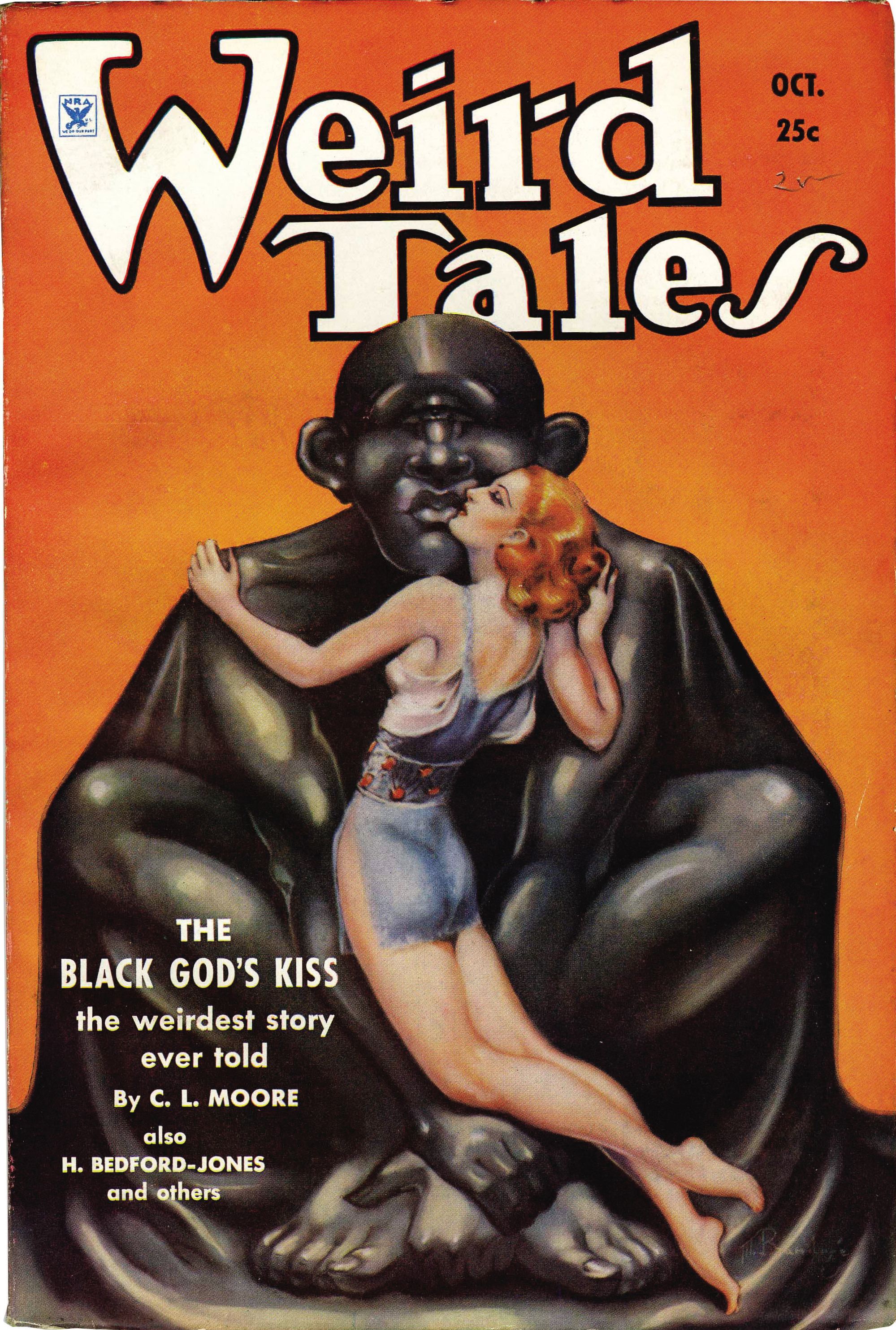
The winner of the 1945 Retro Hugo for Best Professional Artist is Margaret Brundage. Now this is one win I'm thrilled about, because Margaret Brundage was not just one of the very few woman artists working during the Golden Age, but also created some absolutely iconic covers for Weird Tales. Margaret Brundage was the first person to picture Conan and Jirel of Joiry (who wears armour rather than lingerie in the story) and who gave us Puritan executions in haute couture gowns (not actually a Solomon Kane cover, though I always assumed it was) as well as the highest selling Weird Tales cover ever. She was also a political radical, taught black children and she was very likely LGBTQ. It's long overdue that the Hugos recognise her work.


Best Fanzine


The 1945 Retro Hugo winner for Best Fanzine is Voice of the Imagi-Nation, edited by Forrest J. Ackerman and Myrtle R. Douglas. This win prompted another round of wailing and gnashing of teeth, because Forrest J. Ackerman was a sexual harrasser. I didn't vote for it either - not just because I prefer to vote for people who are not sexual harrassers, but also because I don't find Voice of the Imagi-Nation very good. There were definitely better fanzines out there in 1944, which were not edited by sexual harrassers.

However, people should also note that Ackerman wasn't even on the ballot for Best Fan Writer this year, a category he used to dominate at the Retro Hugos.

Which brings us to...


Best Fan Writer


The 1945 Best Fan Writer Hugo goes to Fritz Leiber for his contributions to the Lovecraft fanzine The Acolyte. This is the one win where I really think that my Retro Hugo Recommendation Spreadsheet made a difference. Because if I hadn't found a Fritz Leiber short story, an critical essay about Lovecraft and a poem about the Gray Mouser in The Acolyte, following a trail from ISFDB, and had put his name on the spreadsheet, I doubt that many people would have been aware that Leiber was even eligible.

If we take a look at the full nomination data, I see a couple of other places where the spreadsheet and Retro Reviews had an impact. Would Allison V. Harding have made the novelette longlist with two stories, if I hadn't enjoyed "Ride the EL to Doom" so much and shouted about it to the world?

Which brings me to the wailing and gnashing of teeth, which is really just focussed on three winners - Campbell, Cthulhu and Ackerman. And yes, I'm not happy with those wins either.

However, after a few years of complaining about bad Retro Hugo finalists and winners, I decided to do something about it. And so I created the spreadsheet and started Retro Reviews to make it easier for voters/nominators to make informed choices and point them at good works that might otherwise be overlooked. I had a lot of fun, too, and discovered stories I might never have read otherwise. It wasn’t just me either. N helped to track down elusive dramatic presentation and related work finalists. Steve J. Wright, Paul Fraser, Don Briago and others reviewed lots of stories, novels and whole magazines.

So in short, several of us got together to put the information out there about what is eligible (obviously not Dave Langford nine years before he was born), what is worth checking out and shared our thoughts on the finalists. And yes, I wish more people would have looked at our work before voting/nominating, because if you look at the nomination data, you'll see lots of examples of nominations for people and works, which are flat out ineligible. If the voters and nominators don’t pay attention to this in sufficient numbers, there’s little we can do about it.

As for the people complaining about Retro Hugos for Campbell, Cthulhu and Forrest J. Ackerman, did you nominate and vote? Did you point out better choices? Did you point people to unjustly forgotten authors/editors/fan writers? If not, then don’t complain.

Tuesday, 10 March 2020

Retro Review: "I, Rocket" by Ray Bradbury


"I, Rocket" by Ray Bradbury is a military science fiction short story, which appeared in the May 1944 issue of Amazing Stories and is therefore eligible for the 1945 Retro Hugos. The story may be found here.

Warning: There will be spoilers in the following!

As the title implies, "I, Rocket" is a story written from the POV of a spaceship. This isn't all that unusual in the modern era, see the Imperial Radch trilogy by Ann Leckie or "Damage" by David D. Levine. But while the science fiction and fantasy of the golden age are full of sentient machines, often possessed or otherwise malevolent, I don't know any other story of this period which has a machine, in this case a spaceship, as a POV character.

Pronouns are always tricky with non-human characters. And since neither the rocket nor Ray Bradbury have expressed a pronoun preference, I have decided to go with "she", since seagoing ships and spaceships are traditionally referred to by feminine pronouns. Besides, the crew also refers to the rocket as "she".

At the beginning of the story, the rocket is lying ruined on a barren pebbled plateau with twisted jets and bashed fore-plates. It will, the rocket calculates, take a few hundred years for rust and corrosion to break her down. And since the rocket has a lot of time on its hands, she decides to share her story.

The rocket was created as a warship to serve in the war between Earth and Mars. Her first captain was a man called Lamb, a man who is described as wrinkled brown leather with diamond eyes and uneven white teeth. Does this man that Captain Lamb is a man of colour or merely that he wears brown leather? It's not entirely clear at this point, though Captain Lamb's face is described as brown and wrinkled throughout, so I assume that he is indeed a man of colour.

The rocket experiences her first launch and notes that this is the first time she's outside the hangar and the base to see the world. She is surprised to find that it is round. There are more surprises in store for our rocket. Momentum, zero gravity, the gravitational forces of other celestial bodies and the indescribable tides of space.

During the rocket's first trip, we learn more about her crew. We learn that Captain Lamb is in love with a Martian dancer whom he hopes to take back to Earth with him after the war. The cook, meanwhile, is eager for revenge, because his parents died in a Martian attack. Two other crewmen, Conrad and Hillary, are in love with the same woman. The young navigator Ayres is experiencing a religious awakening, something which is apparently common among spaceship crews.

And then there are Anton Larion and Leigh Belloc, two crewmen who are planning to sabotage the rocket. The rocket is aware of their plot, but has no way of warning Captain Lamb and the rest of the crew. However, the rocket is resourceful. She deals with the saboteur Belloc and takes him out via a bursting oil pipe. During the confusion that follows, the second saboteur Larion blurts out a confession and tries to escape in a lifeboat. However, our rocket causes the airlock to malfunction, shooting Larion out into space. She likens this to an immune system reaction.

The rocket experiences her first battle and then many others. She also loses two crewmembers to the war. And when the war is finally over, our rocket is converted into a cargo vessel and given a new captain and crew. She transports freight from Venus and Mars to Earth for five years, until she crashes on a asteroid and her crew is killed.

The rocket lies wrecked on the pebbled plateau for four months, until a one-man patrol ship finds her. And the captain of that ship is none other than Captain Lamb, now patrolman, who misses his old ship just as much as she misses him and therefore set out to search for her when she was lost.

Captain Lamb confesses to the rocket that she was the only thing he ever truly loved. Apparently, things didn't work out with the Martian dancer. It also turns out that Captain Lamb is no happier in peacetime than the rocket. However, the Captain tells the rocket, there is another war brewing, this time with Venus, and good rockets are always needed. And therefore, Captain Lamb will be back with a salvage and repair crew to make the rocket flight ready again and return her to Earth. "I'll be captain of you again," he says.

And so the rocket waits in anticipation for her captain to return.


"I, Rocket" is a beautiful story about the love between a captain and his ship and the difficulties of old soldiers – whether human or metal – to function in peacetime. Ray Bradbury really was on fire in 1944 and I could fill the entire short story category on my Retro Hugo ballot solely with Bradbury stories.

Stories about sentient machinery were a thing during the golden age. "Ride the El to Doom" by Allison V. Harding features a sentient elevated train, "Killdozer!" by Theodore Sturgeon features a murderous bulldozer, "The Twonky" by C.L. Moore and Henry Kuttner features an overbearing radio-phonograph console. However, of all these stories "I, Rocket" is not just the only story actually narrated from the POV of a sentient machine, it's also the only one where the sentient machine is unambiguously heroic.

Above, I compared "I, Rocket" to modern science fiction stories with spaceship protagonists. However, "I, Rocket" isn't just a spiritual predecessor to the likes of Ancillary Justice by Ann Leckie or "Damage" by David D. Levine. It is a direct ancestor, because like "I, Rocket" both later stories very much hinge on the love between ships and their captains. And yes, "I, Rocket" is a love story, albeit a rather unconventional one.

Apart from Captain Lamb, the rest of the rocket's crew are roughly sketched and yet these characters come alive in their brief interactions with the captain and each other, all observed by the rocket. When two of them die, we feel their loss as keenly as the rocket.

Of the conversations aboard the rocket, the one between Captain Lamb and the young pink-faced navigator Ayres, one of the two crewmembers who will die during the war, is interesting, because it suggests that most spacemen board their ships as staunch atheists, but find religion along the way, inspired by the grandeur of the cosmos. Religion is not a theme that frequently shows up in golden age science fiction – in fact, the only other story I reviewed where religion plays a role is "The Veil of Astellar" by Leigh Brackett – and if religion appears at all, it is usually portrayed negatively. Hence, the conversation between Lamb and Ayres and the implication that all spaceship crews are religious is so unusual.

In my review of "Highwayman of the Void" by Dirk Wylie a.k.a. Frederik Pohl, I noted that a lot of golden age science fiction seems to take place in the same consensus version of the solar system. "I, Rocket" is another story that is clearly set in the pulp science fiction shared universe. And so Martian dancers wear silver bells and Venusian spider-silk is a popular export good, just as in Leigh Brackett's stories of the same period. But then, Ray Bradbury and Leigh Brackett were lifelong friends and critique partners (and even collaborated on one story), so Bradbury probably deliberately inserted those little Easter eggs referring to Brackett's stories.

Ray Bradbury undoubtedly was one of the best stylists of the golden age and "I, Rocket" once again shows off his writing skills. Bradbury attempts to describe what the world and the universe would look like from the POV of a spaceship and likens the rocket's mechanical components and processes going on inside her to the functions of the human body. I particularly liked a passage where the rocket lands on a planet for the first time and likens the mass and the gravity well to the libido and sex drive. But then, rockets are very phallic. Though it is depressing that the most erotic scene in all of the stories I reviewed for this project is that of a rocket landing on Mars.

Of the five Ray Bradbury stories I reviewed for the Retro Reviews project, one is directly about World War II and three others are stories about war, albeit war in space rather than on Earth. Bradbury never served in the army; he was declared medically unfit due to his bad eyesight. Yet he wrote a lot about wartime experiences, more than most other SFF writers active during World War II. It's also notable that the protagonists of Ray Bradbury's war stories are not soldiers, but a medic retrieving corpses from the battlefield ("Morgue Ship"), a wartime nurse turned murderous mermaid ("Undersea Guardians"), a newsreel photographer ("The Monster Maker") and a war rocket respectively. Bradbury really seems to have wanted to make the point that civilian personnel and other non-combatants (and military vehicles like our rocket) can be as important and heroic as soldiers.

Unlike some of the other 1944 Ray Bradbury stories I reviewed, "I, Rocket" has been reprinted a couple of times. What is more, in 1961 Cele Goldsmith selected it as one of the seven best stories ever published in Amazing for the 35th anniversary issue alongside such classics as "I, Robot" by Eando Binder  or "Armageddon 2419 A.D." by Philip Francis Nolan, the story which introduced Buck Rogers to the world.

Another winner by Ray Bradbury in what was a very strong year for him.

Monday, 17 February 2020

Retro Review: "Undersea Guardians" by Ray Bradbury


"Undersea Guardians" by Ray Bradbury is a horror short story, which appeared in the December 1944 issue of Amazing Stories and is therefore eligible for the 1945 Retro Hugos. The magazine version may be found here.

Warning: There will be spoilers in the following!

"Undersea Guardians" starts with the atmospheric description of the wreck of a sunken ship, the U.S.S. Atlantic, lying on the ocean floor. Soon thereafter we meet a group of what initially seems to be merpeople, led by a man called Conda. The group of merpeople also includes several woman, a brunette called Alita and a blonde called Helene as well as an old woman who never gets a name and clearly has maternal feelings towards Alita.

The swarm of merpeople is scattered, when "a shadow crosses the ocean surface, quick, like a gigantic sea-gull." The shadow is an airplane and it drops a depth charge, which is our first hint that this is a contemporary set story, taking place during World War II.

Alita is stunned by the explosion and just wants to sit on the ocean floor, but the others urge her onwards, because they have sighted a German submarine and they have work to do. After all, a US Navy convoy will soon pass by and the German submarine is lying in wait for them.

Gradually, it emerges that Conda, Alita and the other merpeople were aboard the U.S.S. Atlantic, when she was torpedoed and sank. But they had unfinished business, so they did not die, but instead lived on as merpeople. In Alita's case, that unfinished business is her love for a Navy seaman named Richard Jameson, of whom she sometimes catches a glimpse, when his ship passes the spot where the U.S.S. Atlantic sank.

Conda, who in life was the captain of the U.S.S. Atlantic, and his squad of undead have made it their mission to take out German submarines. They use Alita and Helene, two young, attractive and most importantly naked women, as bait to seduce the crew of the submarine. Though at least in Alita's case, Schmidt (of course, he's called Schmidt, being a crewman aboard a German submarine), the poor crewman who happens to see, her believes he's gone mad from weeks underwater and runs screaming through the submarine and tries to climb out of the hatch. The rest of the crew valiantly try to stop him but fail, since their aim is about as bad as a Stormtrooper's. But then this is a WWII story written by an American author, so you cannot have competent German sailors.

Now Helene, Conda and the rest get into the submarine via the open hatch and proceed to wreak havoc. Alita doesn't participate – she clearly dislikes violence. Unlike Helene, who is clearly a mermaid femme fatale driven by hatred, because her lover died inside the U.S.S. Atlantic, while Helene did not. The old woman tells a distraught Alita that yes, they did to the submarine crew what was done to them, but they had to do it, because they saved hundreds of lives. Apparently, the lives of American sailors are the only lives that count.

They are guardians, the old woman says, guardians protecting American ships and convoys. That is why they survive as undead and murderous merpeople, while everybody else aboard the Atlantic died. Because they all have loved ones – husbands, lovers, father, brothers, sons – who are sailors aboard US Navy ships and therefore targets.

The convoy passes by and the destroyer aboard which Richard serves is part of it. Alita flits around the destroyer, trying to catch a glimpse of her lover, when another German submarine appears. But the convoy and Conda and his band of murderous merpeople get lucky, because the crew of this German submarine are crap shots, too, and so their torpedoes keep missing the convoy that is right in front of them.

But the submarine crew finally get their act together and the last torpedo is going to hit the destroyer with Richard on board. But Alita heroically throws herself in the way of the torpedo, sacrificing her not-life to save Richard and the destroyer.

On the bridge of the destroyer, Richard briefly thinks that he saw something just before the torpedo exploded harmlessly. A large fish or maybe a log.


Of the four Ray Bradbury stories I reviewed for the Retro Reviews project so far, I liked "Undersea Guardians" the least. It's an effective little story and – like all Ray Bradbury stories – well written and atmospheric. But I prefer my speculative fiction without a side order of WWII propaganda, thank you very much.

Though to be fair, Alita has her doubts about what she and the other merpeople are doing and is clearly aware of the hypocrisy of condemning others to a fate she so clearly loathes. And indeed, Alita repeatedly has to be coaxed into participating in the raids by the old woman, who never even gets a name. Furthermore, Helene, the mermaid femme fatale, is clearly insane. And Schmidt, the hapless German sailor who happens to spot Alita, is not a xenophobic caricature, just a young man driven nigh crazy from months of isolation. Compared to some of the truly grisly propaganda stuff we've seen in the dramatic presentation and graphic story categories at the Retro Hugos in recent years, "Undersea Guardians" is pretty nuanced.

There are also moments where it seems as if Bradbury is aware of the implications of his premise. For if the crews of allied ships survive as murderous undead merpeople bent on revenge, then so should the crews of German ships, which would soon lead to groups of merpeople waging war on each other under the sea. The ambivalence of the story almost suggests that the editor of Amazing Stories, Raymond F. Palmer, pushed Bradbury to make it more patriotic.

And while it's never explicitly stated, the U.S.S. Atlantic was not a civilian ship, but a US Navy vessel, which makes her a legitimate target in wartime. Alita apparently was on board, because she wanted to work as a nurse in England and see her Richard again. We never learn what Helene and the old woman were doing aboard. Most probably, they were planning to become nurses, too. So what happened to Alita and the others was not some kind of Lusitania, let alone Wilhelm Gustloff incident.

That said, I was pleased that "Undersea Guardians" has three female characters, two of them named, and all of them different from each other. In fact, "Undersea Guardians" is the only story I have reviewed for the Retro Reviews project so far that passes the Bechdel test.

This is the third 1944 Ray Bradbury story I've read where a non-combatant saves the day and wins the battle, if not the war. Sam Burnett from "Morgue Ship" is a medic collecting dead bodies after the battle, Click Hathaway from "The Monster Maker" is a news photographer who only tagged along with an Interplanetary Patrolman to shoot the action and Alita from "Undersea Guardians" is a wartime nurse turned undead mermaid. Methinks Bradbury was trying to make a point about the heroic potential of non-combatants.

Ray Bradbury would revisit the concept of drowned sailors turned into a vengeful undead army two years later in "Lorelei of the Red Mist", his sole collaboration with lifelong friend Leigh Brackett. Only that in "Lorelei of the Red Mist", the undead army consists of sailors from both sides of a local conflict on Venus and that they turn on their own side as well as the enemy, led by a sinister pied piper figure. And the undersea army of the undead only shows up towards the end of "Lorelei of the Red Mist" and is therefore definitely Bradbury's work, who finished the novella, when Leigh Brackett was called away to Hollywood to write the screenplay for The Big Sleep.

Soldiers continuing to fight the war they were in even after death also shows up in Richard Lester's 1967 anti-war film How I Won the War, the climactic scene of which with the undead soldiers marching on to war was filmed near where I live with the Uesen Weser bridge standing in for a Rhine bridge, even though anybody who has ever seen either the Weser in Uesen or the Rhine knows that both don't look even remotely the same.

Even though Amazing Stories was America's first science fiction magazine, there is not a hint of science fiction in "Undersea Guardians". Instead, the story is pure horror and would feel more at home in Weird Tales than in Amazing Stories. Maybe Weird Tales rejected it and since there were no other fantasy and horror magazines on the market in 1944, "Undersea Guardians" ended up in Amazing Stories and even was the cover story of the December 1944 issue with a striking (and accurate) cover courtesy of James B. Settles.

Unlike the much better "Morgue Ship", "Undersea Guardians" has been reprinted a handful of times over the years, usually in anthologies of maritime horror. And the story is certainly a fitting addition to an anthology like that.

"Undersea Guardians" is an effective horror story somewhat marred by its WWII context. But considering how prolific Ray Bradbury was (he published thirteen speculative stories in 1944 alone plus several mysteries), they can't all be winners. And even a weaker Bradbury is still better than most of the other SFF stories out there.


Friday, 7 February 2020

Retro Review: "The Monster Maker" by Ray Bradbury


"The Monster Maker" by Ray Bradbury is a science fiction short story, which appeared in the spring 1944 issue of Planet Stories and is therefore eligible for the 1945 Retro Hugos. The story may be found here.

Warning: There will be spoilers in the following!

I liked "Morgue Ship" so much that I decided to read one of Ray Bradbury's two other stories published in Planet Stories in 1944. And while I did not like "The Monster Maker" quite as much as "Morgue Ship", it's still a good story. It's also a very different story, showcasing Bradbury's range.

"The Monster Maker" hurls us right in medias res, as a spaceship carrying newsreel photographer Click Hathaway (not his real name, we presume) and Interplanetary Patrolman Irish Marnagan (not his real name either – he's actually called Steve, as we learn on the last page) is hit by a meteor and crash-lands on an asteroid. Both Click and Irish (and Click's camera) survive the crash, but their ship is destroyed. Worse, they only have oxygen for sixty minutes.

Click suspects that the meteor strike was no accident, but the work of the man Irish is hunting, a space pirate called Gunther. It's 1944, so of course the villain of the piece has a Germanic name. And since they have only sixty minutes of air and nothing to lose, Click and Irish decide to go in search of Gunther and his base.

During the trek across the surface of the asteroid, Click and Irish first come across an area, where the gravity is lower, suggesting that Gunther used a super-gravity trap to hasten the crash of their spaceship. But before they can figure out what all that might mean, they are attacked by monsters. And Irish's gun doesn't even slow them down.

Our dynamic due hides in a cave, where the monsters can't reach them. Click argues that Gunther has built the perfect trap on the asteroid, because the meteors and the gravity well make the attacks on spaceships look like accidental crashes. And if some crewmembers happen to survive the crash, the monsters will deal with them and it will all seem like a tragic accident.

To pass the time, while they're trapped in the cave, Click takes the film – self-developing film, his own invention – out of the his camera and inserts it into a viewer to admire the great footage he got, footage that no one will likely ever see. And he promptly gets the surprise of his life, when the film doesn't show the monsters, but only Irish aiming his gun at empty vacuum.

Click correctly deduces that the monsters are not real, because film does not lie. But then, he does not live in our era of fake news and doctored photographs. Irish is sceptical, but still volunteers to step outside the caves, whereupon the monsters promptly vanish. Click muses that the monsters are another trick by Gunther to keep his base hidden, because anybody who happens to land on the asteroid for whatever reason (apparently, space tourism is a thing in this future) will be quickly persuaded by the monsters to take off again.

Click and Irish resume their search for Gunther's base, but their oxygen is getting low, Click's more than Irish's. Click suggest following the monsters – which are just telepathic projections – to their source. However, that requires willing the monsters to return. And if Click and Irish believe that the monsters are real again, the monsters can also hurt or even kill them. And in fact, Irish almost succumbs to a monster attack, until Click tells him to snap out of it.

They finally find the base, but Irish is captured and disarmed. Click escapes, but he has no weapon, only his camera. Which he promptly points at the guards who have captured Irish and pretends it's a weapon. Lucky for him, the guards aren't the sharpest knives in the drawer and drop their weapons. So now, both Click and Irish have real guns. They tie up the guards, procure fresh oxygen tanks and infiltrate the base.

Our dynamic duo finds the telepathic projector that creates the monsters, but they're still outnumbered and outgunned. "If only the US Cavalry would ride over the hills", Irish laments. "That's it", Click exclaims and quickly explains his plan to Irish, if not to us. But I suppose most readers will have gotten it anyway by this point.

Click now allows himself to be captured and is taken to Gunther. When Click (and we) finally see the feared pirate, he turns out to be a shrivelled, old man who relies on smoke and mirrors to maintain his reign of terror.

But Click is about to outsmoke and outmirror Gunther. He informs the pirate that the Interplanetary Patrol has landed on the asteroid with a thousand men and has Gunther surrounded. "You're bluffing", Gunther says, but then the Patrol attacks and Patrolmen advancing towards Gunther's headquarters with raised guns. Gunther's men fight back, some are killed and absolutely no one notices that the Patrolmen all look suspiciously like Irish Marnagan.

Because Click had noticed that the telepathic projector used film images to project the monsters, so he took some shots of Irish and used them to turn the projector on the pirates. Gunther is captured, Irish is a hero and Click has some first-rate footage that will make him famous.

Unlike the melancholic "Morgue Ship", "The Monster Maker" is a fun romp, a pulpy science fiction adventure, where the focus is more on the fiction and adventure than on the science. It's also a fairly atypical tale for Ray Bradbury. If not for his byline in the magazine, I'd never have taken this for a Bradbury story.

In my reviews of "The Lake" and "Morgue Ship", I noted that Ray Bradbury's stories feel more timeless than most other golden age stories, because instead of getting bogged down in technical details, which usually age badly, Bradbury focussed on memories, emotions and experiences.

"The Monster Maker", however, is dated. This is not Ray Bradbury's fault, for how could he have known that newsreels would vanish within a few years, as television increasingly took over the function that newsreels once had? And though newsreels go back to the silent era and lasted into the 1950s and early 1960s, I mainly associate them with the 1940s. Because when I was a young girl, there was a TV program – broadcast on Saturday evenings of all times – which consisted of World War II newsreels intercut with interviews with survivors of the events shown. My Dad liked that program a lot – just as much as I hated it, because it was basically just footage of people dying in various awful ways, followed by interviews with people describing in great graphic detail about how other people around them had died in various awful ways.

The fact that Click's camera uses actual physical film also dates the story, though Bradbury had no more way of knowing that film would go digital than he could know that newsreels would die out. Though I was stunned how much I have gotten used to film being digital by now that the reminder that film used to be a physical medium almost threw me out of the story. That said, Bradbury does capture the mindset of a photographer well, because you really do experience events differently when you're behind the camera (I was a member of a film group documenting local events in the 1990s) and "Did I get that?" or "Wow, what great footage…. Ahem, I'd better get away from here" really are common sentiments.

The science – what little there is – is the usual magic by another name with a slight scientific veneer that can often be found in Planet Stories. The gravity well and the meteors used as weapons are both at least plausible and not uncommon even in the harder science fiction of the era, but the telepathic projector is pure magic technology and its function is also very convenient to allow Click to use his filmic skills to turn it against Gunther and his men.

Though it's interesting that Click saving the day with his camera and his filmic knowledge is the second example after "Morgue Ship" of a non-combatant saving the day with their specialist skills in a 1944 Bradbury story. I guess Bradbury really wanted to make the point that yes, non-combatants also serve and can be vital to the war effort. But whereas "Morgue Ship" was a tragedy, "The Monster Maker" is closer to  farce.

But even though "The Monster Hunter" is dated, it is still a fun story. The plot zips along and the reveals that the monsters are fake and that Gunther is a withered old man are nicely done. And since this is a Ray Bradbury story, the writing is well above the standards of the time and the descriptions of the crash and later of Click rushing to rescue Irish, even though he's running out of oxygen, are suitably visceral. Even in this comparatively slight story, Bradbury proves once again what a good writer he already was at this early point in his career.

What is more, Click and Irish have a great odd couple dynamic and in fact, I'm surprised that Bradbury never revisited the characters. They reminded me a bit of Fritz Leiber's Fafhrd and Gray Mouser – a big redhead who is the muscle and a short fellow who is the brains. And yes, Steve "Irish" Marnagan is our second waking Irish stereotype after Mike Donovan from Isaac Asimov's "Catch That Rabbit". Considering that there was still lingering discrimination against people of Irish ancestry in the 1940s (and beyond), maybe those Irish stereotypes (and the Italian stereotypes and the Brooklyn guys) were the golden age's idea of diversity?

"The Monster Maker" is another golden age story with no female characters at all and in fact the third one in a row I have reviewed. And as it tends to happen, when you have two male characters in close contact and no women at all, there also are definite homoerotic vibes between Click and Irish. When their ship crashes, Click finds himself "cradled in Irish's arms". Later in the story, Click ends up on top of Irish during a fight with the fake monsters and at one point Click even sheds some tears, when Irish survives a particularly dangerous moment unscathed. Of course, you could find plenty of similar moments in the Fafhrd and Gray Mouser stories and we have Fritz Leiber's word for it that those two were really just good friends. But so many moments in one story are certainly notable.

Like "Morgue Ship", "The Monster Maker" has never been reprinted until the three volume The Collected Stories of Ray Bradbury: A Critical Edition in the 2010s. But while "Morgue Ship" is an unjustly forgotten gem, "The Monster Maker" really is just a fun romp that's not particularly deep and dated besides. But a slight Bradbury story is still better than eighty percent of stories by other writers. And so "The Monster Maker", while not a classic, is nonetheless well worth reading.

Monday, 3 February 2020

Retro Review: "Morgue Ship" by Ray Bradbury


"Morgue Ship" by Ray Bradbury is a science fiction short story, which appeared in the summer 1944 issue of Planet Stories and is therefore eligible for the 1945 Retro Hugos. The story may be found here.

Warning: There will be spoilers in the following!

Sam Burnett is one of two living humans aboard the Constellation, the titular morgue ship, which picks up the dead of an interplanetary war between Earth and Venus and then returns the bodies to Earth. The ship has room for one hundred bodies and Burnett has just picked up body number ninety-eight of his one hundredth run. It will also be his last, for Burnett is burned out both by the sheer amount of death he's seen and also by the fact that instead of wartime heroics, Burnett and the morgue ship only arrive when the war has already moved on.

Body number ninety-eight turns out to be a Venusian officer named Lethla, the righthand man of the Venusian commander Kriere. Burnett's younger and less jaded partner Rice is excited by this find, for if Lethla is aboard the morgue ship and dead, then Kriere must be close by and perhaps injured or dead as well. Retrieving Kriere might well end the war and make Burnett and Rice heroes. However, Burnett dampens his young partner's enthusiasm. The war has long since moved on and Lethla is just another body to be retrieved and prepared.

There is just one problem. Lethla isn't dead. He suddenly sits up on the morgue slab, draws his gun and points it at Burnett and Rice, both of whom are unarmed. Turns out that that he survived because of a thin glass mask and oxygen capsules (the requirements of surviving in the vacuum of space were not yet well known). Lethla then proceeds to destroy the radio of the Constellation and demands that Rice and Burnett help him rescue his superior Kriere. For the ship carrying Lethla and Kriere was attacked and destroyed. Lethla and Kriere managed to survive in a liferocket (the term "escape pod" wouldn't be coined until much later), but they had neither a radio nor sufficient supplies. The morgue ship is their best chance of getting past the Earth blockades back to Venus.

Rice is something of a hothead and attempts to defy Lethla, but Burnett seemingly goes along with Lethla's orders, while plotting to capture both Lethla and Kriere and thus end the war. When they spot Kriere's floating body, Burnett leaves the controls of the Constellation to Rice and operates the morgue ship's retrieval claw to pull in Kriere – body number ninety-nine.

However, Burnett deliberately lets the retrieval claw grip Kriere too tightly, crushing and killing the Venusian. The death of his commander shocks Lethla long enough that Burnett and Rice can attack him. Together, they manage to disarm and kill Lethla, but not before Burnett is shot.

Burnett dies, knowing that he has ended the war and that there will be no more morgue ship trips necessary. He becomes body number one hundred of the last cargo of the Constellation.

When thinking of Planet Stories – home of space opera adventure and planetary romance – Ray Bradbury is not the first author who comes to mind, even though he wrote a fair number of stories for the magazine, three in 1944 alone. Many of the stories that would eventually make up The Martian Chronicles were also first published in Planet Stories.

"Morgue Ship" manages to be both a typical Planet Stories yarn and a typical Ray Bradbury story. It has all the space action, adventure and suspense one expects to find in Planet Stories and it has the poetic style and introspective melancholia one expects from a Ray Bradbury story.

Few authors of the golden age have the command of language that Ray Bradbury had. Mostly, speculative fiction of the golden age either features the invisible prose found in Astounding or the overly purple prose often associated with Weird Tales under Farnsworth Wright. Not many authors managed to find a golden means between those two extremes, but Bradbury is one of them.

"Morgue Ship" is short, only six pages long (and half a page is taken up by an illustration), but Bradbury perfectly manages to capture the atmosphere aboard the morgue ship with its clinical interior, its shelves full of dead soldiers, the churning blood pumps and whirring machinery, in such a short space. Bradbury also manages to pack the horrors of war in space, the exploding ships and spinning dead bodies among the wreckage, into just a few paragraphs. Finally, Bradbury captures overwhelming weariness of Sam Burnett, weariness with his grisly task, weariness with the war and the feeling that because Burnett is not a combatant, he is not contributing to the war effort.

This last sentiment is something that I have occasionally encountered on the Allied side of World War II, mainly among Americans who were either not fit for active military service or on assignments far from the frontlines and yet yearned for frontline action. On the German side, there also are plenty of accounts of mostly very young boys eager to fight and die for Führer and Fatherland (and by the end of World War II, the Nazis were drafting boys of sixteen and younger, many of whom did not survive), but just as many accounts by mostly somewhat older men, many of whom still remembered World War I and tried to avoid being sent to the frontline by all possible means. In fact, relatively safe posts far from the frontlines were often handed out as rewards for "solid" citizens, while particularly dangerous frontline assignments were viewed as a way of getting rid of malcontents and shutting up problematic people.

"Morgue Ship" was written and published, while World War II was still going on, so the desire of Burnett and Rice to finally get to take part in the action rather than picking up the pieces afterwards is understandable in the context of the time. Furthermore, men of fighting age, who were not in active service, were often treated with contempt or outright hostility on both sides of World War II. "Morgue Ship" is clearly an attempt to show that non-combatants also serve and are vital for the war effort. And since Ray Bradbury was not in the military during World War II (he was rejected for medical reasons), I also wonder whether he did not have first hand experience with the contempt for and hostility towards young male non-combatants at the time.

Though much of the so-called golden age of science fiction coincided with World War II, comparatively few stories of the time reference the war. Of the 1944 Retro Hugo finalists in the fiction categories, the two works that actually reference the war – The Magic Bedknob; or, How to Become a Witch in Ten Easy Lessons  by Mary Norton and to a lesser degree The Little Prince by Antoine de Saint-Exupéry – are both outliers from outside the American science fiction scene. "Morgue Ship" is one of the very few science fiction stories published in the American pulp magazines of the time that address the war at least indirectly.

As I've remarked before, Ray Bradbury's stories are the most timeless of the various Retro Hugo finalists and Retro Hugo eligible stories I have reviewed over the years. Some of the technical details in "Morgue Ship" are dated, but with a few edits the story wouldn't feel out of place in a contemporary issue of Uncanny or Tor.com or Lightspeed or Clarkesworld.

Isaac Asimov and Ray Bradbury were almost the same age (both born in 1920, though Asimov's exact birthdate is not known) and started publishing around the same time, though Asimov managed to break into the pro magazines before Bradbury did. However, the three Asimov stories I reviewed show that Isaac Asimov was still very much developing as a writer at this point in his career, while Ray Bradbury's writing skills are much further along.

In Zen in the Art of Writing, Bradbury wrote that the 1944 Retro Hugo winner for Best Short Story "R is for Rocket" as well as "The Lake", which I reviewed here, were his breakthrough stories, where he stopped trying to imitate other writers and also stopped writing what he believed magazine editors wanted and finally found his own voice. "Morgue Ship" dates from the same period and is another example of Bradbury finding his own voice and style. For "Morgue Ship" is very unlike most stories from this period. In fact, the story of which "Morgue Ship" reminded me most is "Aftermaths" by Lois McMaster Bujold (nowadays included in Shards of Honor as a sort of epilogue), which was first published in 1986, more than forty years after "Morgue Ship".

"Morgue Ship" is not nearly as well known as either "The Lake" or "R is for Rocket" and in fact had never been reprinted until the 2010s in the three volume The Collected Stories of Ray Bradbury: A Critical Edition. This is unfair, because "Morgue Ship" is a great story that shows just how good a writer Ray Bradbury already was at the age of barely twenty-four.

In fact, "Morgue Ship" is probably the most pleasant surprise I've had since I started the Retro Science Fiction Reviews project. For I already knew that "The Lake" and the Leigh Brackett stories were good. "Morgue Ship", on the other hand, was completely unknown to me and turned out to be an unjustly forgotten gem.

Friday, 24 January 2020

Retro Review: "The Lake" by Ray Bradbury


"The Lake" is a short story by Ray Bradbury, which was first published in the May 1944 issue of Weird Tales and is therefore eligible for the 1945 Retro Hugos. The story may be found online here.

Warning: There will be spoilers in the following.

"The Lake" is narrated by Harold, who as a twelve-year-old is spending one last day by the shores of Lake Michigan, the titular lake, with his mother. The next day, Harold will get on a train to move to California. It's September, the beach is largely deserted and the hot dog stalls and merry-go-rounds on the boardwalk have already closed down.

The melancholy of the setting echoes Harold's mood. For Harold is not just sad because he is moving away, but also because he lost something or rather someone important here at the shores of Lake Michigan. His classmate Tally, a girl Harold has been in love with since forever, drowned in the lake earlier that year and her body was never found.

Harold disentangles himself from his mother and ventures into the water, calling for Tally to come back. Finally, he builds half a sandcastle on the beach and calls out to Tally to come and build the other half, just like they used to do. But of course, Tally doesn't come. Instead, the sandcastle is washed away by the waves.

The story now skips ahead ten years in two paragraphs, as Harold takes the train to California, grows up, goes to law school and marries a woman from Sacramento called Margaret. For their honeymoon, Margaret suggests visiting Harold's old stomping grounds in Illinois.

By now, Harold has happily settled down in California and largely forgotten Illinois, but the train ride east brings back memories. Walking through his old hometown, he finds that he doesn't recognise anybody, though some faces seem vaguely familiar, carrying echoes of old classmates.

Of course, Harold and Margaret also find themselves down by shores of Lake Michigan, walking along the beach on a September day much like the one when Harold left Illinois forever. Harold watches a life-guard boat moor at the quay, watches a life-guard carry out a bag containing a body. Full of foreboding, he tells Margaret to stay behind and walks over to the life-guard to ask what happened.

The life-guard tells him that they found the body of a little girl who has been dead a long time. The only reason the life-guard knows the dead body is a girl is because of the locket she had been wearing. The life-guard also says that no child drowned in the lake recently and that only one of the twelve children who drowned there since 1933 was never recovered. Harold already knows that the body has to be Tally, but asks to see it anyway. He also asks the life-guard where the body was found. "In the shallow water", the life-guard says.

Harold walks over to the spot where the body was found and sees half a sandcastle on the beach, footprints leading to the castle and then back into the water. Harold finishes the sandcastle and realises that he will love Tally forever, even though he grew up and she will forever remain a child. He also wonders what to do about this woman called Margaret who's waiting for him on the boardwalk. Though I do feel sorry for Margaret who after all didn't know that she was marrying a man who was still in love with his dead childhood sweetheart.


"The Lake" is a famous story that has been reprinted dozens of times. And rightfully so, because the story is utterly beautiful. I knew that I had read the story before, but I had forgotten how short it is, a mere four pages long. But Bradbury packs a lot into those four pages. You can almost see the beach, you can hear the seagulls, smell the hot dogs, feel the sand between your toes and the water lapping up to your legs. And you also feel the overwhelming sense of melancholy and loss that permeates this story.

Stylistically, Ray Bradbury was one of the best writers of the golden age and "The Lake" is a perfect example of his trademark poetic style. Much of the story consists of evocative descriptions of the shores of Lake Michigan. And it is certainly no coincidence that Bradbury was born in the town of Waukegan, Illinois, which lies on the shores of Lake Michigan, and later moved to California, just like his protagonist. A lot of Ray Bradbury's stories feel autobiographical and "The Lake" is one of them. And if you do the math, you'll notice that Bradbury was about the same age as his protagonist and first-person narrator Harold, when he wrote "The Lake". Was there ever a childhood friend who drowned in Lake Michigan? I don't know. But the evocative descriptions make the story feel very real.

Considering how description heavy this story is, it is interesting what Bradbury does not describe. For we do not get a single description of the dead body in the bag – Bradbury only tells us that Harold looked into the bag and looked away, for one look was enough. Harold also remarks upon how small Tally's body, for while he grew up, she never did. Considering that Weird Tales was a horror magazine, Bradbury's restraint in not giving us a description of the dead body is notable. But then stories in Weird Tales often kept their various horrors vague, the writers well aware that imagination can generate horrors worse than anything a writer can describe. And I guess we can all imagine what a body looks like after ten years in the water. Bradbury doesn't need to tell us.

In one of my posts about last year's Retro Hugo finalists, I noted that Ray Bradbury's 1944 Retro Hugo finalist and eventual winner "R Is For Rocket" was the story which felt most timeless among the finalists, even though it included such vintage science fiction tropes as food pills and rockets with mighty fins. "The Lake" feels even more timeless than "R Is For Rocket", simply because it doesn't contain any overt science fiction tropes. Instead, it is a story about loss, grief and a September day on the shores of Lake Michigan. "The Lake" wouldn't feel out of place in the (virtual) pages of a contemporary issue of Uncanny or Fireside or Tor.com, though instead of a train, Harold would probably take a plane these days.

A wonderful and haunting story.