Showing posts with label ghost story. Show all posts

Saturday, 26 November 2022

Retro Review: "The Hanging of Alfred Wadham" by E.F. Benson


Weird Tales August 1929


"The Hanging of Alfred Wadham" is a short story by E.F. Benson, which was first published in the December 1928 issue of the magazine Britannia and reprinted in the August 1929 issue of Weird Tales. The story may be found online here. This review will also be crossposted to Retro Science Fiction Reviews.

This story is another one which caught my eye via Hugh Rankin's striking interior art under his Doak pseudonym (Doak was Rankin's middle name). For some reason, Rankin did several drawings of hangings and executions under the Doak name, such as the interior art for "In a Dead Man's Shoes", which I reviewed recently. As before, Rankin also supplied to striking Art Deco cover art for this issue, illustrating the The Inn of Terror by Gaston LeRoux.

Hugh Rankin's interior art for "The Hanging of Alfred Wadham"

Though the standout story in this issue is not the cover story, but "The Shadow Kingdom" by Robert E. Howard, the story which introduced Kull of Atlantis as well as the Serpent Men to the world and is widely considered to be the first sword and sorcery story. I should probably do a Retro Review of that story eventually, especially since it's also a very good story.

Many authors who published in the pulps are completely forgotten these days and we know little to nothing about them. I feared this might be the case with E.F. Benson, but on the contrary, Benson was actually a very well-known British writer from a family of well-known people. His father was the Archbishop of Canterbury, one of his brothers wrote the words to "Land of Hope and Glory", another brother was also a writer as well as a priest and his sister was a writer and Egyptologist. To make matters even more impressive, E.F. Benson was a member of the Order of the British Empire. He was also gay and by necessity, given the time during which he lived, closeted.
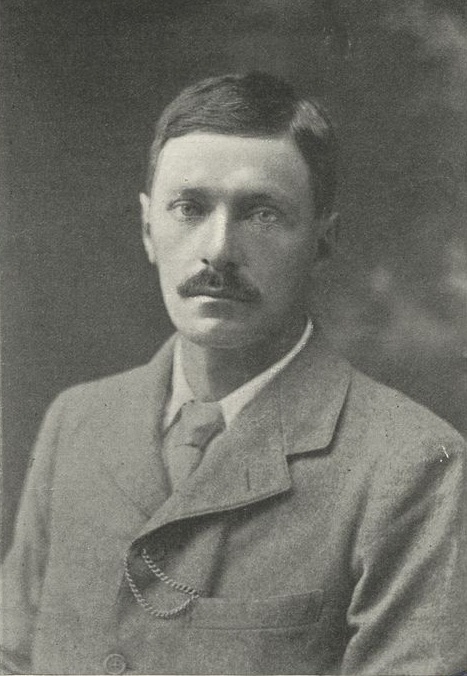
E.F. Benson

Benson's most famous work is the Mapp and Lucia series, a series of satirical novels about upper class people in a small town and their petty rivalries. I have to admit that I have never heard of those books, even though they spawned several sequels by other authors, two TV-adaptations, including one as late as 2014, and a lobster dish.

In addition to satirical novels about upper class people being jerks, Benson also wrote a lot of ghost stories and this is what brought him to the attention of H.P. Lovecraft, who wrote admiringly about Benson's work in "Supernatural Horror in Literature", and finally to Weird Tales.

But enough about the man. Let's talk about the story.

Warning! Spoilers beyond this point!

Compared to the other 1929 Weird Tales story featuring a hanging and interior art by Hugh Rankin, "The Hanging of Alfred Wadham" starts off slow with the unnamed first person narrator discussing a séance he attended with one Father Denys Hanbury. The medium conveyed some messages from a recently deceased friend of the narrator and the narrator is certain that the séance proves something, though whether it is communication with the dead or telepathy he is not sure. Father Denys, true to his profession, believes communication with the dead and impossible or demonic, though he is remarkably open-minded with regard to telepathy.

The narrator then explains that the medium talked about something that she could not have gotten from his mind, because the narrator did not know about it, but which was later confirmed by the dead friend's diary. Father Denys, however, still believes that communication with the dead is dangerous and shares a story of his own.

Such "take within a tale" framing devices were very common in the nineteenth and early twentieth century and pop up quite often in Weird Tales. What is notable about this one is that it's not only dull – we only ever get vague details about séance and what the medium said – but also written in a very stilted style. The (male) narrator also spends two paragraphs describing the beautiful hands of Father Denys. Even if I didn't know by this point that E.F. Benson was gay, that paragraph pretty much confirms it.
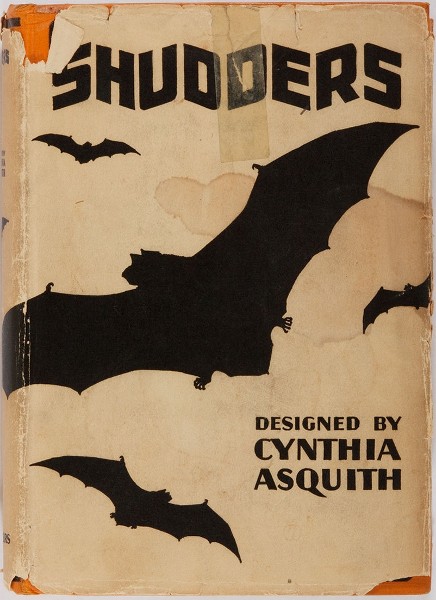
Shudders, edited by Cynthia Asquith

Once Father Denys of the beautiful hands starts his story, I hoped things were finally about to get good. Alas, Father Denys, who is a Catholic priest by the way, starts rambling on about the sacrament of confession, why it is important and why a priest may never ever repeat anything he heard in confession, even if remaining silent will have terrible consequences.

Next, we get an description of the crime allegedly committed by the titular Alfred Wadham. Alfred Wadham was the manservant of a "man of loose life" named Gerald Selfe. That "loose life" was the fact that Selfe was having an affair with a married woman. Someone found out about the affair and started blackmailing Selfe. Selfe went to the police, who investigated the case and quickly zeroed in on Alfred Wadham as a suspect.

The police have set a trap for Wadham, when Selfe is found with his throat slit one morning. Wadham is gone, but stains of human blood are found in his room. The police quickly apprehend him. Wadham proclaims his innocence of the murder, though he does admit to the blackmailing. Wadham declares that he realised that Selfe and the police were on to him and therefore fled. Alas, the judge and jury don't believe him and so Wadham is sentenced to death for murder.

Wadham is Catholic and so he meets Father Denys, who just happens to be the prison chaplain. True to his profession, Father Denys urges Wadham to confess to the murder and repent, but Wadham keeps insisting that he didn't do it. Since Wadham confesses plenty of other sins and crimes, Father Denys starts to believe him.

Father Denys is troubled by this case – not because an innocent man is about to be executed, but because he is not sure whether he should grant Wadham absolution for his other sins, since Wadham flat out refuses to confess to the murder.

More Spook Stories by E.F. Benson

Now it's worth remembering that E.F. Benson's father was an Anglican clergyman and Archbishop of Canterbury and that one of his brothers was an Anglican priest who converted to Catholicism, became a Catholic priest and wrote religious texts, so I probably shouldn't be surprised to see a theological argument in a story written by someone from such a background. However, as I've repeatedly said, I'm not religious, I dislike too much religion in my fiction and theological arguments literally make my eyes glaze over. And in this particular case, I had even less patience for theological arguments, because Alfred Wadham is about to be hanged for a crime he probably didn't commit, so who cares whether a priest absolves him from his sins or not? Never mind that granting absolution for sins is part of Father Denys' job.

On the night before the execution of Wadham, an former acquaintance named Horace Kennion visits Father Denys. Father Denys wants nothing to do with Kennion, because Kennion is a wicked man – more wicked than usual, because Father Denys reminds us that all humans are wicked and that "the life of us all is a tissue of misdeeds". Father Denys' hands must be very beautiful indeed for the narrator to willingly hang out with such a killjoy.

However, Kennion is very insistent to speak to Father Denys, because he needs to make a confession right now and his usual priest is not available. So Father Denys reluctantly hears his confession. Surprise: Kennion is the one who killed Gerald Selfe over a quarrel about a game of cards (though there was no mention of cards or a card table in the earlier description of the crime scene). After stabbing Selfe, Kennion went up to Wadham's room (Selfe had rung for Wadham earlier, but Wadham had already left, so Kennion knew the room would be empty) to wash off the blood – that's how the blood stains came to be found in Wadham's room.

Father Denys of course immediately entreats Kennion to go to the police and confess, so Wadham can be saved. However, Kennion has no intention of going to the police. And when Father Denys threatens that he will call the police, Kennion just grins and points out that he can't, because his faith forbids it. And besides, who would believe a priest who violated to sacrament of confession?

Father Denys now demands why Kennion felt the need to confess his sins at all and why to him specifically. Once again Kennion grins and tells Father Denys that he was very hurt when Father Denys broke off all contact with Kennion. And so he decided to get revenge by putting Father Denys in a terrible situation where there are no good choices. "I daresay I've got Sadie tastes, too, and they are being wonderfully indulged," Kennion says.

The Benson brothers
These are not actually the characters from this story, but E.F. Benson (on the right) and his brothers Arthur Christopher Benson (on the left, wrote the lyrics to "Land of Hope and Glory") and Robert Hugh Benson (the priest).

Now the vibes that I get from this exchange is that Father Denys and Kennion were lovers and that there may well have been some kink involved. But then Father Denys broke off the relationship and Kennion wants revenge. It's also notable that Kennion calls Father Denys by his first name, something which was extremely uncommon among upper class British men in the early twentieth century. Even Kennion's disdain for the doomed Alfred Wadham and his claim that Wadham has it coming for his other crimes – "Blackmail is a disgusting offence" – fits in with this, because gay men were often the target of blackmailers, back when gay relationships were still illegal. In fact, I wonder whether Kennion and his victim Gerald Selfe did not have a relationship, too. After all, it is explicitly stated that Kennion went up to Selfe's room.

I have to admit that though he is a murderer (double murderer to be exact) and generally horrible person, Horace Kennion is the most interesting character in this story. The narrator is a cypher, the victim Gerald Selfe is merely a prop required to get the story going and Alfred Wadham is more moral dilemma than character. As for Father Denys, he is an insufferably sanctimonious prick.

Case in point: Father Denys spends a few paragraphs detailing the terrible torment and suffering he experiences – a suffering that is not even "a needful and salutary experience to burn his sins away", but empty torment. Meanwhile, the actual victim here is not the moping priest with a crisis of conscience, but Alfred Wadham who is about to be executed for a crime he did not commit.

Though at least Father Denys does take some action rather than just sit around feeling sorry for himself. First, he goes to see the Cardinal, who basically tells him that he cannot violate the seal of confession. Then he goes to see the Home Secretary and tells him that Wadham is innocent, because the real murderer just confessed to him.

The Home Secretary is sympathetic, but tells Father Denys that he cannot pardon Wadham without more evidence. He also tells Father Denys to put the fear of God into the real murder to get him to confess and also gives the priest his phone number, just in case.

However, Father Denys doesn't need the phone number, because instead of putting the heat on Kennion, he goes straight to the prison, tells Wadham that he believes in his innocence and finally grants him absolution for all his other sins. Then we learn that Wadham went without flinching to his death. There is also a brief one sentence description of the trapdoor opening and the rope jumping and creaking. But otherwise, the hanging that Hugh Rankin drew so evocatively happens mostly off page.

This is rather disappointing, particularly compared to the visceral description of a hanging in Harold Markham's story "In a Dead Man's Shoes", published a few months before in the April 1929 issue of Weird Tales. Of course, Markham was describing a public hanging in the eighteenth century rather than a prison hanging in the early twentieth century, but there are plenty of much more evocative descriptions of twentieth century prison hanging than the single sentence that Benson gives us.

But then, the story isn't really about the hanging of Alfred Wadham at all, in spite of the title. It is about Father Denys and his moral dilemma. And now Father Denys finally comes to the point of his tale, namely why séances are bad and do not convey messages from the dead, but from some "evil and awful power impersonating them".

 After the execution, Father Denys goes home and Benson gives us more description of the weather than of the actual execution. However, mostly we get yet more musings from Father Denys. Even though he has just watched a man been hanged for a crime he did not commit, Father Denys feels serene and peaceful. After all, in Father Denys' view, it doesn't much matter that Alfred Wadham was hanged. After all, he had all his sins forgiven and still has his immortal soul and getting hanged for a crime he didn't commit is just like martyrdom.

Meanwhile, Father Denys makes it clear that the most important thing to him is that he kept his precious vow and did not commit the worst crime a Catholic priest can commit. This was the moment where I went from, "What sanctimonious bore" to "What a fucking arsehole – I hope something awful happens to him." Thankfully, something does.

Once he gets home, Father Denys lies down for a nap – after all, he has been up all night. He has a bad dream of Wadham screaming at him and begging him to save him. He wakes up to the sound of someone calling his name in Wadham's voice. Yes, apparently Wadham has returned to haunt Father Denys and highly deserved it is, too. Honestly, Wadham, haunt the shit out of that jerk of a priest.

Father Denys now keeps hearing Wadham calling his name, he feels Wadham's presence. he sees him on the street and once sees Wadham's body swinging in the wind outside his window, which is the scene Hugh Rankin's interior actually illustrates.

The haunting of Father Denys – which would be a much better title for this story, come to think of it – culminates when he sees Wadham – with the noose round his neck, face purple and eyes protruding – sitting in a pew at the front of the church, while Father Denys is preaching. However, Father Denys is still convinced that he made the right choice and concludes that the one sending the apparitions is the devil rather than one very pissed off ghost.

The story ends with the ghost of Alfred Wadham – or the devil pretending to be the ghost of Alfred Wadham – reappearing in front of the narrator's and Father Denys' eyes. We get some nice, if conventional description of a ghostly apparition such as the room growing chill and the lights turning dim and then we get a manifestation of Alfred Wadham's hanged body, complete with swollen and purple face and lolling tongue. Alas, Father Denys wards off the evil spirit with his crucifix and appears radiant as he has never seen another human being before to the smitten narrator.

Finally, almost as an afterthought, almost as if Benson had forgotten that Father Denys couldn't possibly tell this whole story to the narrator without breaking his vow, Father Denys reveals that Horace Kennion committed suicide that morning and that he left a full confession behind, which is why Father Denys is no longer bound by the seal of confession and can share his story with the narrator.
 

I have read a lot of stories from Weird Tales over the years, both for the Retro Reviews project or in general. But "The Hanging of Alfred Wadham" is definitely the worst Weird Tales story I have read to date.

This is a pity, because the seeds for a good story are all here. The scenario of a priest who hears about a crime during confession and struggles to find a way to expose the criminal or prevent the crime without violating the seal of confession is a well-worn one, but it can work, when done correctly. The fact that Alfred Wadham will be executed, if Father Denys can't find a way to bring Kennion to justice adds a ticking clock to the proceedings. This scenario might have made for a neat thriller – and indeed there have been many thrillers with this exact premise. Alfred Hitchcock's 1953 movie I Confess, which in turn is based on a French play from 1902, is probably the most famous example, but there are several others.

However, this isn't the story that Benson told. Of course, the story of a priest haunted by the ghost of an executed man he could have saved by breaking the seal of confession, but didn't, might have made for a compelling ghost story as well, but that's not really the story Benson tells either. Or at least, he doesn't tell it very well.

Instead, we get what appears to be a theological argument in the form of a short story. Which is probably my least favourite type of fiction, because as I said above, I'm not religious and theological debates make my eyes glaze over. Plus, I come from a majority Lutheran-Protestant area. And Lutherans, at least in Germany, have massive issues with the Catholic sacrament of confession, which they view as hypocrisy, because you can literally commit a murder and then be forgiven your sins, just because you confessed and said a few prayers. It all goes back to the sales of indulgences, which were one of the issues that caused Martin Luther to nail the ninety-five theses to the door of the Wittenberg castle church.

Of course, it's quite possible that Benson intended "The Hanging of Alfred Wadham" as a critique of the Catholic sacrament of confession and its inherent issues. After all, Benson's father was Archbishop of Canterbury and therefore Anglican, even though one brother converted to Catholicism. And Father Denys is not a likeable character. However, if criticising the issues inherent in the sacrament of confession was Benson's intention, he doesn't do it very well either.

Because "The Hanging of Alfred Wadham" also has massive craft issues. The framing device and the unnamed narrator are completely unnecessary – just let Father Denys narrate the story and maybe end with him seeing Alfred Wadham's executed corpse in the church pew. It would certainly have made for a stronger story.

The murder mystery is also sloppily executed (pun fully intended), because it seems the police ignored crucial clues such as the fact that Selfe and Kennion had played cards and that there was a card table set up, which would suggest that Selfe had a visitor on the night he was killed. The blood stains found in Wadham's room also don't add up. For starters, they're explicitly described as human blood stains, though I have no idea if 1920s forensic science could tell the difference between human and animal blood from a few traces. Also, there are any number of ways the blood could have gotten into Wadham's room such as Wadham accidentally cutting himself while shaving. This may sound nitpicky, but by 1928/29, the so-called Golden Age of Mystery was in full swing, most mysteries were so-called fair play mysteries and plenty of predominantly British authors knew how to plant clues and red herrings. So there is really no excuse for Benson's sloppiness. Read some Agatha Christie or Dorothy Sayers, will you.

The writing style is also stilted, ponderous and dull throughout. "The Hanging of Alfred Wadham" is short, only nine pages, but it feels much longer. Benson also has the tendency to overfocus on Father Denys' internal conflict and underdescribe the murder, the execution and the supernatural events, i.e. the sort of thing Weird Tales readers were probably far more interested in than in a theological argument and a priest's mental torment.

Furthermore, the story also feels very old-fashioned, more like something that might have appeared in the nineteenth century alongside a Sherlock Holmes or Edgar Allan Poe story than something that appeared alongside Robert E. Howard's "The Shadow Kingdom". Of course, Benson was not a young man, but already 61 when this story was published and so his style and sensibilities likely were more Victorian.

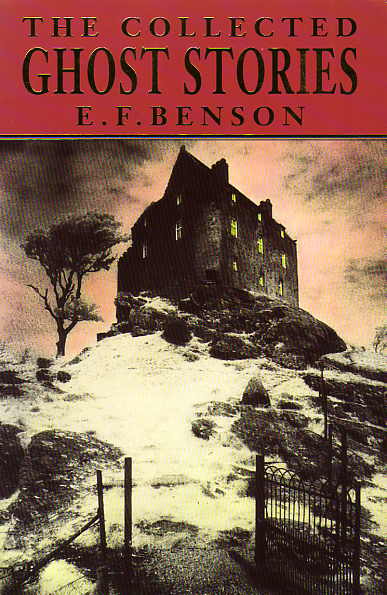
The cover of this fairly recent edition of E.F. Benson's collected ghost stories actually illustrates "The Hanging of Alfed Wadham"

The one thing about this story that is interesting is the glimpse into closeted gay life in the early twentieth century. Because make no mistake, this is a very gay story. Father Denys, the narrator, murderer Horace Kennion and his victim Gerald Selfe are implied to be closeted gay man, while wrongful execution victim turned vengeful ghost Alfred Wadham was a blackmailer who blackmailed men about their indiscretions. And yes, Gerald Selfe's sexual indiscretions are said to have been with a married woman, but I suspect Benson just added that tidbit to make the story more palatable in a world, where LGBTQ themes could only be hinted at.

Another thing that's notable is that this is a fairly rare example of a pulp story that's explicitly religious. Because contrary to what certain folks say, religion in general and Christianity in particular do not play a big role in pulp SFF and pulp fiction in general. Especially in pulp SFF, religion is either a scam or for aliens or it involves sacrificing nubile virgins to Cthulhu. Yes, there are exceptions such as Robert E. Howard's Solomon Kane, but they are few and far between.

And come to think of it, Solomon Kane, Howard's fanatical Puritan avenger and scourge of all that is evil, is a much more interesting and compelling portrait of an intensely religious person in moral distress, though in Kane's case is moral dilemma is that he is a violent man who kills a lot of people, believing himself to be on a mission from God. Only that both Kane's religious and moral  dilemma and his adventures are a lot more exciting and better written than "The Hanging of Alfred Wadham". This is particularly interesting since three Solomon Kane stories, "Red Shadows", "Skulls in the Stars" and "Rattle of Bones" had already been published by the time this story was published. So Weird Tales had already published much variations on the theme of "An intensely religious person is confronted by the supernatural and has their faith tested".

In fact, if you come across explicitly religious SFF from the 1930s and 1940s, it usually hails from Britain and was published outside the pulp magazine ecosystem. C.S. Lewis is probably the best known example, though E.F. Benson also fits the bill. Now I make no secret of the fact that I intensely dislike C.S. Lewis' fiction, but much as Lewis' religious blathering annoys me, there is no doubt that Lewis could write. E.F. Benson, at least based on this example, couldn't.

"The Hanging of Alfred Wadham" was my first exposure to E.F. Benson's work, but based on this story, I certainly won't go seeking out more of his work. In fact, I am baffled that Benson is famous enough to have a Wikipedia entry, plenty of reprints of his work and film and TV adaptations. Maybe his satirical small town tales are better or maybe this story is just a dud. It definitely is proof that even Weird Tales did publish duds on occasion, though they are still a lot more consistent than other pulp magazines.

If you want a Weird Tales story featuring an execution, read the much superior "In a Dead Man's Shoes" by Harold Markham. If you want a story about an intensely religious person having their faith and personal morality tested by encounters with the supernatural, read Robert E. Howard's Solomon Kane stories. If you want religious blathering but well written, read C.S. Lewis. If you want to read a great story from the August 1929 issue of Weird Tales, read "The Shadow Kingdom" by Robert E. Howard.

But don't bother with "The Hanging of Alfred Wadham", unless you are a fan of E.F. Benson's or really like religious blathering and theological arguments in your fiction or are doing a study of early LGBTQ speculative fiction.

Thursday, 5 March 2020

Retro Review: "Hoofs" by Manly Wade Wellman


"Hoofs" is a horror short story in the John Thunstone series by Manly Wade Wellman. It was first published in the March 1944 issue of Weird Tales and is therefore eligible for the 1945 Retro Hugos. The story may be found online here.

Warning: There will be spoilers in the following.

John Thunstone is an occult detective created by Manly Wade Wellman who appeared in fifteen stories in Weird Tales between 1943 and 1951 as well as one further short story and two novels in the 1980s. Six of the John Thunstone stories appeared in 1944 alone, that's a third of the entire series excluding the novels, so the character and series were clearly popular. Steve J. Wright reviewed all six of the 1944 John Thunstone stories on his blog.

However, "Hoofs" does not begin with John Thunstone himself, but with his love interest, Sharon Countess Monteseco, a recurring character in the series. In spite of her Italian surname, the Countess is American, a woman named Sharon Hill who married an Italian Count who – so the first paragraph informs us – "was a rank bad man, and the world and the Countess were better off for his death".

But is the Count truly dead? A plump little man named Hengist who visits the Countess in her hotel suite claims that the Count is not in fact dead, but alive in another body. Hengist also insists that the Count loves his wife, which Sharon vehemently denies. Hengist also drops a name, Rowley Thorne. It's a name Sharon – and the reader – knows, because Thorne appeared in the very first John Thunstone story "The Third Cry to Legba" in the November 1943 issue of Weird Tales and was a recurring antagonist of Thunstone.

The Countess is not impressed, especially since Hengist not just drops Thorne's name, but also hits on her. And so she slaps him and throws him out. Hengist, on the other hand, is quite satisfied with the meeting. He calls Thorne and informs him that he carried out his instructions and that the Countess believes.

Sharon indeed believes, if only because being the girlfriend of an occult detective means experiencing a lot of otherwise inexplicable phenomena. And so Sharon has personally witnessed Rowley Thorne raise evil spirits, a description which certainly fits her late husband.

It quickly occurs to Sharon that John Thunstone might be able to help her. But unfortunately, they had a quarrel. Therefore, Sharon blows him off with the old "I have a headache" line, when he calls her to apologise. Barely a second later, she curses herself for not confiding in John Thunstone. But Sharon has bigger problems, for Rowley Thorne comes calling.

The description of Rowley Thorne that Wellman gives us – tall, hawklike, bald, gunmetal eyes – match a familiar occultist of our own world, namely Aleister Crowley, whose nonfiction work The Book of Thoth: A Short Essay on the Tarot of the Egyptians is eligible for the 1944 Retro Hugos in the Best Related Work category, by the way. Even the names Rowley and Crowley are similar. Like Crowley, Thorne has a huge ego. "Some day," he informs the Countess, "the world will know me by a name of own choosing, a name of mastery." Thorne also assure Sharon that world domination is not what he's after, because that's a flat and outworn idea. I'm sure the world and its citizens will be very relieved.

In her first confrontation with Thorne, Sharon certainly holds her own. She tells Thorne that she's not afraid of him, for "Fear is folly, for people like you to feed on." She also accuses Thorne of lying about her husband. "If I lie, come and prove it," Thorne counters and so Sharon goes with him.

Thorne takes Sharon to an apartment where Hengist is already waiting. The apartment is empty except for a table on which there is a single object, a glowing glass horse. Thorne insists that the horse contains the spirit of the late Count. Sharon is understandably sceptical, but when she touches the glass, it feels warm. The glass horse also seems to nod in response to Thorne's questions. And when Thorne invites Sharon to ask the spirit a question that only the late Count could answer, the horse once more knows the answer.

Thorne's plan is to transfer the Count's spirit to Hengist and use the resurrected Count to subdue Sharon to get control of her money and also piss off John Thunstone in the bargain. Of course, Thorne assumes that Sharon will remain true to her marriage vows, even if the spirit of her husband – a husband she clearly despised – now resides in another body. It would certainly make an interesting court case to determine if a marriage is still valid, if one partner's spirit resides in a different body.

Meanwhile, Hengist – whose name is almost identical to "Hengst", the German word for "stallion" – isn't too keen on becoming a vessel for a dead Italian Count. And so he proposes to Sharon to throw away the potion he is supposed to drink and just fake that the transfer was successful. For certainly, a relationship with Hengist is preferable to having the Count back and being a slave to Rowley Thorne, he slimily proposes.

While Hengist is hitting on Sharon, Thorne is preparing his ritual, when he is interrupted by none other than John Thunstone himself. Thunstone had come to visit Sharon to make up with her, when he saw Hengist leaving. Recognising Hengist, Thunstone followed him to the apartment building, let himself in and hid behind the drapes, while Thorne explained his grand plan.

Once Hengist took Sharon away, Thunstone emerges to stop Thorne's ritual. In the resulting fight, Thorne grabs a swordcane and draws the blade – which is interesting, because a swordcane with a blade of silver inscribed with "Thus perish all your enemies" in Latin is John Thunstone's signature weapon. Alas, Thunstone did not bring his own swordcane, though he does manage to disarm Thorne. The glass horse also shatters during the fight.

"Do you realise what this means?" Thorne exclaims.

Thunstone calmly informs Thorne that the reincarnation of the late Count has been called off, because there is nowhere else for the trapped spirit to go. Thorne points out that he had already began the ritual and pointed the spirit at Hengist. Whereupon Thunstone replies that if Hengist isn't prepared, that's his misfortune and also Thorne's, because the results will be quite embarrassing.

Meanwhile, Hengist is still oozing slime all over Sharon who keeps insisting that there's someone or rather something outside the door. Hengist tries to draw her attention back to himself, when cloud of glowing vapour passes through the door, takes the shape of a horse and attacks Hengist. It's the spirit of the Count, looking for a new body, but finding no entrance, because Hengist hasn't taken the potion he was supposed to take. Sharon flees and stumbles right into the arms of John Thunstone who takes her home.

Thunstone and Sharon never discuss the incident directly, but the next day at lunch, Thunstone tells Sharon that the papers are reporting that a dead body was found in an empty apartment, seemingly trampled to death by horses, although there were no horses anywhere in the vicinity.


This was my first encounter with Manly Wade Wellman's occult detective John Thunstone. Based on this story, I certainly wouldn't mind learning more about the character. Because "Hoofs" doesn't give us much of a chance to get to know John Thunstone. The story is short, only seven pages long, and Thunstone himself only appears on the second-to-last page after a brief appearance of a only few paragraphs earlier. Instead, the bulk of the story is given over to Sharon, Countess Monteseco. As a result, we also learn a lot more about Sharon – that she is American, that her marriage was ill-advised and unhappy, that she is brave and used to solving her problems on her own, what she looks like ("compactly, blondely handsome, neither doll nor siren") – then we ever learn about John Thunstone himself.

Stories with female protagonists were rare during the golden age. So far I have reviewed only two stories with female protagonists for the Retro Reviews project, "Undersea Guardians" by Ray Bradbury and "The Gothic Window" by Dorothy Quick. "Hoofs" is the third story with a female protagonist, even though John Thunstone is nominally the hero of the series.

The shortness of the story also makes it difficult to get an idea of what the relationship between John Thunstone and Sharon is like. We learn that they've quarrelled, "a disagreement over trifles which wound up a quarrel", and that they are both proud and are having a hard time apologising to each other. In a move that's probably uncommon for the 1940s, John Thunstone takes the first step, though he does begin what he hopes will be their reconciliation with "Aren't we being childish?", which does feel condescending, particularly viewed from a 2020 point of view.

The brief phone conversation early in the story is the only time that John and Sharon actually talk, so these two certainly have a communication problem. And indeed, I had hoped for a somewhat more romantic reunion of the pair than just Sharon stumbling into John's arms during her flight from the ghostly horse and he taking her home in silence. But then the briefness of the story doesn't leave a whole lot of room for romantic interludes. In fact, if there is one complaint I have about "Hoofs", it's that the story is too short.

Rowley Thorne makes a suitably sneerworthy antagonist and his henchman Hengist is sufficiently slimy that I at least did not feel the slightest bit sorry that he got trampled to death by a ghost horse. The supernatural threat du jour in the form of an evil occultist and his slimy henchman, the risen spirit of someone the characters would very much prefer to stay dead and finally a murderous ghost horse is certainly menacing enough.

Manly Wade Wellman was a folklorist and worked on a project to collect local American folklore for the Works Progress Administration in the 1930s. His knowledge of folklore certainly shines through in his stories, more so in the later Silver John a.k.a. John the Balladeer stories than in the John Thunstone stories

Stories about occult detectives were a popular hybrid genre in the first half of the twentieth century and go back to Algernon Blackwood's John Silence and William Hope Hodgson's Thomas Carnacki, the Ghost-Finder. In the US, occult detectives quickly found a home in Weird Tales, which published the adventures of Seabury Quinn's Jules de Grandin (who is eligible for Best Series for the 1945 Retro Hugos), Manly Wade Wellman's Judge Pursuivant and of course John Thunstone himself. Indeed, there are plenty of hints that the adventures of Jules de Grandin, Judge Pursuivant, John Thunstone and Wellman's later character Silver John a.k.a. John the Balladeer take place in the same universe and that the characters all know each other. Indeed, Judge Pursuivant is namechecked in "Hoofs", when Thunstone mentions that he is planning to get on a plane with Judge Pursuivant for some investigation far away, before he cancels his plans, once he realises Thorne is in town.

These characters are the ancestors of today's urban fantasy heroes. Their literary descendants include John Constantine, Harry Dresden, John Taylor (John is certainly a popular first name for occult detectives), Jack Winter, the Leandros brothers, the Winchester brothers and many others. And while Sharon, Countess Monteseco had to content herself with being the hero's love interest, today's occult detectives not just have formidable romantic partners like John Taylor's girlfriend/bride Suzie Shooter (nomen est omen) – no, there are also plenty of female occult detectives such as Anita Blake, Kate Daniels, Mercy Thompson, Rachel Morgan, Dante Valentine and others.

But while today's occult detectives usually narrate their adventures in the first person in hardboiled/noir mode, older characters like John Silence, Carnacki, Jules de Grandin or Judge Pursuivant are closer to Sherlock Holmes than to Philip Marlowe and Sam Spade. John Thunstone is a bit of a transitional character here. He is a younger and more physically active hero than the likes of Jules de Grandin and Judge Pursuivant, a wealthy playboy with a penchant for fighting evil who is also reminiscent of Richard Wentworth a.k.a. The Spider and Bruce Wayne a.k.a. Batman.

However, the character that John Thunstone most reminds me of – at least based on this story – is Lee Falk's Mandrake the Magician. For Mandrake is also a handsome moustachioed playboy who fights supernatural as well as false supernatural enemies with the help of his plucky aristocratic girlfriend Narda (and best friend Lothar, who has no equivalent in the John Thunstone stories). And indeed, it's interesting that all of these characters were operating at the same time.

Furthermore, the John Thunstone stories also show how the occult detective genre has changed and developed over the past seventy-five years. Early occult detectives mainly appeared in short fiction – the two John Thunstone novels only appeared in the 1980s, some forty years after the bulk of the series – whereas their modern brethren mainly appear in novels. The adventures of early occult detectives are also more episodic. Characters may reappear, see recurring antagonist Rowley Thorne, but there is little in the way of internal continuity and the stories can often be read in any order. Meanwhile, modern series, whether it’s the Dresden Files, the Nightside series, the Leandros Brothers, Kate Daniels or Mercy Thompson series, have a definite series arc.

Finally, modern series place way more emphasis on the occult detective's social and romantic life and the occult detective is usually surrounded by a network of friends, family and loved ones, often assembled across several books. Meanwhile, the occult detectives of the golden age tended to be loners with few connections aside from the occasional faithful Watson figure such as Jules de Grandin's friend/partner (and maybe more, since several folks claim to have detected homoerotic vibes between the two) Dr. Trowbridge. John Thunstone is actually something of an exception here, because he has a friend/mentor in Judge Pursuivant and a recurring love interest in Sharon Countess Monteseco. Nonetheless, their relationship takes a backseat to the supernatural mystery of the month, which is probably why the romance aspects of "Hoofs" feel a little unsatisfying from a modern POV.

That probably sounds more critical than it should, because I enjoyed "Hoofs" quite a bit and would certainly like to read more about John Thunstone's adventures. And if I had a nice print collection of the Thunstone stories rather than being forced to read them in scanned copies of vintage issues of Weird Tales on archive.org, I might well have ended up reading the whole series, which is what happened last year when I planned to reread just the one Retro Hugo nominated Fafhrd and Gray Mouser story and wound up rereading the entire series.

"Hoofs" is a neat occult detective tale in a series I would certainly like to read more of.

Wednesday, 26 February 2020

Retro Review: "The Dear Departed" by Alice-Mary Schnirring


"The Dear Departed" is a ghost short story by Alice-Mary Schnirring, which was first published in the May 1944 issue of Weird Tales and is therefore eligible for the 1945 Retro Hugos. The story may be found online here.

Warning: There will be spoilers in the following.

"The Dear Departed" opens with a séance in progress. Six people are seated around the table, including the medium Radha Ramavi. During the séance, the voice of a child can be heard calling "Mommie, Mommie". One of the people at the table, a woman named Mrs. Harcourt, recognises the voice as that of her late daughter Dorrie. Clearly upset, she gropes about in the dark and breaks the circle, ending the séance early. When the lights go on again, Mrs. Harcourt is holding a stuffed toy elephant that used to belong to Dorrie, but has been missing since her death.

Radha Ramavi declares that once the circle has been broken, there is no use in going further today. But they can try again tomorrow. Then his assistant, described as a small man in Eastern clothes, sees the guests out, but not before Mrs. Harcourt slips him an envelope containing one hundred dollars, which was a lot of money in the 1940s.

Once the guests are gone, Radha Ramavi and his assistant take off their pseudo-Indian outfits and share a smoke. We learn that Radha Ramavi is really called Joe and that his assistant is called Mark. Neither of them has ever even been to India and Radha a.k.a. Joe cannot really talk to the spirits of the dear departed either. Instead, Joe and Mark are frauds, preying on the despair of the recently bereaved. They acquired the toy elephant from a nurse and used it to fleece Mrs. Harcourt and the others for money.

Joe and Mark head out for dinner and we learn a little more about how their scam works. Mark researches the customers and their dead relatives. He's also a ventriloquist and produces the voices, while Joe plays the medium. Occasionally, Mark also organises the materialisation of a spirit, using props such as an old Air Force uniform. Since the story was written in the middle of WWII, there would have been a great demand for spirits in uniform and as well as a lot of bereaved parents and widows and therefore a great demand for mediums to talk to the dead. However, Joe and Mark decide to lay off the materialisations for now, because they suspect that one of their customers, a man called Henderson, might be an undercover cop.

By now it's pretty clear that Joe and Mark are despicable people. But just in case there was any doubt, Mark decides to use his ventriloquist skills to harass a black truck driver waiting at a traffic light, while he and Joe are crossing. And so Mark produces a disembodied voice that whispers "Black boy, debbil's waitin' fo' you," to the truck driver. As a result, the terrified truck driver slips off the brake, the truck lurches forward and runs over Mark. Poetic justice, I'd say.

Schnirring's decision to make the truck driver black not just shows that New York City, where "The Dear Departed" is set, was a highly diverse place, it also adds racism to the already long list of Mark's sins and proves beyond the shadow of a doubt that Mark is or rather was a horrible person. I could have done without a awful accent Schnirring gave the black truck driver, though.

Now that Mark has gotten his comeuppance, Joe is distraught. For starters, he needs Mark or someone with his skills to run his fake medium scam. And besides, Joe was fond of Mark, because Mark worshipped him and would have done everything for him. Like a mongrel who'd do everything for a bone, a pat on the back or a kick. Just in case there was any lingering doubt, Joe comparing his faithful friend (and maybe more?) and business partner to a dog shows that he is a horrible person, too. Not to mention that we wonder why Mark put up with Joe, especially since Mark was the one who did all the work. Joe just pretended to be a fake medium.

However, Joe still has a séance scheduled for the next day and his customers arrive on cue. Joe has no idea what to do now, cause with Mark gone there is no one to do the voices of the spirits and arrange all the other little tricks. But since he can hardly send his customers home again, Joe decides to go through with the séance and just pretend that the spirits are not in the mood to answer that day. And so he sits at the table with the others, eyes closed, and wonders just how long he will have to pretend that he's trying to contact the spirits before he can send everybody home.

Suddenly Joe smells cigar smoke and wonders about that. After all, he told Mark not to smoke in the séance room, because the smell of smoke gets stuck in the draperies. Then Mrs. Harcourt screams and faints. Joe opens his eyes and there is Mark or rather his ghost, his body still mangled from the accident. "You wanted me, Joe, so I came," Mark's ghost says.


"The Dear Departed" is short, only three and a half pages long, but a certainly manages to pack a lot of punch into its short length. In many ways, this story is similar to "The Gothic Window" by Dorothy Quick, which ran in the same issue. For both stories feature a character faking a supernatural occurrence – though for very different reasons – only for the supernatural to really happen and make sure that a loathsome character gets their comeuppance. Though in "The Gothic Window" there is a plausible natural explanation for the supposedly supernatural occurrences. In "The Dear Departed", the ghost of Mark really does appear at the end, witnessed not just by Joe but by Mrs. Harcourt and the rest of the circle as well.

Apart from Mark's sudden death by truck, there are very few surprises in "The Dear Departed" and a savvy reader can quickly tell where the story is going. Nonetheless, the story is well written and highly effective. And while fake mediums are as common in fiction as they probably are in the real world, I nonetheless found the explanations how Joe and Mark conduct their scam fascinating.


Alice-Mary Schnirring is another forgotten woman writer of the golden age, except that she is even more obscure than Allison V. Harding and Dorothy Quick, if that's possible. According to ISFDB, she was born in Brooklyn in 1912 and died in 1978. Her byline is very likely her real name, if only because no one in their right mind would choose a surname like Schnirring, which is almost impossible for Americans to pronounce and spell (and not exactly great for Germans either), as a pen name. And indeed, in my quest to learn more about Alice-Mary Schnirring I found the obituary of her son, William Schnirring who was born in 1938 and died in 2003 and also worked in publishing, though in very different fields than his mother.

Alice-Mary Schnirring was less prolific than Harding or Quick. ISFDB lists only six stories by her, all published in Weird Tales between 1942 and 1944. However, she also seems to have been active in other genres. A 1975 Alfred Hitchcock anthology contained a story by her and crime fiction writer and Edgar Award winner Robert L. Fish dedicated a novel to her. All this points to a writer who left SFF for friendlier and more lucrative pastures (Weird Tales was notoriously slow to pay its writers). Alas, there is no crime and mystery equivalent to ISFDB, therefore it is impossible to tell how active she was in that genre.

Considering that every scrap of paper left behind by H.P. Lovecraft or Robert E. Howard has been scrutinised to death, it's telling how very little is known about the women who wrote for Weird Tales, even though Weird Tales had more female contributors on all levels (writers, editors, artists) than any other SFF magazine of the pulp era. We clearly need a comprehensive study about the women of Weird Tales.


Screenshot from the Night Gallery adaptation of "The Dear Departed"

With regard to reprints, Schnirring seems to have done a little better than Harding or Quick and several of her stories, including "The Dear Departed" have been reprinted in anthologies over the decades. Furthermore, "The Dear Departed" was also adapted for an episode of Rod Serling's Night Gallery in 1971, which David Juhl reviews here. The Night Gallery episode sticks to the basic plot of the story, but adds in a love triangle between Joe, Mark and his wife. I suspect that the adultery subplot was added to dispel any suspicions that Joe and Mark are a couple on a personal as well as professional level. Because the story certainly contains hints in that direction.

An effective and genuinely spooky ghost story by yet another underrated woman writer of the golden age.