Showing posts with label religion. Show all posts

Saturday, 26 November 2022

Retro Review: "The Hanging of Alfred Wadham" by E.F. Benson


Weird Tales August 1929


"The Hanging of Alfred Wadham" is a short story by E.F. Benson, which was first published in the December 1928 issue of the magazine Britannia and reprinted in the August 1929 issue of Weird Tales. The story may be found online here. This review will also be crossposted to Retro Science Fiction Reviews.

This story is another one which caught my eye via Hugh Rankin's striking interior art under his Doak pseudonym (Doak was Rankin's middle name). For some reason, Rankin did several drawings of hangings and executions under the Doak name, such as the interior art for "In a Dead Man's Shoes", which I reviewed recently. As before, Rankin also supplied to striking Art Deco cover art for this issue, illustrating the The Inn of Terror by Gaston LeRoux.

Hugh Rankin's interior art for "The Hanging of Alfred Wadham"

Though the standout story in this issue is not the cover story, but "The Shadow Kingdom" by Robert E. Howard, the story which introduced Kull of Atlantis as well as the Serpent Men to the world and is widely considered to be the first sword and sorcery story. I should probably do a Retro Review of that story eventually, especially since it's also a very good story.

Many authors who published in the pulps are completely forgotten these days and we know little to nothing about them. I feared this might be the case with E.F. Benson, but on the contrary, Benson was actually a very well-known British writer from a family of well-known people. His father was the Archbishop of Canterbury, one of his brothers wrote the words to "Land of Hope and Glory", another brother was also a writer as well as a priest and his sister was a writer and Egyptologist. To make matters even more impressive, E.F. Benson was a member of the Order of the British Empire. He was also gay and by necessity, given the time during which he lived, closeted.
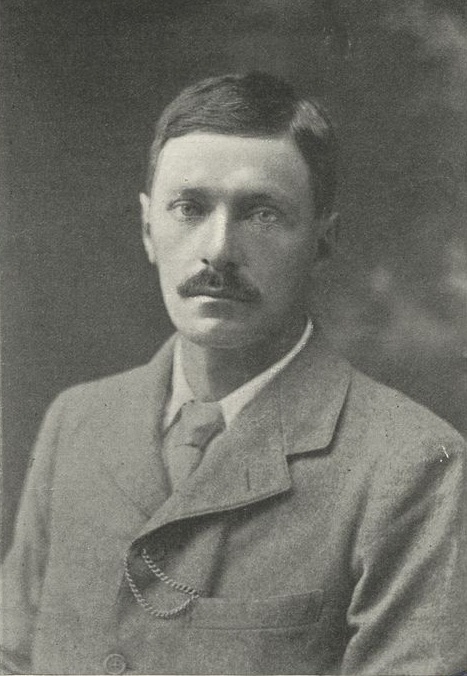
E.F. Benson

Benson's most famous work is the Mapp and Lucia series, a series of satirical novels about upper class people in a small town and their petty rivalries. I have to admit that I have never heard of those books, even though they spawned several sequels by other authors, two TV-adaptations, including one as late as 2014, and a lobster dish.

In addition to satirical novels about upper class people being jerks, Benson also wrote a lot of ghost stories and this is what brought him to the attention of H.P. Lovecraft, who wrote admiringly about Benson's work in "Supernatural Horror in Literature", and finally to Weird Tales.

But enough about the man. Let's talk about the story.

Warning! Spoilers beyond this point!

Compared to the other 1929 Weird Tales story featuring a hanging and interior art by Hugh Rankin, "The Hanging of Alfred Wadham" starts off slow with the unnamed first person narrator discussing a séance he attended with one Father Denys Hanbury. The medium conveyed some messages from a recently deceased friend of the narrator and the narrator is certain that the séance proves something, though whether it is communication with the dead or telepathy he is not sure. Father Denys, true to his profession, believes communication with the dead and impossible or demonic, though he is remarkably open-minded with regard to telepathy.

The narrator then explains that the medium talked about something that she could not have gotten from his mind, because the narrator did not know about it, but which was later confirmed by the dead friend's diary. Father Denys, however, still believes that communication with the dead is dangerous and shares a story of his own.

Such "take within a tale" framing devices were very common in the nineteenth and early twentieth century and pop up quite often in Weird Tales. What is notable about this one is that it's not only dull – we only ever get vague details about séance and what the medium said – but also written in a very stilted style. The (male) narrator also spends two paragraphs describing the beautiful hands of Father Denys. Even if I didn't know by this point that E.F. Benson was gay, that paragraph pretty much confirms it.
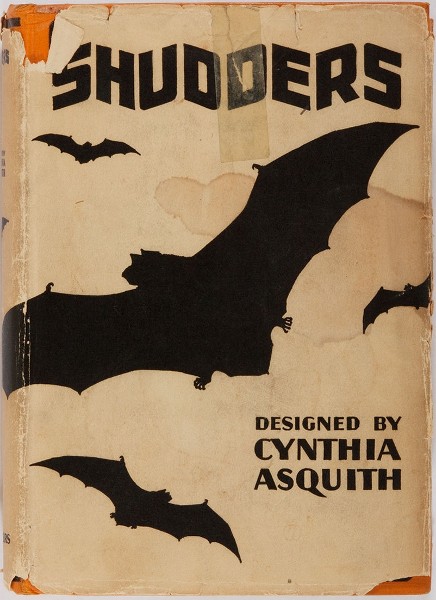
Shudders, edited by Cynthia Asquith

Once Father Denys of the beautiful hands starts his story, I hoped things were finally about to get good. Alas, Father Denys, who is a Catholic priest by the way, starts rambling on about the sacrament of confession, why it is important and why a priest may never ever repeat anything he heard in confession, even if remaining silent will have terrible consequences.

Next, we get an description of the crime allegedly committed by the titular Alfred Wadham. Alfred Wadham was the manservant of a "man of loose life" named Gerald Selfe. That "loose life" was the fact that Selfe was having an affair with a married woman. Someone found out about the affair and started blackmailing Selfe. Selfe went to the police, who investigated the case and quickly zeroed in on Alfred Wadham as a suspect.

The police have set a trap for Wadham, when Selfe is found with his throat slit one morning. Wadham is gone, but stains of human blood are found in his room. The police quickly apprehend him. Wadham proclaims his innocence of the murder, though he does admit to the blackmailing. Wadham declares that he realised that Selfe and the police were on to him and therefore fled. Alas, the judge and jury don't believe him and so Wadham is sentenced to death for murder.

Wadham is Catholic and so he meets Father Denys, who just happens to be the prison chaplain. True to his profession, Father Denys urges Wadham to confess to the murder and repent, but Wadham keeps insisting that he didn't do it. Since Wadham confesses plenty of other sins and crimes, Father Denys starts to believe him.

Father Denys is troubled by this case – not because an innocent man is about to be executed, but because he is not sure whether he should grant Wadham absolution for his other sins, since Wadham flat out refuses to confess to the murder.

More Spook Stories by E.F. Benson

Now it's worth remembering that E.F. Benson's father was an Anglican clergyman and Archbishop of Canterbury and that one of his brothers was an Anglican priest who converted to Catholicism, became a Catholic priest and wrote religious texts, so I probably shouldn't be surprised to see a theological argument in a story written by someone from such a background. However, as I've repeatedly said, I'm not religious, I dislike too much religion in my fiction and theological arguments literally make my eyes glaze over. And in this particular case, I had even less patience for theological arguments, because Alfred Wadham is about to be hanged for a crime he probably didn't commit, so who cares whether a priest absolves him from his sins or not? Never mind that granting absolution for sins is part of Father Denys' job.

On the night before the execution of Wadham, an former acquaintance named Horace Kennion visits Father Denys. Father Denys wants nothing to do with Kennion, because Kennion is a wicked man – more wicked than usual, because Father Denys reminds us that all humans are wicked and that "the life of us all is a tissue of misdeeds". Father Denys' hands must be very beautiful indeed for the narrator to willingly hang out with such a killjoy.

However, Kennion is very insistent to speak to Father Denys, because he needs to make a confession right now and his usual priest is not available. So Father Denys reluctantly hears his confession. Surprise: Kennion is the one who killed Gerald Selfe over a quarrel about a game of cards (though there was no mention of cards or a card table in the earlier description of the crime scene). After stabbing Selfe, Kennion went up to Wadham's room (Selfe had rung for Wadham earlier, but Wadham had already left, so Kennion knew the room would be empty) to wash off the blood – that's how the blood stains came to be found in Wadham's room.

Father Denys of course immediately entreats Kennion to go to the police and confess, so Wadham can be saved. However, Kennion has no intention of going to the police. And when Father Denys threatens that he will call the police, Kennion just grins and points out that he can't, because his faith forbids it. And besides, who would believe a priest who violated to sacrament of confession?

Father Denys now demands why Kennion felt the need to confess his sins at all and why to him specifically. Once again Kennion grins and tells Father Denys that he was very hurt when Father Denys broke off all contact with Kennion. And so he decided to get revenge by putting Father Denys in a terrible situation where there are no good choices. "I daresay I've got Sadie tastes, too, and they are being wonderfully indulged," Kennion says.

The Benson brothers
These are not actually the characters from this story, but E.F. Benson (on the right) and his brothers Arthur Christopher Benson (on the left, wrote the lyrics to "Land of Hope and Glory") and Robert Hugh Benson (the priest).

Now the vibes that I get from this exchange is that Father Denys and Kennion were lovers and that there may well have been some kink involved. But then Father Denys broke off the relationship and Kennion wants revenge. It's also notable that Kennion calls Father Denys by his first name, something which was extremely uncommon among upper class British men in the early twentieth century. Even Kennion's disdain for the doomed Alfred Wadham and his claim that Wadham has it coming for his other crimes – "Blackmail is a disgusting offence" – fits in with this, because gay men were often the target of blackmailers, back when gay relationships were still illegal. In fact, I wonder whether Kennion and his victim Gerald Selfe did not have a relationship, too. After all, it is explicitly stated that Kennion went up to Selfe's room.

I have to admit that though he is a murderer (double murderer to be exact) and generally horrible person, Horace Kennion is the most interesting character in this story. The narrator is a cypher, the victim Gerald Selfe is merely a prop required to get the story going and Alfred Wadham is more moral dilemma than character. As for Father Denys, he is an insufferably sanctimonious prick.

Case in point: Father Denys spends a few paragraphs detailing the terrible torment and suffering he experiences – a suffering that is not even "a needful and salutary experience to burn his sins away", but empty torment. Meanwhile, the actual victim here is not the moping priest with a crisis of conscience, but Alfred Wadham who is about to be executed for a crime he did not commit.

Though at least Father Denys does take some action rather than just sit around feeling sorry for himself. First, he goes to see the Cardinal, who basically tells him that he cannot violate the seal of confession. Then he goes to see the Home Secretary and tells him that Wadham is innocent, because the real murderer just confessed to him.

The Home Secretary is sympathetic, but tells Father Denys that he cannot pardon Wadham without more evidence. He also tells Father Denys to put the fear of God into the real murder to get him to confess and also gives the priest his phone number, just in case.

However, Father Denys doesn't need the phone number, because instead of putting the heat on Kennion, he goes straight to the prison, tells Wadham that he believes in his innocence and finally grants him absolution for all his other sins. Then we learn that Wadham went without flinching to his death. There is also a brief one sentence description of the trapdoor opening and the rope jumping and creaking. But otherwise, the hanging that Hugh Rankin drew so evocatively happens mostly off page.

This is rather disappointing, particularly compared to the visceral description of a hanging in Harold Markham's story "In a Dead Man's Shoes", published a few months before in the April 1929 issue of Weird Tales. Of course, Markham was describing a public hanging in the eighteenth century rather than a prison hanging in the early twentieth century, but there are plenty of much more evocative descriptions of twentieth century prison hanging than the single sentence that Benson gives us.

But then, the story isn't really about the hanging of Alfred Wadham at all, in spite of the title. It is about Father Denys and his moral dilemma. And now Father Denys finally comes to the point of his tale, namely why séances are bad and do not convey messages from the dead, but from some "evil and awful power impersonating them".

 After the execution, Father Denys goes home and Benson gives us more description of the weather than of the actual execution. However, mostly we get yet more musings from Father Denys. Even though he has just watched a man been hanged for a crime he did not commit, Father Denys feels serene and peaceful. After all, in Father Denys' view, it doesn't much matter that Alfred Wadham was hanged. After all, he had all his sins forgiven and still has his immortal soul and getting hanged for a crime he didn't commit is just like martyrdom.

Meanwhile, Father Denys makes it clear that the most important thing to him is that he kept his precious vow and did not commit the worst crime a Catholic priest can commit. This was the moment where I went from, "What sanctimonious bore" to "What a fucking arsehole – I hope something awful happens to him." Thankfully, something does.

Once he gets home, Father Denys lies down for a nap – after all, he has been up all night. He has a bad dream of Wadham screaming at him and begging him to save him. He wakes up to the sound of someone calling his name in Wadham's voice. Yes, apparently Wadham has returned to haunt Father Denys and highly deserved it is, too. Honestly, Wadham, haunt the shit out of that jerk of a priest.

Father Denys now keeps hearing Wadham calling his name, he feels Wadham's presence. he sees him on the street and once sees Wadham's body swinging in the wind outside his window, which is the scene Hugh Rankin's interior actually illustrates.

The haunting of Father Denys – which would be a much better title for this story, come to think of it – culminates when he sees Wadham – with the noose round his neck, face purple and eyes protruding – sitting in a pew at the front of the church, while Father Denys is preaching. However, Father Denys is still convinced that he made the right choice and concludes that the one sending the apparitions is the devil rather than one very pissed off ghost.

The story ends with the ghost of Alfred Wadham – or the devil pretending to be the ghost of Alfred Wadham – reappearing in front of the narrator's and Father Denys' eyes. We get some nice, if conventional description of a ghostly apparition such as the room growing chill and the lights turning dim and then we get a manifestation of Alfred Wadham's hanged body, complete with swollen and purple face and lolling tongue. Alas, Father Denys wards off the evil spirit with his crucifix and appears radiant as he has never seen another human being before to the smitten narrator.

Finally, almost as an afterthought, almost as if Benson had forgotten that Father Denys couldn't possibly tell this whole story to the narrator without breaking his vow, Father Denys reveals that Horace Kennion committed suicide that morning and that he left a full confession behind, which is why Father Denys is no longer bound by the seal of confession and can share his story with the narrator.
 

I have read a lot of stories from Weird Tales over the years, both for the Retro Reviews project or in general. But "The Hanging of Alfred Wadham" is definitely the worst Weird Tales story I have read to date.

This is a pity, because the seeds for a good story are all here. The scenario of a priest who hears about a crime during confession and struggles to find a way to expose the criminal or prevent the crime without violating the seal of confession is a well-worn one, but it can work, when done correctly. The fact that Alfred Wadham will be executed, if Father Denys can't find a way to bring Kennion to justice adds a ticking clock to the proceedings. This scenario might have made for a neat thriller – and indeed there have been many thrillers with this exact premise. Alfred Hitchcock's 1953 movie I Confess, which in turn is based on a French play from 1902, is probably the most famous example, but there are several others.

However, this isn't the story that Benson told. Of course, the story of a priest haunted by the ghost of an executed man he could have saved by breaking the seal of confession, but didn't, might have made for a compelling ghost story as well, but that's not really the story Benson tells either. Or at least, he doesn't tell it very well.

Instead, we get what appears to be a theological argument in the form of a short story. Which is probably my least favourite type of fiction, because as I said above, I'm not religious and theological debates make my eyes glaze over. Plus, I come from a majority Lutheran-Protestant area. And Lutherans, at least in Germany, have massive issues with the Catholic sacrament of confession, which they view as hypocrisy, because you can literally commit a murder and then be forgiven your sins, just because you confessed and said a few prayers. It all goes back to the sales of indulgences, which were one of the issues that caused Martin Luther to nail the ninety-five theses to the door of the Wittenberg castle church.

Of course, it's quite possible that Benson intended "The Hanging of Alfred Wadham" as a critique of the Catholic sacrament of confession and its inherent issues. After all, Benson's father was Archbishop of Canterbury and therefore Anglican, even though one brother converted to Catholicism. And Father Denys is not a likeable character. However, if criticising the issues inherent in the sacrament of confession was Benson's intention, he doesn't do it very well either.

Because "The Hanging of Alfred Wadham" also has massive craft issues. The framing device and the unnamed narrator are completely unnecessary – just let Father Denys narrate the story and maybe end with him seeing Alfred Wadham's executed corpse in the church pew. It would certainly have made for a stronger story.

The murder mystery is also sloppily executed (pun fully intended), because it seems the police ignored crucial clues such as the fact that Selfe and Kennion had played cards and that there was a card table set up, which would suggest that Selfe had a visitor on the night he was killed. The blood stains found in Wadham's room also don't add up. For starters, they're explicitly described as human blood stains, though I have no idea if 1920s forensic science could tell the difference between human and animal blood from a few traces. Also, there are any number of ways the blood could have gotten into Wadham's room such as Wadham accidentally cutting himself while shaving. This may sound nitpicky, but by 1928/29, the so-called Golden Age of Mystery was in full swing, most mysteries were so-called fair play mysteries and plenty of predominantly British authors knew how to plant clues and red herrings. So there is really no excuse for Benson's sloppiness. Read some Agatha Christie or Dorothy Sayers, will you.

The writing style is also stilted, ponderous and dull throughout. "The Hanging of Alfred Wadham" is short, only nine pages, but it feels much longer. Benson also has the tendency to overfocus on Father Denys' internal conflict and underdescribe the murder, the execution and the supernatural events, i.e. the sort of thing Weird Tales readers were probably far more interested in than in a theological argument and a priest's mental torment.

Furthermore, the story also feels very old-fashioned, more like something that might have appeared in the nineteenth century alongside a Sherlock Holmes or Edgar Allan Poe story than something that appeared alongside Robert E. Howard's "The Shadow Kingdom". Of course, Benson was not a young man, but already 61 when this story was published and so his style and sensibilities likely were more Victorian.

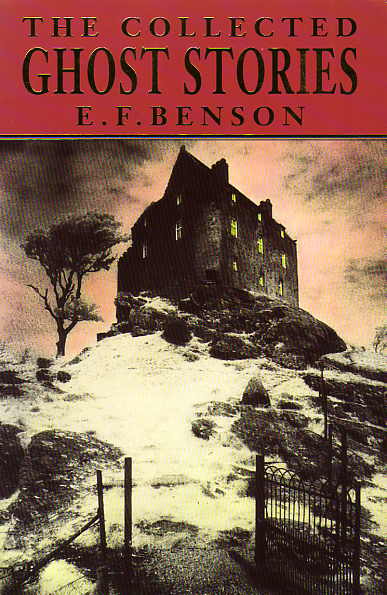
The cover of this fairly recent edition of E.F. Benson's collected ghost stories actually illustrates "The Hanging of Alfed Wadham"

The one thing about this story that is interesting is the glimpse into closeted gay life in the early twentieth century. Because make no mistake, this is a very gay story. Father Denys, the narrator, murderer Horace Kennion and his victim Gerald Selfe are implied to be closeted gay man, while wrongful execution victim turned vengeful ghost Alfred Wadham was a blackmailer who blackmailed men about their indiscretions. And yes, Gerald Selfe's sexual indiscretions are said to have been with a married woman, but I suspect Benson just added that tidbit to make the story more palatable in a world, where LGBTQ themes could only be hinted at.

Another thing that's notable is that this is a fairly rare example of a pulp story that's explicitly religious. Because contrary to what certain folks say, religion in general and Christianity in particular do not play a big role in pulp SFF and pulp fiction in general. Especially in pulp SFF, religion is either a scam or for aliens or it involves sacrificing nubile virgins to Cthulhu. Yes, there are exceptions such as Robert E. Howard's Solomon Kane, but they are few and far between.

And come to think of it, Solomon Kane, Howard's fanatical Puritan avenger and scourge of all that is evil, is a much more interesting and compelling portrait of an intensely religious person in moral distress, though in Kane's case is moral dilemma is that he is a violent man who kills a lot of people, believing himself to be on a mission from God. Only that both Kane's religious and moral  dilemma and his adventures are a lot more exciting and better written than "The Hanging of Alfred Wadham". This is particularly interesting since three Solomon Kane stories, "Red Shadows", "Skulls in the Stars" and "Rattle of Bones" had already been published by the time this story was published. So Weird Tales had already published much variations on the theme of "An intensely religious person is confronted by the supernatural and has their faith tested".

In fact, if you come across explicitly religious SFF from the 1930s and 1940s, it usually hails from Britain and was published outside the pulp magazine ecosystem. C.S. Lewis is probably the best known example, though E.F. Benson also fits the bill. Now I make no secret of the fact that I intensely dislike C.S. Lewis' fiction, but much as Lewis' religious blathering annoys me, there is no doubt that Lewis could write. E.F. Benson, at least based on this example, couldn't.

"The Hanging of Alfred Wadham" was my first exposure to E.F. Benson's work, but based on this story, I certainly won't go seeking out more of his work. In fact, I am baffled that Benson is famous enough to have a Wikipedia entry, plenty of reprints of his work and film and TV adaptations. Maybe his satirical small town tales are better or maybe this story is just a dud. It definitely is proof that even Weird Tales did publish duds on occasion, though they are still a lot more consistent than other pulp magazines.

If you want a Weird Tales story featuring an execution, read the much superior "In a Dead Man's Shoes" by Harold Markham. If you want a story about an intensely religious person having their faith and personal morality tested by encounters with the supernatural, read Robert E. Howard's Solomon Kane stories. If you want religious blathering but well written, read C.S. Lewis. If you want to read a great story from the August 1929 issue of Weird Tales, read "The Shadow Kingdom" by Robert E. Howard.

But don't bother with "The Hanging of Alfred Wadham", unless you are a fan of E.F. Benson's or really like religious blathering and theological arguments in your fiction or are doing a study of early LGBTQ speculative fiction.

Thursday, 2 July 2020

Retro Review: "Intruders from the Stars" by Ross Rocklynne


"Intruders from the Stars" is a novella by Ross Rocklynne. It was first published in the January 1944 issue of Amazing Stories and is finalist for the 1945 Retro Hugos. The magazine version may be found online here.

Warning: Spoilers beyond this point!

"Intruders from the Stars" opens on a far off planet, where a decisive battle is taking place. It's the battle for the fate of an empire, with insurgent forces led by the unnamed prime minister about to vanquish the forces loyal to the Empress, a former slave girl named Bess-Istra. Her forces beaten, Bess-Istra and her surviving soldiers retreat to their citadel, where an escape ship is being readied.

The reader quickly realises that Bess-Istra, though beautiful, is a nasty piece of work, a typical pulp fiction femme fatale. Her reign was bloody, the revolution necessary to depose a tyrant. The prime minister, who is in love with Bess-Istra, even offers her to rule by his side and rebuilt the planet together. However, Bess-Istra will have none of that. She even knocks out her own general Bandro, when he urges her to negotiate to save his own neck.

Bess-Istra and her surviving forces, including the unconscious Bandro, board the escape ship. Her plan is to leave her homeworld and head to a neighbouring solar system and conquer a planet there. The journey is supposed to take thirteen years, which all aboard will spend in suspended animation courtesy of sleep gas.

However, the inhabitants of the neighbouring planet spot Bess-Istra's ship in time and deflect it away from their world. So Bess-Istra and her loyal troops float through space until they happen to land on Earth.

The scene now shifts to Mozambique in the middle of World War II, where American war correspondent Bill van Astor Smythe encounters two missionaries, the Reverend John Stevens and his assistant Thomas Reynolds, while both parties are hiding from the Japanese, who have invaded Mozambique. The young Reverend and his assistant are on their way to a village, for the locals have abandoned Christianity for a new god and also stolen the Reverend's altar candles. Bill is on the run, for the squadron of British soldiers he was embedded with has been wiped out by the Japanese.

Now there never was any Japanese military activity in Africa during World War II – the only axis countries fighting in Africa were Italy and Nazi Germany and they had largely been driven out by 1944. Furthermore, Mozambique was a Portuguese colony and Portugal remained neutral during World War II, so what a squadron of British soldiers was doing there is anybody's guess. It's interesting that Ross Rocklynne messes up something as basic as World War II frontlines. Though the summary of events he gives is correct up to the point where the British take over Mozambique and the Japanese invade Madagascar and Mozambique. Was this a scenario that was considered plausible at some point, since it seems extremely far-fetched to me? I have no idea.

Bill, the Reverend and his assistant make their way to the village, where they find Bess-Istra's spaceship. It turns out that the new god the locals are worshipping is none other than the sleeping Bess-Istra herself, who is conveniently visible (and conveniently half naked) through a porthole of the spaceship.

The Reverend is deeply upset that his converts have abandoned Christianity to worship scantily clad women. He is even more upset, when Bill points out that the sleeping woman is not from Earth, for the existence of extraterrestrial life is not compatible with his faith. Bill, the Reverend and Reynolds are still arguing what to do, when Bill spots a plunger and pushes it downward, because messing with an alien spaceship is obviously such a brilliant idea. As a result, the sleep gas is vented outside the ship, knocking out Bill, the Reverend and his assistant. Bess-Istra awakes.

The three men are taken prisoner and come to aboard the ship. They are subjected first to an interrogation machine and then taken to see Bess-Istra herself. The Reverend immediately accuses Bess-Istra and her people of planning to conquer the Earth. Bill tries to calm him down, but the Reverend has another fit when Bess-Istra mentions gods – in plural – and informs her that there is only one true god. If Bess-Istra had shot him at this point, I certainly would have understood.

However, Bess-Istra has a different plan. Instead of revealing her intentions outright, she tells Bill and the two missionaries that she has scanned their brains and thus learned not only English, but also much about the Earth, including that the world is at war and that the Allies are losing, which is certainly an interesting interpretation of the situation in early 1944, when the battle of Stalingrad (which is generally considered the turning point for Nazi Germany) was already over, even if the Normandy landings were still several months in the future. However, Bess-Istra can help. She and her people will end the war and bring peace to Earth, using their superior alien weapons.

Bess-Istra's offer quickly convinces the Reverend that she is not evil after all, even though he would prefer world peace to be achieved without bloodshed. I have to commend him for this, especially considering the genocidal tendencies we've seen elsewhere on the ballot ("Arena", cough).

Bill is a little bit more sceptical, probably because he spares the occasional glance for General Bandro and Bess-Istra's subordinates who are having a hard time keeping a straight face at Bess-Istra's sudden commitment to world peace. Furthermore, Bess-Istra is also a little too dominant for Bill's taste, though he quickly becomes as besotted with her as everybody else. Bess-Istra, meanwhile, asks Bill and the Reverend (Thomas Reynolds has wandered out of the story and returned to the mission by now) where her forces shall begin their mission to bring peace to Earth. Bill and the Reverend both suggest liberating beleaguered Mozambique and Madagascar from the Japanese. And so they set off in Bess-Istra's ship to disable the Japanese supply fleet, leaving it floating aimlessly in the Indian ocean. Cut off from supplies, the Japanese will be forced to retreat and surrender.

Next, Bess-Istra directs her spaceship to New York City and lands on the roof of the offices of the newspaper syndicate Bill works for, so he can deliver his report in person and will also be believed.

The next target of the campaign for world peace is Italy. Now by early 1944, the Allies had already invaded Italy and Mussolini had been deposed, arrested and subsequently freed by the German army and installed as a sort of puppet ruler in those parts of Italy that were still under Axis control. Nonetheless, the situation did not look particularly desperate for the Allies in Italy in the real world, though the battle of Monte Cassino happened in the winter of 1943/1944. And even though it's never named in the novella itself, it's clearly this battle that Bess-Istra's forces interrupt by knocking out the Italian and German forces with a gas ray, causing Mussolini to flee to Germany.

The Russian front and the western front are next. Bess-Istra's gas ray and another weapon which causes amnesia take out the German forces and the Allies converge on Berlin, where a revolution breaks out (which would coincide nicely with the group around Claus Schenk Graf von Stauffenberg and their ultimately failed plot to assassinate Hitler) and Hitler is deposed.

Once World War II has been ended in Europe – and with less bloodshed than in the real world, though we might have ended up with Stauffenberg and his fellow reactionaries in charge, which would likely have been worse for Germany in the long run – the next aim is ending the war in Asia and the Pacific. This time around, Bess-Istra's forces deploy contracting fire rings around Japanese occupied cities in Asia. These fire rings destroy all sulphur and render gunpowder and therefore all firearms useless, leaving the Japanese soldiers at the mercy of the locals. In his review of the story, Steve J. Wright points out that even with alien super science, this scenario would not have worked, because modern armies including the Japanese forces had abandoned blackpowder by World War II.

As a coup de grace, Bess-Istra also teleports Hitler, Goebbels, Göring (at any rate, I assume that the fat, cruel man is supposed to be Göring, since it's unlikely to be Churchill), Mussolini, Admiral Tojo, Emperor Hirohito and other Axis leaders aboard her spaceship as prisoners. Quisling, head of the Norwegian Nazi puppet government, commits suicide.

Bill finds himself falling hard for Bess-Istra, even though he knows it's a bad idea. Meanwhile, Reverend Stevens tries to convert her – not entirely without success, for Bess-Istra is quite fascinated by the idea of a god who is not in favour of power and cruelty. And of course, the Reverend falls for Bess-Istra, too, because every man in this story eventually falls for Bess-Istra. Bill, however, still has sense enough to wonder just what exactly Bess-Istra's motive is in all this.

During a broadcast to the entire world, Bess-Istra declares herself ruler of the Earth. Bill launches himself at her, only to be shot down by her stun gun. He and the Reverend are thrown into a cell aboard her ship.

Meanwhile, Bess-Istra has been busy. She has set up a world court to try the Axis leaders and other war criminals, has ordered all warships and warplanes scrapped, has redrawn the world map and set up new states, has introduced a world currency, set up a climate control system and overhauled the global transportation system to use the same technology her spaceship uses. In short, she's been remarkably efficient and also hasn't proven herself a cruel tyrant so far, because apparently she has been listening to Reverend Stevens extolling the virtues of Christianity to her and was convinced.

Bess-Istra frees Bill and the Reverend and makes Bill her personal press agent to make her look good, since someone from her own camp is feeding negative stories about her less than glorious past to the press. Bess-Istra refuses to suppress these stories, because she now believes in the freedom of the press. Bill, on the other hand, is still not convinced that Bess-Istra really has the world's best interests at heart, even though she has only done good so far. By now, he's also completely in love with her, even though he hates himself for it. Bess-Istra is also falling for Bill, though she hates the idea almost as much as he does.

Bess-Istra's benevolent dictatorship is interrupted, when her former general Bandro, now head of the international world police, and chief scientist Sab-Hallo revolt against her, because they have had enough of Bess-Istra's sudden desire for peace and democracy. They take Bill and Bess-Istra prisoner and end the trial of the Axis leaders by summarily executing them, turning Hitler into an oily stain on the courtroom floor. Bill and Bess-Istra are about to be executed as well, when Reverend Stevens crashes a power glider into Bess-Istra's headquarters, takes out the rebelling soldiers with the gas ray and rescues Bill and Bess-Istra.

The Reverend explains that a convert among Bess-Istra's soldiers tipped him off about the plot. Together, they head for the Reverend's old mission in the jungle of Mozambique (which is still a Portuguese colony, Bess-Istra not having gotten around to eliminating the evil of colonialism yet), Bandro's forces hot in pursuit. Bandro's forces sweep the jungle with the green ray, a devastating weapon, but luckily Bess-Istra has an energy shield which can protect them – but only one, so they have to huddle together. They make it to the mission, where they find Thomas Reynolds and several of the converted locals dead, killed by the green ray. I honestly wonder why Thomas Reynolds is in this story at all, since his character serves no real purpose, disappears from the story about a third in and only reappears to be killed off.

Bill, the Reverend and Bess-Istra hole up in the mission house, where tension quickly comes to a head. Bill accuses Bess-Istra of not being sincere in her newfound conversion to Christianity and tells her point blank that deep inside, she still worships the terrible goddess Stuz, even though the priests of Stuz abused her and turned Bess-Istra into the warped person she has become. Bess-Istra hotly denies this and declares that she must kill Bill for his presumption, whereupon he hits her repeatedly, even though he normally does not strike woman.

This is one of my least favourite tropes in older works, where the masculine hero hits an "uppity woman" to make her more pliable and she goes along with it instead of kicking the bastard to the curb. This trope usually occurs within the framework of an "I hate you, I hate you, I love" relationship, which is of course what is happened between Bill and Bess-Istra. The "man hits woman" trope that's extremely common in old Hollywood movies and also shows up in genre fiction, though it is not all that common in SFF, probably because golden age SFF is not particularly interested in interpersonal relationships. "I hate you, I hate you, I love you" relationships are somewhat more common. Examples include the relationship between Jirel of Joiry and Guillaume in "Black God's Kiss" by C.L. Moore or the relationship between Eric John Stark and Ciaran in "Black Amazon of Mars" by Leigh Brackett or the relationship between Matthew Carse and Ywain of Sark in "Sea-Kings of Mars" a.k.a. "The Sword of Rhiannon", also by Leigh Brackett.

However, in all three examples attempting to use physical violence against the woman they definitely are not in love with does not end well for the men in question. Guillaume gets magically slain and has his soul banished into hell (Jirel eventually frees him, once she realises that she loves him after all), while Eric John Stark and Matthew Carse get whipped for their trouble and Eric John Stark gets decked by Ciaran, too (they both eventually get the woman after many exciting adventures). And while I suspect that Jirel, Ciaran and Ywain would get along just fine with Bess-Istra, none of them would allow a man to hit them and get away with it. I guess the difference here is that those stories were written by female authors, while "Intruders from the Stars" was written by a man.

And so Bess-Istra does not make Bill suffer, but instead starts crying, while her features becomes softer and less cruel, after Bill hits her. Her conversion to Christianity is also a lot more sincere now. However, Bill is still not happy, because Bess-Istra does start to become a bit too affectionate towards the Reverend John Stevens.

While Bill, Bess-Istra and the Reverend are busy with their own interpersonal drama, Bandro hasn't been idle either. He executes all captured war criminals and completely destroys Berlin and Tokyo. Bill is not at all happy with the former – he believes in trials and due process – but does find some justification for the latter. After all, the Japanese and the Nazis considered themselves superior to others, which apparently excuses killing civilians who may not even have agreed with their respective regimes. It's one of those slap in the face moments I occasionally experience when reading/watching Retro Hugo finalists – the realisation that as far as some long dead author is concerned, I'm not really a human being and deserve to be killed just because of my nationality. The worst examples usually occur in the dramatic presentation and graphic story categories, though I have also seen a few examples in the fiction categories. It's not even limited to the Retro Hugos – there are alternate history novels written in this century that openly fantasize about how wonderful it would be, if the Allies had nuked Germany.

To be fair to Ross Rocklynne, Bess-Istra immediately tells Bill that there won't be any cities destroyed and civilians murdered on her watch, because they are better than that. And indeed, it is also possible to view this scene as a commentary on the large-scale bombing of cities and other civilian targets in which the US and UK were engaged at the time. After all, our heroes have always attempted to deal with their enemies via non-lethal means and with a minimum of bloodshed throughout the novel and also only aimed their operations at military and not civilian targets. The Reverend even feels ill, when he is forced to shoot some of Bandro's soldiers.

Bandro also has temples dedicated to the cruel Goddess Stuz built and all other religions banned. Furthermore, he orders that all power gliders be equipped with a device that allows his police forces to take control of the vehicle, making it impossible to use the power gliders against him. And since Bess-Istra had all other vehicles scrapped in an attempt to make global transport faster and more energy-efficient, Bandro's order effectively makes any resistance against him impossible.

However, Bill, Bess-Istra and the Reverend still have a power glider that Bandro's forces cannot control. And so they embark on a desperate mission to sneak aboard the spaceship that brought Bess-Istra and her people to Earth and take out Bandro and Sab-Hallo.

The plan works, too. The three of them evade Bandro's patrols, sneak aboard the spaceship, while it is en route to San Francisco, make their way to the control room, where they kill Sab-Hallo. Bess-Istra then floods the rest of the ship with sleep gas to render Bandro and his forces unconscious. However, Bandro has managed to make his way into the control room just in time and holds the trio at gunpoint, planning to kill them.

However, the Reverend won't let himself be shot quite so easily. He commands Bandro to stop and drop his weapons in the name of the Lord. Bandro is not impressed by the Reverend's religious fervour, but caught off balance long enough that Bill can jump him. In the resulting struggle, the Reverend is shot, Bill breaks Bandro's neck and the spaceship is about the crash into the San Francisco Bay.

Once the dust settles and Bess-Istra gets the ship back under control, only she and Bill are left standing. Bill tries to comfort the grieving Bess-Istra and says that he knows how much she loved the Reverend. Bess-Istra replies that she of course loved the Reverend – after all, he was a truly good man. However, she only loved the Reverend as a brother. In turn, Bill assures Bess-Istra that it does not matter what she did on another planet millions of years ago, for on Earth she did good. They kiss, finally admitting their feelings for each other.


"Intruders from the Stars" is the first story by Ross Rocklynne I ever read and I have to admit, I wasn't expecting much. I fully expected to read a weak story that would end up at the bottom of my Retro Hugo ballot, either below or just barely above "No Award". And indeed, the only reason I read it before the remaining two novella finalists is because I found "Trog" unreadable and just couldn't face another A.E. van Vogt story after struggling through "The Winged Man".

However, I was pleasantly surprised, because "Intruders from the Stars" is not a bad story at all. True, it's not a timeless classic either and probably wouldn't have made the ballot at all, if 1944 hadn't been a weak year for novellas. However, "Intruders from the Stars" was thoroughly entertaining and genuinely clever in parts in spite of its flaws.

I particularly like that after the alien mass slaughter in the prologue, "Intruders from the Stars" consistently goes for non-lethal solutions and seeks to solve the problems thrown at the characters – including ending World War II – with a minimum of bloodshed. After the "genocide is good" message in stories like "Arena", the fact that "Intruders from the Stars" privileges non-lethal solutions and actually condemns large-scale slaughter was a breath of fresh air. Also, what happens after World War II is ended early by superior alien technology not only partly mirrors what happened in the real world, e.g. war crimes tribunals rather than summary executions, but also tries to envision a more peaceful postwar world. Interestingly, the picture drawn up of Bess-Istra's new world order does mirror some quasi-utopian essays about how science fiction can contribute to a better world after the war that you can find in fanzines of the period.

Another thing I enjoyed was that a character who is introduced as an unambiguous villainess in the prologue and who has bad intentions for at least half of the story nonetheless ends up doing a whole lot of good. It's also interesting that Bess-Istra (and likely Bandro and Sab-Hallo as well) are presented not as intrinsically bad, but as the products of a bad environment. Bess-Istra is a classic example of an abuse victim who becomes an abuser. Except that she changes, once she finds herself in a better environment and meets better people.

Bess-Istra starts out as a 1940s femme fatale, a stereotype that was extremely common at the time, but eventually grows into a character of her own, though I don't like the taming part at all. Nonetheless, Bess-Istra is one of the more interesting female characters I've come across in the course of the Retro Reviews project.

Bill van Astor-Smythe and the Reverend John Stevens similarly start out as stereotypes. The Reverend is a true believer and a pompous fire and brimstone preacher, while Bill is a standard dashing reporter hero – another 1940s stereotype – and speaks in irritating period slang. Like Bess-Istra, both of them eventually grow into more rounded characters and become a lot more interesting. Too bad that the love triangle between the three of them and the "I hate you, I hate you, I love you" relationship between Bill and Bess-Istra never grows beyond cliché.


Those who know me are probably aware that I'm not a fan of religious content in science fiction. Thankfully, golden age science fiction usually doesn't pose much of a problem in that regard, because if religion plays a role at all, it's more likely to be a scam like the fake religion from the early Foundation stories or the equally fake and vastly more oppressive religion from Gather Darkness by Fritz Leiber. "Intruders from the Stars" in unusual, for religion not only plays an important role in the story, but even serves as an agent of character development, because it is the encounter with Reverend Stevens and his brand of Christianity that causes Bess-Istra to change. Nonetheless, the religious content in "Intruders from the Stars" does not bother me beyond some eye-rolling moments, probably because religion is also used as a shorthand for how the prevailing culture of a society influences character. After all, Rocklynne makes it clear that the cult of the goddess Stuz is the reason why Bess-Istra and presumably Bandro and Sab-Hallo are the sort of people they are. Once Bess-Istra comes into contact with a less violent culture and religion, she changes and becomes a better person.

Considering how prolific Ross Rocklynne was during the golden age and how long his career lasted (long enough that he embraced the New Wave and even had a story in Again, Dangerous Visions), surprisingly little is known about him. According to the Encyclopaedia of Science Fiction, "Rocklynne had one of the most interesting, if florid, imaginations of the Pulp-magazine writers of his time, and wrote very much better than most." The first bit certainly applies to "Intruders from the Stars". As for the second, I didn't find "Intruders from the Stars" badly written, in spite of some clunky passages,  and dated slang (which is a common problem with older pulp fiction in general). However, I didn't find it exceptionally well written either, compared to the likes of Clifford D. Simak or Ray Bradbury or C.L. Moore.

Rocklynne debuted in Astounding during the F. Orlin Tremaine era and published several of his early stories there, but by the 1940s, his fiction was more likely to appear in other venues like Amazing Stories, Thrilling Wonder Stories or Fantastic Adventures. Was Rocklynne one of those science fiction writers of the golden age who just didn't get along with John W. Campbell? Based on "Intruders from the Stars" at any rate, Rocklynne's fiction wasn't particularly Campbellian (the aliens triumph, religion saves the day, genocide is bad and non-bloody solutions are preferred), but then much of what Campbell published in Astounding wasn't particularly Campbellian either. Given the role religion plays in "Intruders from the Stars", I also wonder whether Rocklynne was a religious man. Does anybody who has read more of his work know whether Christianity appears frequently in his work?

That said, "Intruders from the Stars" does have its share of flaws. I've already pointed out some of them above. And while calling Joseph Stalin of all people gallant might be excusable in 1944, when the Soviet Union and the US were allies in World War II and little was known about the system of gulags and general regime of terror in the USSR, it has not aged well at all. Calling Winston Churchill gallant has not aged well either, even though people in the US and UK are only now getting around to recognising the many problematic aspects of the man. Still, it's a known risk of contemporary set stories – and I'm surprised how many SFF stories I've read for the Retro Reviews project that are either directly or indirectly about World War II – that some things will age badly.

Another flaw that the story shares with Henry Kuttner's "A God Named Kroo" and many other stories with non-western settings from the period is that it is full of dated racial and ethnic stereotypes, which can make a modern reader cringe, even though you have to give props to Rocklynne, Kuttner and others for at least remembering that the world does not solely consist of White Anglo-Saxon Protestant Americans and maybe the occasional Irish stereotype. Rocklynne also remembers that World War II was a truly global war and mentions Chinese and Senegalese soldiers along with various westerners.

In the end, the flaws of the story are too many to make "Intruders from the Stars" a true classic and viable Retro Hugo contender, especially considering that "The Jewel of Bas", "Killdozer" and "A God Named Kroo" are all better. Nonetheless, this novella was a lot more entertaining and enjoyable than I expected and takes an anti-genocide stand, which is more than can be said for many other stories of the period. That said, it does feel like a throwback to an earlier era of science fiction, namely the super science stories of the so-called radium era of the 1930s.

Wednesday, 10 June 2020

Retro Review: "A God Named Kroo" by Henry Kuttner


This cover does not illustrate "A God Named Kroo", but Venusian Nightmare" by Ford Smith

"A God Named Kroo" is a novella by Henry Kuttner, this time writing under his own name. It was first published in the Winter 1944 issue of Thrilling Wonder Stories and is finalist for the 1945 Retro Hugos. The magazine version may be found online here.

Warning: Spoilers beyond this point!

"A God Named Kroo" begins with Kroo, a minor village god in the Himalayas. Kroo has a problem, for his last worshipper died fifty years before. Ever since then, Kroo's temple has lain abandoned, avoided by the villagers. Now the only follower that Kroo has is a yak, which wandered onto the temple grounds one day in search of food and now belongs to Kroo according to ancient tradition.

And so Kroo would eventually have faded away for lack of attention and worshippers, if American archaeologist and ethnologist Dr. Horace Danton hadn't come along in dire need of a yak, for two of his have died and the rest are exhausted. The villagers are reluctant to sell Danton the yak, for it belongs it Kroo, but eventually the almighty dollar wins out. Danton now has a yak and Kroo has a new acolyte.

The point of view shifts to Danton now. We learn that he has been travelling the Himalayas for two years, cut off from all news. Idly, he wonders how the European war (what we would call World War II) is doing, unaware that the war is purely European no longer (and frankly never was in the first place, though Danton views the war between Japan and China as a separate conflict).

Kroo first makes his presence felt, when his sacred yak falls into a ravine and Kroo levitates it to safety. He also follows Danton and his native guide Jieng in the form of a thundercloud. When Danton mentions the mystery of the floating yak to Jieng, Jieng points out that he initially assumed the yak was a magician or a god in disguise, but when he questioned the yak, the yak did not answer. Jieng also noticed the thundercloud long before Danton did (but then Danton is your typical absent-minded professor type rather than Indiana Jones) and suggests that Danton may have become a living buddha. When Jieng mentions the goddess Kali whom he worships (Kuttner does not explain why a man with a vaguely Chinese name worships a Hindu goddess), there is a sound of thunder, which Jieng takes for a sign that another god is present. Danton, being a sceptical westerner, will have none of this.

Before the debate can go any further, Danton and Jieng are interrupted by a native attack. However, Kroo will not lose his newfound acolyte and so he picks off the attackers with well-aimed lightning bolts. And as if all this were not yet strange enough, Danton and the yak are suddenly lifted into the air and briefly find themselves sitting upon the thundercloud. And once Kroo sets them down again, he suddenly begins speaking through the very confused Danton, demanding the Jieng and the rest of the expedition worship Kroo or suffer the consequences.

Kroo also declares Danton his high priest. A conversation between Kroo and his new high priest follows, even though Danton is basically talking to himself. Danton understandably thinks that he is having a mental breakdown and also drinks a lot of whiskey, while Kroo tries to convince Danton that he is real. But only when Kroo levitates Danton into the air again and threatens to fly him halfway to the Moon does Danton relent. Kroo now demands that his high priest provide him with a temple. Danton meanwhile tells Kroo that he doesn't want to be his high priest, because he has no idea what to do. All he wants is to go home to the States. Kroo asks where the States are and Danton says eastwards, ever eastwards. He is clearly confused by the experience, because New York, where Danton wants to go, is west of Tibet. Nonetheless, Kroo obliges and flies Danton and the yak eastwards.

However, Kroo is weakened and so he only gets as far as Burma (nowadays, we would call it Myamar) to a town called Myapur (likely fictional, at any rate no town by that name exists in modern day Myamar), where he decides to find a temple, evict the resident god, if necessary, and rest awhile. However, the "temple" upon which Kroo decides is really a power station and it is guarded by Japanese soldiers who have taken over the formerly British colony of Burma. Kroo dumps off Danton and yak inside the power station and goes in search of the resident god to challenge him to a duel.

Danton, meanwhile, finds himself confronted by some very angry Japanese soldiers. But though Danton speaks Japanese, he has no idea that the US are at war with Japan now. The Japanese soldiers assume that Danton is a spy, arrest him and take him to their commander, one Captain Yakuni. There he also meets another western prisoner, a young woman named Deborah Hadley, who came to Burma as a singer in a travelling show. Deborah is no wilting wallflower. She smokes, wears pants, curses (in Gaelic, so not to upset the censors), knows how to fly a plane and banters with Yakuni and Danton (whom she calls Dan, because she dislikes the name Horace). At one point, she tells Yakuni to have the hapless Danton shot, because he obviously doesn't have the brains to be a spy. Imagine Katherine Hepburn or Lauren Bacall playing her in a movie and you've got the idea.

When Yakuni qustions Danton, Danton manages to put himself perilously close to the wrong side of a firing squad. He politely asks Yakuni for transport, because he urgently needs to get his specimens and data back to the US, which goes down about as well as you'd expect. Yakuni also wants to know how Danton got from Tibet to Burma. Danton obviously cannot tell the truth, so he claims he was hypnotised and only came to in the power station.

Yakuni decides not to shoot Danton for now and instead asks Deborah to show him around. Deborah takes Danton to a bar and catches him up on recent events. She also tells Danton that Yakuni needs the power station, because he is manufacturing bombs from a special, electrolytically created superexplosive. Deborah wants to either get word to the Allied forces or destroy the power station herself and enlists Danton's help. Danton also tells Deborah about Kroo, but naturally she doesn't believe him.

Kroo picks just that moment to return and work another miracle. He levitates Danton and the yak into the air and has Danton order Burmese and Japanese (and Deborah) alike to worship him. The Burmese comply, the Japanese try to shoot down Danton and get fried by lightning bolts for their trouble. Deborah procures a dead goat as an offering to Kroo, which pacifies him for now.

Yakuni, on the other hand, is not at all pacified. He has Danton arrested again and demands to know what exactly is going on. Danton of course can't explain and then Kroo starts speaking through him again, demanding that Yakuni worship him. And when Yakuni refuses, Kroo starts to curse him using Danton's voice. As a result, Kroo almost gets his high priest shot by the furious Yakuni, but luckily he decides that discretion is the better part of valour and teleports Danton and Deborah to his "temple", before Yakuni can pull the trigger.

At the "temple", really the power station, Kroo makes Deborah his priestess, informs Danton that he has gotten rid of the men who defiled the temple (Japanese soldiers who were supposed to repair a broken dynamo, before Kroo reduced them to piles of ashes) and demands that they prepare the temple for a sacrifice. Kroo departs and Deborah and Danton discuss what to do now. They both realise that the Japanese will shoot them, should they find them in the power station. Deborah suggests wrecking the power station and Danton grabs a sledge hammer that is conveniently lying around and proceeds to smash the dynamos. This brings Kroo back, who considers the dynamos his altars and will not have them touched. Deborah persuades Kroo that this was all part of the ritual. Kroo relents and demands that Danton go outside the temple to bring Kroo's commandments to the people.

"I'll tell the Japanese what you want", Danton tells Kroo, "But they won't listen. They'll just shoot me."

Kroo confidently replies that he will protect his priest. So Danton goes out and promptly finds himself starring into the barrels of dozens of Japanese rifles. Yakuni orders his soldiers to shoot Danton, but Kroo intervenes and freezes them. He then declares a holiday in his honour and demands that his worshippers celebrate. A Burmese man points out that they don't have any food, because the Japanese took it all, so Kroo promptly raids the Japanese stores and teleports that food into the street, much to the delight of the Burmese and the chagrin of Captain Yakuni.

Kroo finally unfreezes the Japanese soldiers and demand that they join in the celebration. And just to make a point, he incinerates several Japanese soldiers who advance upon the power station. So Yakuni and his soldiers pretend to go along and join the festivities to honour Kroo. Several soldiers try to seize and shoot Danton, but once more Kroo intervenes, incinerates the soldiers and then erupts into a thunderstorm. He also lifts Yakuni up into the air and has Danton order him to worship Kroo or be incinerated. Then Kroo orders a tournament to be held to determine the chieftain of his tribe, which Kroo personally will oversee while inhabiting the body of the yak.

Left alone at the power station, Danton and Deborah decide to steal some of Yakuni's bombs and blow up the power station, even if that will infuriate Kroo. However, they find that Kroo's taboo is too strong. Nor can they radio for help, because Yakuni has disabled the radio. Danton is also certain that Yakuni has not truly given in, even though he is pretending to go along with Kroo for now.

Over the next few days, Danton proceeds to manipulate Kroo. First, he persuades Kroo to make Danton and Deborah invulnerable. Kroo does grant them invulnerability, but only if they remain near the sacred yak. Next, Danton persuades Kroo to have the people build a floating temple, which conveniently doubles as a raft. Finally, Danton persuades Kroo that in order to become a better and more legendary god, he needs to symbolically die and be reborn.

So Kroo goes into hibernation. Danton and Deborah take the chance to board the floating temple together with the yak, claiming to make a sacrifice to Kroo in a secret place. They also tell the Burmese that if they do not return within two days, the town of Myapur is a taboo place in order to protect the Burmese from a possible Allied bombing as well as the enraged Kroo.

Danton and Deborah get away from the village without incident and travel down the river on their raft. However, they fail to find an Allied base. Worse, Kroo awakens from hibernation to find Myapur deserted, his high priest, priestess and worshippers gone and his "temple" desecrated, since the Japanese took the dynamos with them, when they left. So Kroo seeks out his faithless priest and priestess, fully determined to kill them for the sacrilege. However, Deborah and Danton manage to persuade Kroo that it was the Japanese who desecrated the "temple" and that Deborah and Danton were just trying to get help. This satisfies Kroo for now, though he demands that Danton get his "shining altars" – the dynamos – back.

Danton deduces that Yakuni must have transported the dynamos downriver and that he must have set them up near a waterfall to utilise water power. So he asks Kroo to fly them down the river to search for Yakuni and the missing dynamos. They finally find Yakuni's new power station, which is fully operationally. The dynamos are up and running and Yakuni is manufacturing bombs again.

Confused, Kroo asks what happened to his temple and his altars. Danton tells him that an evil god has taken up residence in the temple, an evil god worshipped by the Japanese, and that Kroo should challenge this god in battle. Kroo promptly flies off to do that and succeeds in blowing up the dynamos, the Japanese and himself. The yak drops dead the moment Kroo does. Danton and Deborah are finally free. They mourn Kroo, who may have been a barbarian god, but wasn't a bad sort overall. An Allied plane comes to investigate the explosion and Danton and Deborah are rescued at last.

The point of view now switches to Kroo again, who finds himself on the rainbow bridge to Asgard – pardon, Godheim, the afterlife for deceased gods. Kroo is confused, because Godheim is for great gods and Kroo was just a Tibetan village god who never had the chance to grow to greatness. However, the other gods inform him that Kroo was brave enough to go up against a mighty deity whom none of them have ever dared to face. And even though he was slain in that battle, this more than qualifies Kroo for a place in Godheim. Is the point here that science and technology are more powerful than any of the gods of old? Or am I reading too much into this?


I have no idea which story this cover illustrates, but it's not "A God Named Kroo"

"A God Named Kroo" is a charming and highly entertaining adventure story. The plot moves at a brisk pace and so the story feels shorter than it actually is. Occasionally, SFF novellas from the golden age can feel padded and overly long – the authors were paid by the word, after all. I never had this feeling with "A God Named Kroo".

Thrilling Wonder Stories was mainly a science fiction magazine, but "A God Named Kroo" is pure fantasy without even a hint of science fiction. I could easily imagine it in John W. Campbell's Unknown – the science versus religion angle would have appealed to Campbell and Unknown published a lot of contemporary fantasy and also published lighter and more humorous stories than Weird Tales – and maybe that's what the story was intended for. Alas, Unknown fell victim to World War II paper rationing the year before and so "A God Named Kroo" wound up in Thrilling Wonder Stories instead.

Danton, Deborah, Kroo, Yakuni and even the yak are all fully developed characters with their own goals and motivations. I liked the fact that Danton – though brave and intelligent – is also something of a bumbler. Nor is he technically proficient – he is an archaeologist and ethnologist, after all, not an engineer. Deborah is a great example of a 1940s take on a strong female character, written by a man no less. I bet she'd get along just wonderfully with Mayo McCall from Leigh Brackett's Shadow Over Mars. Even Kroo, village god with an inferiority complex, is a remarkably sympathetic character – especially considering he is a barbarian god with a taste for blood sacrifices and the tendency to incinerate recalcitrant worshippers.

Considering how many American works of the WWII era portray the Japanese as grossly racist caricatures (e.g. last year's Retro Hugo winning Wonder Woman comic or the Retro Hugo nominated Batman serial), it is a pleasant surprise that Yakuni, though the antagonist, is still very much a human being. Nor is Yakuni portrayed as pointlessly cruel, which is even more of a rarity. Yes, he plans to shoot Danton, but that's actually understandable given the situation. He also does not sexually harass Deborah, though one of his subordinates does. But then, Earth's Last Citadel, a 1944 Best Novel Retro Hugo finalist by Henry Kuttner and C.L. Moore, has two main characters who are Nazi spies and only contains one offensive scene. Kuttner and Moore do not dehumanise their antagonists, which makes me like their fiction even more.

That's not to say that there aren't several moments in "A God Named Kroo" that will make a modern reader roll their eyes or grit their teeth. Because there's quite a bit of casual racism in the story. Jieng, Danton's guide, is described as monkeylike. The Burmese and Tibetan people are described as superstitious and backwards, even though they are generally sympathetic characters. The Japanese are repeatedly described as "yellow-skinned" (Has Kuttner ever seen a Japanese person? Or any Asian person, for that matter?) and referred to as "Japs" or "Nips" in the dialogue throughout.

Furthermore, Kuttner also seem to be an adherent to the Lester Dent method of writing adventure stories in foreign settings. Foreign words are scattered throughout the text to evoke a sense of authenticity, whether the terms make any sense in that setting or not. Jieng is described as Hindu, even though he appears to be Chinese or Tibetan and would therefore most likely be Buddhist. Finally, Kroo manifesting as a thundercloud and striking down his enemies and insufficiently worshipful followers with lightning bolts is based on a very western and Christianised idea of religion. For manifesting their anger as thunder and striking down enemies with lightning is something western deities do.

But in spite of these criticisms, "A God Named Kroo" is highly enjoyable story. I could easily imagine this as a movie, a sort of cross between Indiana Jones, African Queen and Bringing Up Baby.

Talking of Indiana Jones, his inspirations are not as well documented as those for Star Wars, though in general Indiana Jones is believed to have been inspired by the movie serials of the 1930s and 1940s with maybe a dash of Doc Savage thrown in. However, I have also come across several science fiction and fantasy stories from the golden age which were more than a little reminiscent of Indiana Jones. "A God Named Kroo" could actually be an Indiana Jones movie – down to the protagonist and his female partner being saved and the antagonists being destroyed by divine intervention. For though Indy is more of an action hero than Horace Danton, he nonetheless is saved by divine intervention in his first three movie and by alien intervention in the fourth that we shall not talk about. I don't know if George Lucas ever read "A God Named Kroo". However, we know that he was an avid reader of pulp science fiction, so I wonder if there isn't a little bit of Horace Danton or Leigh Brackett's various archaeologist protagonists in Indiana Jones.

The fact that "A God Named Kroo" is such a delightful and entertaining story makes it even more of a surprise that the story is relatively obscure. It is probably my favourite of the Kuttner solo stories I've read so far. At any rate, I enjoyed "A God Named Kroo" more than the better known Gallegher stories from the same period. Nonetheless, "A God Named Kroo" has only been reprinted once in seventy-five years – in 1954.

This very obscurity may well count against "A God Named Kroo" in the Retro Hugos, which tend to reward stories and authors with name recognition – which is why substandard early stories by future stars get nominated and occasionally win Retro Hugos over better, but lesser known stories. And though the novella category for the 1945 Retro Hugos is a tad weak, "A God Named Kroo" is up against the well-known and very good "Killdozer" by Theodore Sturgeon as well as also very good "The Jewel of Bas" by Leigh Brackett and "The Changeling" by A.E. Van Vogt, who still has a lot of fans. Furthermore, Henry Kuttner has somewhat fallen into obscurity, probably because he died much too young. "A God Named Kroo" would certainly be a worthy winner, but I suspect it's too obscure to win.

Monday, 24 February 2020

Retro Review: "The Veil of Astellar" by Leigh Brackett


"The Veil of Astellar" by Leigh Brackett is a space opera novelette, which appeared in the spring 1944 issue of Thrilling Wonder Stories and is therefore eligible for the 1945 Retro Hugos. The magazine version may be found here.

Warning: There will be spoilers in the following!

Uncommon for Leigh Brackett, "The Veil of Astellar" begins with a framing story about a manuscript found inside a message rocket sent to the Interworld Space Authority headquarters on Mars. This manuscript offers an explanation of the space phenomenon called "the Veil" which comes out of nowhere and swallows spaceships in the asteroid belt. The space police officers are initially sceptical about the account, but eventually manage to determine that it is authentic. Furthermore, the much feared Veil has vanished and the message inside the rocket explains why.

Once the framing story is out of the way, Leigh Brackett takes us to one of her favourite locales, the low-canal town of Jekkara on Mars, a wretched hive of scum and villainy to quote Obi-Wan Kenobi. Here we meet the first person narrator – unnamed for now, though we will eventually learn that his name is Steve Vance – stumbling over a corpse that has been thrown out of a Martian brothel. The corpse clearly bothers the narrator, though he did not kill the man, and so he closes the dead man's eyes.

Once he's done, he meets a young couple – Virgie, a redhead who reminds the narrator of his dead wife Missy, and her husband Brad. Brad and Virgie are passengers aboard a space liner called the Queen of Jupiter, which is carrying immigrants to the Jovian colonies. Vance serves aboard the same ship – quell coincidence. We also learn that Vance is telepathic, that he has a glowing aura, which responds to his emotions, as well as white hair, even though he does not look old.

Virgie is troubled by the dead body in the street and also by Vance, who she claims looks familiar. Vance says that they probably met aboard the Queen of Jupiter and tells Brad and Virgie to return to the ship where it's safe. Then, after a tastefully described pit stop at a Martian brothel, he heads back to the ship himself and has another encounter, this time with a man called Gallery, a fellow crewmember aboard the Queen of Jupiter. Gallery is yet another of the Irish stereotypes I've encountered several times before in the course of the Retro Reviews project. And so Gallery is a big quick-tempered brawler who smells of whiskey. Though unlike the redheads Mike Donovan from Isaac Asimov's "Catch That Rabbit" and Steve "Irish" Marnagan from Ray Bradbury's "The Monster Maker", Gallery has black hair, which must count for something. I already knew before I embarked on the Retro Reviews project that Irish stereotypes were a thing during the pulp era and well beyond (Star Trek: The Next Generation featured several in the late 1980s/early 1990s), but it was still a surprise to encounter three of them in such a short span of time.

Though Gallery adds a new item to the list of pulp era stereotypes about the Irish, for he also happens to have extra-sensory perception, which – so Vance informs us – you occasionally find, particularly among humans of Celtic and Romani origin. Yeah, more stereotypes, but at least Brackett uses the term "Romani" rather than the more common slur. Gallery's touch of ESP is a problem for Vance, because Gallery has perceived that something is off about him. "You ain't human," Gallery confronts Vance who replies, "No, not anymore. Not for a very long time."

Gallery is planning to kill Vance. To make sure, he has even brought two silver crucifixes, one for each hand. Vance informs Gallery that the crucifixes won't help, because he's not that kind of vampire, but Gallery is undeterred. So Vance kills him by telepathically stopping his heart. He hides the corpse in a ruined tower (there are a lot of those on Leigh Brackett's dying Mars) and returns to the Queen of Jupiter.

Now anybody who knows anything at all about astronomy knows that in order to get from Mars to Jupiter, you must first pass through the asteroid belt. And from the framing story, we know that spaceships have been vanishing in the asteroid belt. So we don't really need a chapter title like "Voyage of Doom" to know where the story is going.

And indeed, as the Queen of Jupiter hits the asteroid belt, Vance is on watch, while the passengers crowd around the portholes. Rumours are traded about the Veil and how it snatches ships and how it's all absolutely true, because one passenger's brother saw it from a distance once, while it took the spaceship upon which the son of another was serving.

Virgie and Brad reappear as well and Vance is mesmerised not just by Virgie's resemblance to his dead wife, but also by her locket. Noticing his interest, Virgie opens the locket which contains an photo of a man who looks uncannily like Vance. The locket is more than three hundred years old, Virgie tells him, a family heirloom and was a present by an ancestor of hers, a crewman aboard the first spaceship to Jupiter, to his wife Missy. Unbeknownst to her husband, Missy was pregnant, when he left for Jupiter, never to return. The locket has been in the family ever since.

Vance is stunned, for not only does he wear an identical locket under his uniform, he is also Virgie's long lost ancestor, who vanished during that first flight to Jupiter. But before Vance can say anything, the feared Veil appears and everybody aboard the Queen of Jupiter falls unconscious. That is, everybody except for Vance.

The Queen of Jupiter finally reaches her destination, a world called Astellar that looks outwardly like just another asteroid, is half the size of Vesta and can travel not just through space, but between dimensions as well, all powered by telepathy and something called X-crystals. In fact, Astellar and its people were expelled from their home dimension for reasons which will soon become apparent.

On Astellar, the passengers and crew of the Queen of Jupiter disembark as if in a trance, drawn by a telepathic signal. Vance disembarks as well and meets first Flak, a man of colour who also was a crewman aboard a snatched spaceship, and then his alien lover Shirina.

Gradually, we learn what happened to Vance. His ship was taken by the Veil and brought to Astellar. Shirina and her people normally drain the lifeforce out of the crew and passengers of the ships they snatch to rejuvenate themselves – which is why they were expelled from their home dimension, because no one likes space vampires. However, they decided to keep Vance, Flak and three other humans alive and changed them into beings like themselves, immortal as long as they regularly rejuvenate themselves with the stolen lifeforce of others. Then Shirina and her people used Vance, Flak and the others to lure more spaceships to Astellar and more humans to the slaughter. And Vance and the others went along with it.

Vance has clearly been feeling guilty of what he's been doing for Shirina and her people for a long time now, but he is too afraid of dying because of the many sins he committed and the many deaths he caused in his long life. But something is different now. Now Vance knows that he had a daughter, a family, and that Virgie is his descendant. And even though Shirina assures him that Virgie's death will be painless, that they will all die painlessly, Vance cannot take it anymore. He takes off, determined to save his several times great-granddaughter and the other humans.

Flak and the other altered humans block his way, but Vance kills all of them. He reprograms the X-crystals to send the hypnotised humans back aboard the Queen of Jupiter. Then he kills Shirina and destroys the crystals, which causes Astellar to break apart. Vance manoeuvres the Queen of Jupiter out of the docking bay, before the asteroid is completely destroyed. Finally, he activates the autopilot, sets a course for Jupiter, boards a lifeboat and leaves. At last, he sends the message mentioned in the framing story, a message which ends with Vance cursing himself for betraying both humanity as well as Shirina's people and causing the deaths of his friends and his lover. And he's not even sure if humanity is worth saving or if it was worth killing the people of Astellar for.

"Why did I give Missy that locket?" he writes, "Why did I have to meet Virgie, with her red hair? Why did I remember? Why did I care? Why did I do what I did? Why was I ever born?" Neither we nor Vance ever get answers to those questions, unless an ad for Star Razorblades counts as an answer. If so, it's a depressing one.


During her lifetime, Leigh Brackett was known as the Queen of Space Opera, even though most of what she wrote was actually planetary romance. "The Veil of Astellar", however, is pure space opera. It's also a fine example of the noir side of Brackett's work and the guilt-ridden and self-loathing Steve Vance is a classic noir protagonist, even if he is a vampire. Even the first person narration, uncommon for Brackett, recalls the hardboiled crime novels of the era. In his review of this story, Adventures Fantastic says that Leigh Brackett's husband Edmond Hamilton believed that Humphrey Bogart was the inspiration for Steve Vance. And indeed, there is something Bogartesque about the voice Brackett gives Vance.

Steve Vance is another outlaw protagonist with a kernel of goodness buried somewhere deep inside his hard shell. This was a character type Brackett obviously liked and frequently wrote about, both in her science fiction and her filmic work. But while Leigh Brackett's other outlaw protagonists are thieves, small-time criminals, mercenaries or revolutionaries, Vance is a literal space vampire. With his guilt, world-weariness and self-loathing, Vance is also a protagonist who would never have found a home in John W. Campbell's Astounding, even if his residual humanity is what allows him to triumph over the alien space vampires in the end.

In my review of Leigh Brackett's "Terror Out of Space" I wrote that it was a comparatively rare example of the horror side of Leigh Brackett's work. However, "The Veil of Astellar", which was published in the same year, is another science fiction horror story by Leigh Brackett. But while "Terror Out of Space" was clearly inspired by Lovecraft, "The Veil of Astellar" is a classic vampire story transposed into outer space.

As far as I know, "The Veil of Astellar" is the first space vampire story, published thirty-two years before Colin Wilson's novel The Space Vampires and forty-one years before its film adaptation Lifeforce. And indeed, "The Veil of Astellar" bears certain similarities to The Space Vampires. In both stories, the space vampires lurk in the asteroid belt, where a hapless spaceship stumbles upon them, both vampire races have been expelled from their original homes, both Wilson's and Brackett's space vampires drain the lifeforce rather than the blood of their victims and both are eventually defeated by a human who has learned their powers. I don't know if Colin Wilson ever read "The Veil of Astellar", but the parallels are certainly striking. Though Wilson has admitted that The Space Vampires was strongly influenced by the works of H.P, Lovecraft, who was of course also an influence on Leigh Brackett.

There also are some similarities to another Leigh Brackett story from the same year that I reviewed, "The Jewel of Bas". Both stories feature world-weary and depressed immortals who eventually turn on their own comrades, though Steve Vance is the protagonist of "The Veil of Astrellar", while Bas from "The Jewel of Bas" is merely a supporting character. Furthermore, both stories contain a tense scene of hypnotised humans going unknowingly to their doom and in both, the protagonist tries to save a woman he cares for. Though Ciaran tries to save his newlywed wife Mouse, while Steve Vance tries to save his descendant Virgie who looks uncannily like his dead wife.

"The Veil of Astellar" also contains something else one rarely finds in the US pulp science fiction of the golden age, namely explicit references to Christianity, whether it's Gallery and his two crucifixes or Vance introducing himself as J. Goat – J for Judas – or Vance fearing God's wrath and hoping that someone somewhere will pray for him.

Contrary to what certain Sad and Rabid Puppy offshoots claim, there is very little religion, let alone Christian religion, to be found in the American pulp science fiction of the golden age, probably because many of the writers were secular Jews or equally secular Christians. Explicitly Christian works of the era, such as the Space trilogy by C.S. Lewis, come from outside the pulp science fiction scene. But in American science fiction magazines of the golden age, religion – if it is mentioned at all – is either a) a sham, b) for aliens or c) both and you are far more likely to find a reference to Cthulhu than to the Judeo-Christian God.

And so, religion usually plays no role in Leigh Brackett's science fiction of the 1940s (religion does play a role in her 1955 post-apocalyptic novel The Long Tomorrow, though not a positive one). There are the occasional ancient Martian and Venusian cults, which sometimes turn out to be a sham and sometimes not, but Brackett's protagonists are normally not religious. However, Christianity is baked into the western vampire mythos on which Leigh Brackett is drawing for this story and so religion does figure into "The Veil of Astellar".

Like any story by Leigh Brackett, "The Veil of Astellar" is well written and dripping with atmosphere. The scenes in Jekkara and aboard the spaceship carry a heavy noir vibe, while the descriptions of the interior of Astellar are positively psychedelic, even though the story was written before the term "psychedelic" was even coined.


Leigh Brackett is undoubtedly one of the finest authors of the golden age and was also highly influential on anything from Star Wars (and not just because she wrote an early draft of the screenplay for The Empire Strikes Back either) via Indiana Jones (there are several Leigh Brackett stories from the 1940s, which are basically Indiana Jones in space) to Guardians of the Galaxy. In fact, Shirina from "The Veil of Astellar" is pretty much a femme fatale version of Mantis from Guardians of the Galaxy down to the antennae.

Nonetheless, Leigh Brackett is not always as appreciated as she should be, maybe because she fits in nobody's pigeon hole. She did publish a few stories in Astounding, but she never wrote Campbellian science fiction. Instead, Leigh Brackett's stories are unabashed pulp science fiction, filled with adventure, intrigue and morally grey outlaw protagonists who are a lot more interesting than the competent cardboard cut-outs of Astounding.

Leigh Brackett is also one of the two female SFF writers of the golden age (the other is C.L. Moore) who are always held up as an example that women were always part of the genre, even as other women writers of the period such as Allison V. Harding, Clare Winger-Harris, Leslie F. Stone or Dorothy Quick are forgotten. But while Leigh Brackett is one of the poster girls for women writing SFF during the golden age, there is nothing particularly feminine about her stories. Her heroes were usually macho types, who often engage in hate-love relationships with sword, axe or whip-wielding women who want to kill them. And while there always are notable female characters in her stories, a lot of them are femme fatales. Besides, very few of Leigh Brackett's stories pass the Bechdel test.

Politically, she's all over the map as well. The Sad and Rabid Puppies, particularly the Pulp Revolution offshoot thereof, have tried to claim her for their own, but a lot of Brackett's stories from the 1940s are highly critical of capitalism and colonialism and occasionally read like the very social justice warrior fiction they Puppies claim to dislike. On the other hand, her late period Skaith trilogy features evil hippy and evil space socialists trying to keep honest, hardworking barbarians from escaping their doomed planet.

But even though Leigh Brackett doesn't really fit into anybody's pigeon hole, one thing you can always be sure of is when reading one of her stories is that you'll be having a good time. There are Leigh Brackett stories I like more than others, but I've never yet read a Leigh Brackett story I didn't like. And while Leigh Brackett is mainly associated with her Martian adventures and Eric John Stark these days, the breadth and scope of what she wrote is much bigger. In 1944 alone, we have Lovecraftian space horror (Terror Out of Space), lyrical planetary romance ("The Jewel of Bas"), noirish gothic horror space opera ("The Veil of Astellar") and social justice warriors of Mars ("Shadow Over Mars" a.k.a. "Nemesis from Terra", which will be the subject of an upcoming review).

"The Veil of Astellar" feels very much as if Weird Tales and Black Mask (home of many classic noir and hardboiled tales) had a baby and decided to foster it at Thrilling Wonder Stories. It's also a fine example of how the speculative fiction of the golden age was so much more varied, weirder and stranger than just the competent engineers of Astounding. Highly recommended.