Showing posts with label Fritz Leiber. Show all posts

Friday, 11 September 2020

Retro Review: "Black God's Shadow" by C.L. Moore or Overcoming Trauma as a Core Theme of Sword and Sorcery


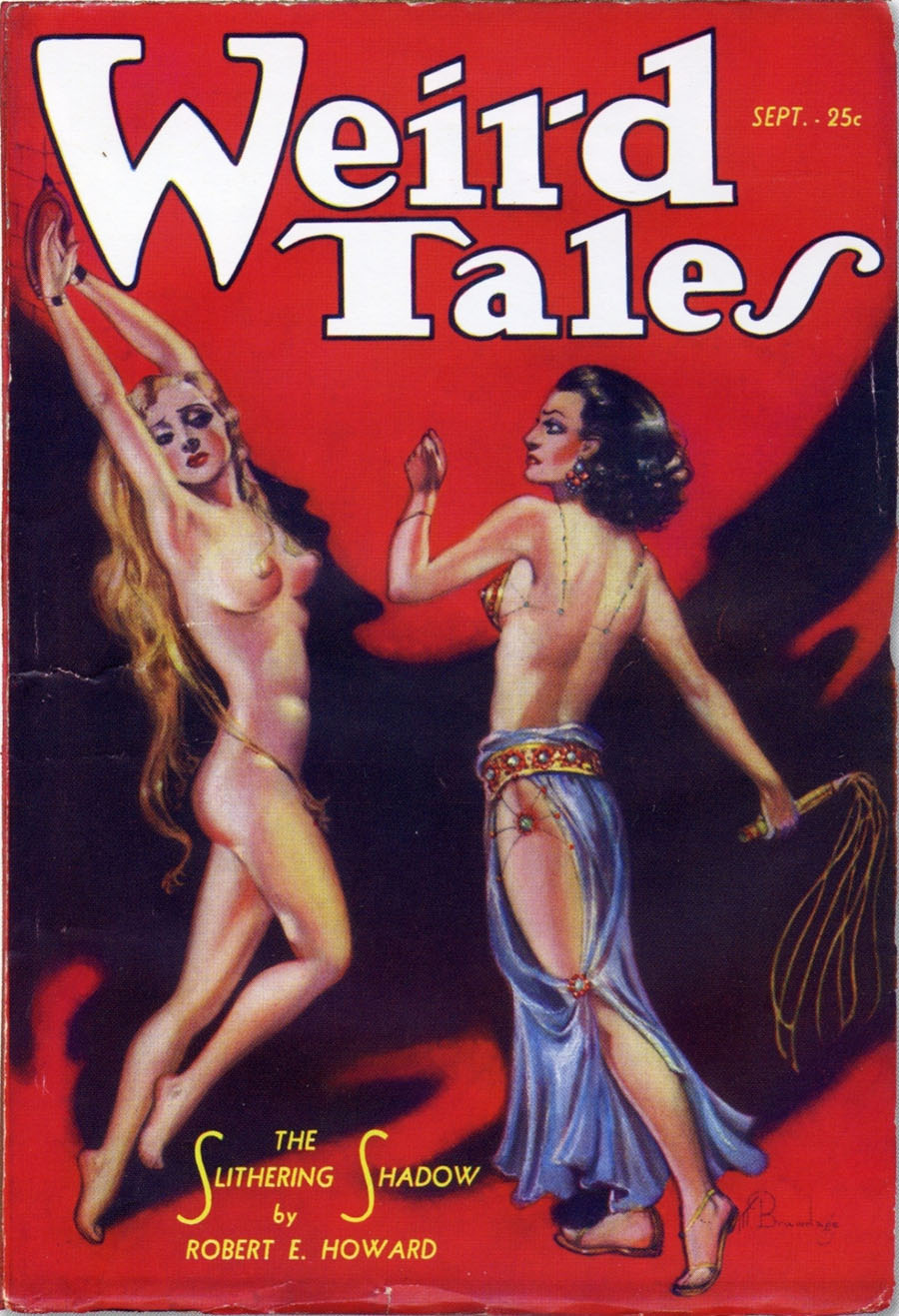
This is not Jirel, but Tamaris and Salome, the twin sisters at the heart of Robert E. Howard's "A Witch Shall Be Born". Leave it to Margaret Brundage to ignore one of the most iconic scenes in the entire Conan canon - Conan crucified in the desert - to draw two attractive women fighting.

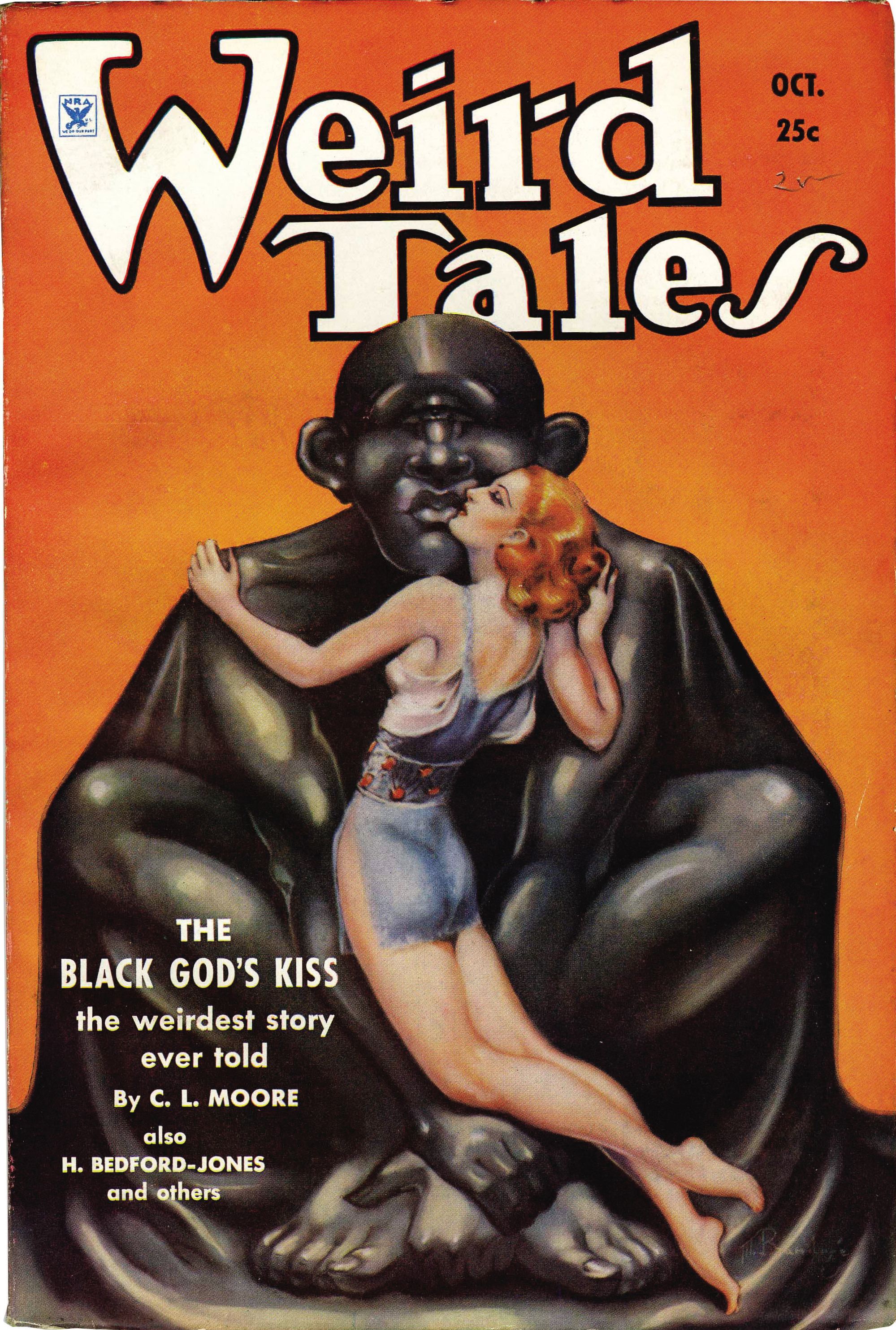
My last post was a review of "Black God's Kiss" by C.L. Moore, the story that introduced the swordswoman Jirel of Joiry to the world. So it's only fitting that I review the direct sequel, "Black God's Shadow", too. The sword and sorcery novelette "Black God's Shadow" appeared in the December 1934 issue of Weird Tales, two months after the original story. Coincidentally, that issue also contains plenty of letters responding to "Black God's Kiss". The story may be read online here.

Warning: Spoilers beyond this point! Also trigger warning for discussion of sexual violence.

"Black God's Shadow" takes place a few weeks or even months after "Black God's Kiss". Our heroine Jirel of Joiry is still haunted by the events in the previous story and it shows. She's having trouble sleeping and she still has flashbacks to enemy knight Guillaume forcibly kissing her in the famous opening scene of "Black God's Kiss". The ongoing flashbacks all but confirm what I said in the review of the previous story, namely that the kiss is a stand-in for a far more serious sexual assault, because Jirel's reactions are those of a rape survivor. And just case there was any doubt, Jirel explicitly states that she always used to boast that her fortress would never fall (which can be read both literally and metaphorically) and that no lover would dare lay hands on her except in answer to her smile. Of course, today's heroines would offer a more enthusiastic form of consent than a smile, but nonetheless it's very clear that Jirel did not consent to being manhandled by Guillaume.

What complicates matters is that Jirel still believes herself to be in love with Guillaume. To complicate matters even more, Jirel also hears Guillaume's voice in her dreams, calling her his murderess (to be fair, Jirel did kill him with a cursed kiss) and begging her to have mercy on his soul. And considering that in life, Guillaume was not at all the begging type, this is certainly something.

From Guillaume's plea from beyond the grave, Jirel deduces that Guillaume is not in hell, as she initially assumed (after all, he died without sacraments, though Father Gervase, who is absent from this story, could have done the honour in "Black God's Kiss"), but trapped in the strange dream dimension that can be accessed from a handy portal in the cellar of castle Joiry. And because Jirel still fancies herself in love with Guillaume and also feels guilty about killing him, she decides to hear his plea and descend into the otherworldly dream dimension once more to free his soul.

We now get a repeat of Jirel descending into the dungeon, opening the portal and further descending the strange spiralling ramp that seems to have been made by giant serpents rather than humans, though there still is no sign of any giant serpents living in Jirel's basement. Once more, Jirel also comes to the point, where she needs to take off her crucifix in order to venture onwards.

Once Jirel has taken off her crucifix, she is in for a shock, because while it was night in the dreamworld last time Jirel visited, it's bright daylight this time around. And since Jirel is convinced that she will go mad, if she sees the strange dreamworld by day, she decides to wait in a cave until nightfall.

But when night finally falls, Jirel is in for another shock, because the landscape outside the cave looks completely different than the last time she visited. The tower of light is gone, instead there is a mighty river flowing through strange misty fields. Not knowing where to go, Jirel decides to follow the faint sound of Guillaume's voice blowing in the wind.

We now get another detailed tour of the wondrous sights Jirel encounters in the nightmarish dreamworld. This time around, there are fields in which glowing insects grow, which sting when released. There are monstrous trees with malignant shadows. There are brooks and rivers speaking evil things in a language that is almost understandable. There are disembodied shadows with nothing to cast them. And above it all, a green moon with a face like a decomposing corpse shines in the alien sky.

Jirel eventually finds Guillaume or rather what is left of him. For Guillaume has been turned into a grotesque statue that symbolises all the evil in him. And there was a lot of evil in Guillaume, as Jirel knows only too well. However, chained to the grotesque statue of evil Guillaume is the ghostly form of all that was good and noble in Guillaume, forever forced to reckon with the evil inside himself. Jirel declares that this punishment – confronting Guillaume with the evil inside himself – is both just and enormously unfair.

Nonetheless, Jirel decides to free Guillaume from his predicament and suddenly finds herself under attack by the black god himself. As before, she feels a heavy leaden weight upon her soul, feels her body freezing and turning to ice. But whereas Jirel could save herself before by passing on the black god's curse to Guillaume, there is no way out for her this time. Jirel is doomed. Not long now and she will turn into the same grotesque representation of all that's evil inside her (and Jirel is very much not a saint) as Guillaume.

What saves her in the end is yet another flashback to Guillaume forcing a kiss on her. These flashbacks have been haunting Jirel since the previous story, but now they remind her of her humanity, causing her to fight back against the black god. The darkness and ice that enveloped Jirel slowly retreat, as Jirel sees ghostly forms of herself in different moods and emotions dancing around the grotesque statue that once was Guillaume.

Eventually, Jirel's humanity prevails. The black god retreats and the grotesque statue representing all the evil in Guillaume crumbles to dust. All that's left is Guillaume's disembodied shadow, which now leads Jirel on a mad chase through the dream world.

The battle with the black god repeats twice more. Both times, Jirel suddenly feels herself overcome by despair, her body and soul turning to ice. And both times, what saves her and reminds her that she is human is a flashback to Guillaume forcing a kiss upon her. After the second fight with the black god, Guillaume's shadow vanishes and all that remains is his voice wailing on the wind.

The third and final fight takes place at the black god's temple. There is no statue this time, just murals of twisted and evil figures. And once more, Jirel is saved by the memory of Guillaume's unwanted kiss reminding her of her humanity.

After the third and last fight, Jirel no longer hears Guillaume's voice on the wind, so she assumes that he has finally found peace. She also knows that even though she was able to beat back the black god three times, she can never fully defeat him, because without darkness there can be no light and vice versa. Weary but satisfied, Jirel makes her way back to her castle.


Even though "Black God's Kiss" and "Black God's Shadow" are basically two halves of one long story, "Black God's Shadow" is much less well known than "Black God's Kiss". I suspect the reason is that unlike the previous story, "Black God's Shadow" takes place almost entirely inside the dream world and the battles Jirel fights are entirely psychological. Jirel does use her sword at one point to free herself from a malign tentacled monster tree, but her three duels with the black god all happen only in the mind. Readers looking for sword and sorcery action will be better serves by the Conan story "A Witch Shall Be Born" by Robert E. Howard, which was originally published in the selfsame issue of Weird Tales. And to be fair, it is a good story, though marred by unfortunate antisemitic stereotypes.

The flashbacks to Guillaume's sexual assault that Jirel already experienced in the previous story continue to haunt her throughout "Black God's Shadow". But this time, Jirel's experience of the flashbacks is different. Whereas they only elicited murderous fury in Jirel in the previous story, in this story the flashbacks are what keeps Jirel alive, what allows her to prevail against the black god at least for the time being. During her first battle with the black god, Jirel experiences the flashback as "something that happened to some other woman somewhere far away". Modern psychology would call this dissociation.

Nor is it an accident that what Jirel experiences every time the black god attacks her – the darkness, the leaden heaviness, the despair, the sensation of turning to ice and no longer feeling her body – very much mirrors the symptoms of depression. Jirel's battle with the black god truly is psychological, for what Jirel is battling here is depression.


In the end, the duology of "Black God's Kiss" and "Black God's Shadow" is very much the story of a woman coming to terms with sexual assault. In my review of the previous story, I already argued that the forced kiss in "Black God's Kiss" was a stand-in for the rape that C.L. Moore could not mention in the confines of a 1930s pulp magazine. "Black God's Kiss" chronicles Jirel's reactions immediately after the sexual assault – the flashbacks, the red-hot fury, the grief and the confusion, because her body responded to the man who assaulted her.

"Black God's Shadow" is set several weeks or months later and Jirel's initial anger has been replaced by the leaden heaviness of depression. The flashbacks to the assault still haunt her, but this time Jirel turns them into a weapon against a far more dangerous enemy than Guillaume, namely her own depression. And in the end, she prevails, though she knows that the black god will never be fully beaten, that depression will always be a part of her life.


The story also illustrates how Jirel's image of Guillaume literally changes. In "Black God's Kiss", Guillaume was repeatedly described as magnificent and was also very much an arsehole who has never heard of consent. The version of Guillaume that Jirel encounters in the dream world, first as a statue and later as a shadow, is literally the embodiment of all that is evil in Guillaume, a grotesque and twisted thing. But bound to this grotesque image is a ghostly version of all that is good and noble in Guillaume, a Guillaume who is magnificent, but not an arsehole, a Guillaume whom – so Jirel muses – she never got to know. Jirel even agrees that Guillaume's punishment, being confronted with all the evil inside himself, is both just and unjust. Because regardless of everything Guillaume did to Jirel, there was also good in him.

It's notable that Guillaume, even though he's dead, is portrayed as a much more nuanced character in "Black God's Shadow" than in the previous story. In "Black God's Kiss", Guillaume was either the magnificent knight or the despicable villain who assaulted our heroine with no shades of grey in between. We and Jirel encounter both of these versions of Guillaume again in "Black God's Shadow" in the form of the twisted statue and the ghostly heroic Guillaume, but they are revealed for the caricatures they are. The real Guillaume is somewhere between those two, capable of both good and evil, but still an arsehole.

By the end, it's not just Guillaume's soul that has found peace, it's also Jirel herself. She can now see Guillaume for what he was. She is no longer haunted by flashbacks of his assault nor does she fancy herself in love with him any longer. It's been awhile since I read the other three Jirel of Joiry stories, but I don't recall Guillaume ever being mentioned again. Jirel is over him, one way or another.


The "Black God" duology is a powerful story of a woman experiencing and recovering from sexual assault. In fact, it's so powerful that I wonder whether C.L. Moore had any experience with the subject, whether it happened to her or a friend or loved one.

However, considering the subject matter of the story, it's also very clear why the sort of sword and sorcery fans who mainly want action and adventure are not satisfied with the Jirel of Joiry stories. Because psychological insights and metaphors for recovering from trauma are not what these readers want out of sword and sorcery. Which is perfectly fair and if it's action and swordfights you want, well, there's Conan getting crucified in the desert and surviving to wreck vengeance on those responsible right there in the very same issue of Weird Tales.

Nonetheless, it's fascinating that how much internal battles as well as trauma and recovering from trauma are baked into the sword and sorcery genre, which is something that I at least never quite realised before. Because Jirel is far from the only sword and sorcery heroine who experienced and recovered from trauma.


Let's take a look at Fritz Leiber's Fafhrd and Grey Mouser. In "Ill Met in Lankhmar", an absolutely brilliant story and probably the best Hugo winner for Best Novella of all time (and yes, I will eventually review it), Fafhrd and Grey Mouser meet the most important person in their lives, namely each other, on the same day they lose everything – the lives they only just made for themselves and the women they love or at least think they love – for the second time in the space of a few months. What makes the situation even worse is that Fafhrd and Grey Mouser are trying to help their girlfriends overcome their own trauma – the brutal murder of her friend and partner in crime in the case of Fafhrd's lover Vlana and growing up with an abusive father (at the very least physical abuse and there are hints at sexual abuse as well) in the case of Mouser's girlfriend Ivrian – and cause their deaths in the process. And Fafhrd and Grey Mouser are deeply traumatised by that experience. They will be haunted – quite literally – by the ghosts of their murdered lovers for years, even as they live on, having great adventures and living largely satisfying lives. They also face down the literal Death – as well as their murdered lovers – in Death's realm several times.

What makes the Fafhrd and Grey Mouser stories so fascinating is that Fritz Leiber kept returning to the characters and writing stories about them for a period for fifty years, longer than any other sword and sorcery author. Leiber bridged the first sword of sorcery boom of the 1930s and the second boom of the 1960s and kept writing into the third sword and sorcery boom of the 1980s – the only of the original sword and sorcery authors to do so, since Robert E. Howard was dead and C.L. Moore and Clark Ashton Smith had both stopped writing SFF. Over this almost fifty year span, the Fafhrd and Grey Mouser stories demonstrated both how the SFF genre changed, for example with regard to how much sexual content was acceptable, but also how the characters themselves and Leiber's insight into them changed.


"Ill Met in Lankhmar" was published in 1970, shortly after Fritz Leiber lost his wife of more than thirty years. The grief Fafhrd and Grey Mouser experience is so relatable, because their author shared it. And indeed, the Fafhrd and Grey Mouser stories written during the early 1970s are all on the gloomy and depressing side, showing both the characters and their author dealing and coming to terms with their grief. Leiber eventually came out on the other side and so did Fafhrd and Grey Mouser. They both found partners who fit them and were willing to put up with the fact that you only get Fafhrd and Grey Mouser as a duo, they both learned they had children they never knew about plus the possibility of more children in the future, they both ended their story in a good place. And so I think, did their author.


The early 1970s streak of dark and depressing Fafhrd and Grey Mouser stories is very noticeable, when reading the series in order, but it's not the only time during their lengthy career that Fafhrd and Grey Mouser dealt with trauma. Their respective origin stories, "The Snow Women" from 1970 and "The Unholy Grail" from 1962, are both stories of trauma and escaping from it, an overbearing mother and an absent and idealised father in Fafhrd's case, and the murder of his mentor in Mouser's case. Indeed, there are parallels between "The Unholy Grail" and the "Black God" duology, because Mouser is also willing to risk his soul to avenge himself on the murderer of his mentor and he also defeats his enemy in a purely psychic battle (by pure necessity, because Mouser is bound to a rack, about to be tortured to death, at the time and also not yet all that great as a swordsman). Other Fafhrd and Grey Mouser stories that deal with trauma and overcoming it (or succumbing to it) include "The Cloud of Hate" from 1963 as well as "The Bleak Shore" and "The Howling Tower" from 1940 and 1941 respectively, which are among the earliest stories in the series. Just like Jirel and Guillaume, Fafhrd and Grey Mouser also come face to face with the not so good aspects of themselves (and their lovers) at several points during the series.

So what about other sword and sorcery heroes? Well, Michael Moorcock's Elric of Melniboné is often so gloomy and depressed that he makes Henning Mankell's Kurt Wallander, surely one of the most depressed characters in popular fiction, seem cheerful. Karl Edward Wagner's Kane is the most anti-hero of sword and sorcery heroes anyway. As for Robert E. Howard, he certainly knew the black god of depression and the shadow of that black god only too well – with devastating results. Conan, Kull, Bran Mak Morn and Solomon Kane never deal as directly with their author's demons as Jirel and Fafhrd and Grey Mouser do – though Conan is crucified in "A Witch Shall Be Born", the novella that was published in the same issue of Weird Tales as "Black God's Shadow", and if that isn't a very metaphorical fate I don't know what is – but I can't help but wonder what stories Howard would have written, if he had lived. I can't say much about Clark Ashton Smith, because I bounced hard off his work, when I tried to read it many years ago. I should probably give him another try.


It's been long since clear to me that sword and sorcery is much more than just muscular men and women with broadswords having adventures. However, until I reread the first two Jirel of Joiry stories, I never fully realised how much the sword and sorcery genre is also about dealing with and overcoming trauma and grief. But the theme is there in many of the important works of the genre. And indeed, I wonder whether these deeper themes aren't what separates the great and memorable sword and sorcery characters from Conan pastiches like John Jakes' Brak the Barbarian, Clifford Ball's sorry attempts at replacing Robert E. Howard and the many forgettable sword and sorcery novels of the 1980s. It's certainly something I will keep in mind for my own contributions to the genre.

Fritz Leiber was almost sixty when he wrote "Ill Met in Lankhmar" and revealed the formative trauma that lies at the heart of the story of Fafhrd and Grey Mouser. Robert E. Howard never got there, before his own depression claimed him, and part of me is still angry that his friends and loved ones and modern medicine couldn't save him, if only because I mourn the stories he could have written, if he'd lived to experience the sword and sorcery revival of the 1960s.

C.L. Moore, on the other hand, wrote about trauma and recovering from it at age 23. And that makes her one of the greats of a genre that is so much more than just heroes and heroines with big muscles and bigger swords.


Friday, 31 July 2020

Some Thoughts on the 1945 Retro Hugo Winners

The winners of the 1945 Retro Hugos have been announced as well as the winners of the 2020 Sir Julius Vogel Awards. The indefatigable Nicholas Whyte also shares some additional information about the Retro Hugos as well as the full voting and nominations breakdown. Also check out the comments at File 770, where there is a lively discussion going on.
So let's take a look at the individual categories:


Best Novel


Shadow Over Mars a.k.a. The Nemesis from Terra by Leigh Brackett wins Best Novel. I'm really happy about this, because Leigh Brackett is one of the greats of our genre and was never recognised by the Hugos in her lifetime, though she did win a posthumous Best Dramatic Presentation Hugo for The Empire Strikes Back.

That said, I had expected that Sirius by Olaf Stapledon would win, because it is better known. But I guess Stapledon is too Marmite to win. I'm a bit surprised that The Wind on the Moon by Eric Linklater finished in last place, because it is a charming story - unlike the tedious Winged Man.


Best Novella


"Killdozer" by Theodore Sturgeon wins Best Novella. This isn't a big surprise, because "Killdozer" is the best known story nominated, though it's not the best story, because "The Jewel of Bas" by Leigh Brackett and "A God Named Kroo" by Henry Kuttner were both better. However, the Retro Hugos are still often determined by name recognition and nostalgia and the efforts of myself and others to change this have only met with mixed success.

That said, it's a pity that "A God Named Kroo" only barely beat "No Award", coming in fifth after the unreadable "Trog" and the Van Vogt novella I didn't get around to reviewing, because I can only tolerate so much Van Vogt.


Best Novelette


The 1945 Retro Hugo for Best Novelette goes to "City" by Clifford D. Simak. This isn't a huge surprise, because the City cycle is well regarded, still in print and Clifford D. Simak was one of the best writers of the Golden Age. "City" is a pretty good story, too, though not the best City story of 1944 or even the best City novelette, because "Census", which didn't make the ballot, is better.

That said, this was not the category I wanted to see Simak win. In fact, I was hoping that C.L. Moore, either with or without Henry Kuttner, would win Best Novelette, because both "No Woman Born" (which finished second) and "The Children's Hour" (which finished unfairly in sixth place) are great stories.

Though I'm glad that "Arena" by Fredric Brown with its "Genocide is good" message didn't win, because I feared that it might.

Best Short Story


The winner of the 1945 Retro Hugo for Best Short Story is "I, Rocket" by Ray Bradbury. I have to confess that this win surprised me, because not only was "I, Rocket" not the best story on the ballot - it's a fine story, but "Desertion" by Clifford D. Simak is much better - it's not even the best Ray Bradbury story of 1944, because both "The Lake" (which is a classic that has been reprinted lots of times) and the vastly underrated "Morgue Ship" are better. I also have no idea why Retro Hugo voters nominated "I, Rocket" over "The Lake", though I have no illusions that anybody except me nominated "Morgue Ship". I'm a bit surprised that "Far Centaurus" by A.E. van Vogt finished in last place, because this is the one van Vogt story on the ballot that's actually good.


Best Series


The Retro Hugo for Best Series goes to the Cthulhu Mythos by H.P. Lovecraft, August Derleth (via whose stories the mythos qualified seven years after Lovecraft's death) and many, many others.

There were some complaints about the renown racist H.P. Lovecraft winning a Retro Hugo in 2020. And while I didn't put the Cthulhu Mythos in first or even second place - my number one was Captain Future who was one of my entry drugs into science fiction - I'm not surprised that it won. Because of all the nominated series, the Cthulhu Mythos is the only one which is still going strong - 83 years after the death of the original author. Also, I don't view this solely as a win for H.P. Lovecraft, but for everybody who ever wrote a story in the world he created. And this includes authors as diverse as Victor LaValle, Silvia Moreno-Garcia, Ruthanna Emrys, Matt Ruff, Neil Gaiman, Robert Bloch, Fritz Leiber and many, many others, some of whom would have horrified Lovecraft.

So while Lovecraft was undoubtedly a racist, he also created a universe in which many writers have played over the years, often subverting Lovecraft's ideas. So I think we should view this as a vote for the universe and everybody who ever wrote in it in the past ninety year. Cthulhu is an icon - more than the Shadow or Doc Savage, who are damned iconic in themselves - and has his own plush toy, so doesn't he deserve a Hugo?


Best Related Work


The winner of the 1945 Retro Hugo for Best Related Work is "The Science-Fiction Field" by Leigh Brackett. I'm happy that the Retro Hugos have recognised Leigh Brackett not once but twice this year, but I'm still surprised that it won, because "The Science Fiction Field" is probably the most elusive Retro Hugo finalist of 1945.

The essay was originally published in Writer's Digest and isn't available online anywhere. The best way to get it is via Windy City Pulp Stories No. 13, which reprinted it a few years ago. I suspect that the publisher of Windy City Pulp Stories was very surprised about the sudden uptick in interest in his magazine.

That said, it is an interesting essay that offers insight both into Leigh Brackett's writing process and the SFF field as it was in 1944. Who would have guessed that Planet Stories was considered one of the more scientifically accurate publications? There's also a nice jab against John W. Campbell, whom Brackett famously didn't get along with, as well as another jab against Weird Tales and their infamously bad payment practice.


Best Graphic Story or Comic


The winner of the 1945 Retro Hugo Award for Best Graphic Story is the Superman comic “The Mysterious Mr. Mxyztplk” by Jerry Siegel and Joe Shuster.

This is one case where I have no idea what the Retro Hugo voters were thinking. Yes, Superman is an iconic character beloved by many and even Mr. Mxyztplk is apparently a popular character, but have the voters looked at the actual comic? For while it's not as bad as the racist Wonder Woman comic which won last year (and if you voted for that one, don't complain about Campbell and Cthulhu?) it's no more than competent.

My first choice was Flash Gordon, because Alex Raymond was probably the best artist working during the Golden Age and this would have been our last chance to honour him. Instead, the to Flash Gordon strips finished last, even lower than Buck Rogers, which was really, really bad.

Looking at the nominations, it seems as if us Mandrake fans need to settle on one story and we might lift Mandrake and Lothar (who was the first black comic hero 30 years before Black Panther) on the ballot next time. And if the Phantom fans would like to rally to the cause as well, we might still get the full Defenders of the Earth on the ballot.


Best Dramatic Presentation Short


We have two winners in the Best Dramatic Presentation category, The Curse of the Cat People and The Canterville Ghost. Both are fine winners and were my number one and two choices in this category. The Canterville Ghost is only the only Retro Hugo finalist, where someone involved with the production is still alive, namely former child actress Margaret O'Brien, then seven years old. The actress who played the little girl in The Curse of the Cat People unfortunately passed away a few years ago.


Best Editor


The winner of the 1945 Retro Hugo for Best Editor is John W. Campbell, which is not exactly a surprise, even though it did cause some wailing and gnashing of teeth, how people can still vote for Campbell after his name was removed from the Not-a-Hugo for Best New Writer, which is now known as the Astounding Award?

But while I agree that it's not a good idea to name an award for the best new writer of 2020 after a (very problematic) man who died almost fifty years ago, Campbell was the leading figure in the field in the 1940s. And Astounding Science Fiction is still considered the best magazine of the era, even though I for one found that other magazines offered more consistent quality than Astounding, which when it was good, was very good indeed, but which was also truly dreadful, when it was bad.

And indeed, I ranked Dorothy McIlwraith of Weird Tales, W. Scott Peacock of Planet Stories and Raymond Palmer of Amazing Stories above Campbell. Nonetheless, for better or worse, Campbell was one of the most influential figures of our genre, which is why people keep voting for him.

I also suspect that the wins for the Cthulhu Mythos and Campbell prompted the slightly cringeworthy intro by the CoNZealand chairs, in which they talk about how these are works of their time, which may be reactionary today.


Best Professional Artist


The winner of the 1945 Retro Hugo for Best Professional Artist is Margaret Brundage. Now this is one win I'm thrilled about, because Margaret Brundage was not just one of the very few woman artists working during the Golden Age, but also created some absolutely iconic covers for Weird Tales. Margaret Brundage was the first person to picture Conan and Jirel of Joiry (who wears armour rather than lingerie in the story) and who gave us Puritan executions in haute couture gowns (not actually a Solomon Kane cover, though I always assumed it was) as well as the highest selling Weird Tales cover ever. She was also a political radical, taught black children and she was very likely LGBTQ. It's long overdue that the Hugos recognise her work.


Best Fanzine


The 1945 Retro Hugo winner for Best Fanzine is Voice of the Imagi-Nation, edited by Forrest J. Ackerman and Myrtle R. Douglas. This win prompted another round of wailing and gnashing of teeth, because Forrest J. Ackerman was a sexual harrasser. I didn't vote for it either - not just because I prefer to vote for people who are not sexual harrassers, but also because I don't find Voice of the Imagi-Nation very good. There were definitely better fanzines out there in 1944, which were not edited by sexual harrassers.

However, people should also note that Ackerman wasn't even on the ballot for Best Fan Writer this year, a category he used to dominate at the Retro Hugos.

Which brings us to...


Best Fan Writer


The 1945 Best Fan Writer Hugo goes to Fritz Leiber for his contributions to the Lovecraft fanzine The Acolyte. This is the one win where I really think that my Retro Hugo Recommendation Spreadsheet made a difference. Because if I hadn't found a Fritz Leiber short story, an critical essay about Lovecraft and a poem about the Gray Mouser in The Acolyte, following a trail from ISFDB, and had put his name on the spreadsheet, I doubt that many people would have been aware that Leiber was even eligible.

If we take a look at the full nomination data, I see a couple of other places where the spreadsheet and Retro Reviews had an impact. Would Allison V. Harding have made the novelette longlist with two stories, if I hadn't enjoyed "Ride the EL to Doom" so much and shouted about it to the world?

Which brings me to the wailing and gnashing of teeth, which is really just focussed on three winners - Campbell, Cthulhu and Ackerman. And yes, I'm not happy with those wins either.

However, after a few years of complaining about bad Retro Hugo finalists and winners, I decided to do something about it. And so I created the spreadsheet and started Retro Reviews to make it easier for voters/nominators to make informed choices and point them at good works that might otherwise be overlooked. I had a lot of fun, too, and discovered stories I might never have read otherwise. It wasn’t just me either. N helped to track down elusive dramatic presentation and related work finalists. Steve J. Wright, Paul Fraser, Don Briago and others reviewed lots of stories, novels and whole magazines.

So in short, several of us got together to put the information out there about what is eligible (obviously not Dave Langford nine years before he was born), what is worth checking out and shared our thoughts on the finalists. And yes, I wish more people would have looked at our work before voting/nominating, because if you look at the nomination data, you'll see lots of examples of nominations for people and works, which are flat out ineligible. If the voters and nominators don’t pay attention to this in sufficient numbers, there’s little we can do about it.

As for the people complaining about Retro Hugos for Campbell, Cthulhu and Forrest J. Ackerman, did you nominate and vote? Did you point out better choices? Did you point people to unjustly forgotten authors/editors/fan writers? If not, then don’t complain.

Saturday, 29 February 2020

Retro Review Links for February 29, 2020

Welcome to the latest edition of Retro Review Links, where I link to reviews of 1945 Retro Hugo eligible works by other bloggers:

Magazine reviews:

Novel reviews:

Short fiction reviews:

Graphic story reviews:

Dramatic presentation reviews: