Showing posts with label theatre. Show all posts

Monday, 21 November 2022

Retro Review: "In a Dead Man's Shoes" by Harold Markham


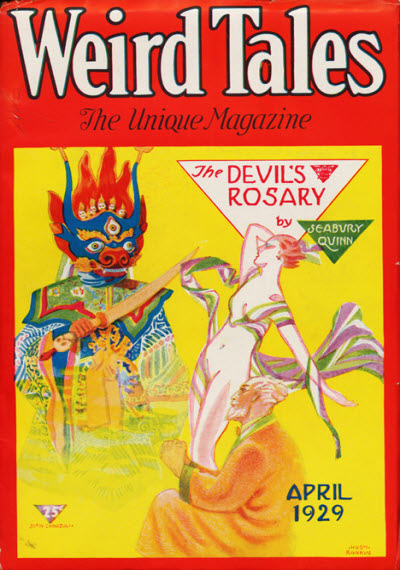
Weird Tales April 1929 

"In a Dead Man's Shoes" is a historical short story by Harold Markham, which was first published in the April 1929 issue of Weird Tales. The story may be found online here.

I came across this story via the striking interior artwork (see below) of an eighteenth century hanging by prolific Weird Tales interior and cover artist Hugh Rankin under his pseudonym Doak (Doak was Rankin's middle name), which intrigued me enough to read the story itself. Rankin also supplied the striking Art Deco cover, illustrating a Seabury Quinn Jules de Grandin story, for this issue of Weird Tales, by the way.

Harold Markham is one of the many pulp era authors about whom we know next to nothing. ISFDB lists only six stories by him, published between 1928 and 1936. Three of those stories were published in British horror anthologies, which leads me to believe that Markham may have been British. The remaining three appeared in Weird Tales.

The Fiction Mags Index lists a few non-fiction pieces by Markham that appeared in Boys' Life and Boy's Own Paper. Several of these non-fiction articles are about amateur theatre and indeed Harold Markham published a manual for staging amateur theatre productions in 1931. There also is a Harold Markham who ran a coconut plantation in the Solomon Islands from the 1930s into the 1960s and was a prolific letter writer and diarist, though it's not clear whether he is the Harold Markham who wrote "In a Dead Man's Shoes".

Warning: There will be spoilers in the following.

"In a Dead Man's Shoes" opens with a bang or rather the slamming of a gavel, as a judge sentences a young man named Jim O'Dale to death for highway robbery. O'Dale is remarkably sanguine about his fate. He readily admits that he is guilty and even boasts of a particularly daring heist, where he robbed a fellow highwayman who had previously robbed the actor David Garrick. David Garrick was a real person, by the way, a famous eighteenth century actor and director of the Drury Lane Theatre.

O'Dale only has three requests for the judge. He asks for a reasonably sober hangman to avoid a botched execution, that a certain lady be allowed to visit him in prison and that his old friend, the innkeeper Jacob Larkyn, come to see him hanged. After all, Larkyn paid for O'Dale's lawyer, though the lawyer never stood a chance in the face of overwhelming evidence. "See ye again at Tyburn," O'Dale calls out to Larkyn in what turns out to be a very ominous statement.

Larkyn has every intention to watch O'Dale's execution, since he was the one who tipped off the authorities and led the Bow Street Runners to O'Dale's hideout. As for why Larkyn sold out his old friend, it's a classic case of "cherchez le femme", since both O'Dale and Larkyn happen to be in love with the same woman, Barbara Challis. However, Barbara chose the handsome O'Dale over the unattractive Larkyn, so Larkyn decided to get his rival out of the way and then console the bereaved Barbara. He even paid for O'Dale's lawyer, because he knew that the evidence against O'Dale was so overwhelming that even the best of lawyers could not save him.

Next, we get the execution of Jim O'Dale at Tyburn, described from Larkyn's POV in grisly detail. We get plenty of description of the jeering, cheering crowd and of the handsome Jim O'Dale being driven to the gallows, dressed in fine new clothes. This is historically accurate, by the way, since condemned prisoners about the be hung in Tyburn would often wear particularly nice clothes to look their best during their execution.

Even on the way to his own hanging, Jim O'Dale is still charming and suave as ever. He doesn't have a dying speech, though he does have a final request. He asks to speak to Jacob Larkyn and asks that his fine and very distinctive shoes with wrought gold buckles be given to Larkyn as a final gift. This is contrary to custom, since the hangman gets the clothes of the executed victims as a sort of bonus, though the resale value is questionable considering that people executed by hanging tend to lose control of their bowels and bladder. However, O'Dale tells the hangman that he can have all his other clothes, including a very fine velvet coat, as long as Larkyn gets the shoes "in memory of what he did for Jim O'Dale".

What makes the shoe request even more strange is that earlier on the same page, it was explained that part of the reason Larkyn hates Jim O'Dale is that O'Dale is handsome and has dainty hands and feet, whereas Larkyn has the big paws and feet of a labourer. So given the difference in their shoe sizes, how will O'Dale's shoes even fit Larkyn?

The hangman agrees to let Larkyn have the shoes and so the execution proper begins. Charming, handsome and debonair as Jim O'Dale was in life, his death is brutal and unpleasant and he struggles a lot, before the hangman tugs on his legs to break his neck, a scene illustrated by Hugh Rankin in the interior art.

Interior art for "In a Dead Man's Shoes" by Hugh Rankin a.k.a. Doak 

The description of the hanging and of Jim O'Dale's twitching, struggling body is not only quite graphic, it is also accurate compared to descriptions of actual short drop hangings. The only thing that is not entirely accurate is that O'Dale is the only person to be hanged that day, since in the eighteenth century multiple prisoners were usually hanged at once. In fact, the description of the hanging was so accurate that I wondered whether Harold Markham had ever witnessed an execution by hanging. This is not completely unlikely, since the last public hanging execution in the US took place in Kentucky in 1936, i.e. seven years after "In a Dead Man's Shoes" was published. The UK no longer had public executions in the twentieth century, but Markham might still have witnessed a hanging in a professional capacity (journalist, lawyer, priest, prison warden) of some kind.

However, twentieth century hangings were long drop hangings, at least in the US and the UK and its former and current colonies. Short drop hangings such as the executions at Tyburn and the resulting violent death struggles were long a thing of the past by the early twentieth century, at least for official executions. Therefore, it's also quite possible that Markham used lurid reports about executions at Tyburn from old broadsheets or the Newgate Calendar as the basis for the graphic description of the hanging of Jim O'Dale.

The hanging of Jim O'Dale is such an unpleasant sight that Larkyn feels a little ashamed for what he's done, especially since he is obliged to wait and watch his rival swinging dead in the wind for an hour, until the body is cut down. We get another nice bit of period detail, as spectators try to snag a piece of a hangman's rope, which was a popular good luck talisman during the era. The hangman also keeps his word and gives Larkyn the late Jim O'Dale's shoes.

A drink at a nearby pub lifts Larkyn's spirit and he even wonders that since parts of the hangman's rope are considered good luck charms, whether O'Dale's shoes will not bring him luck. So Larkyn decides to try on the nice new shoes and lo and behold, they even fit, though they are a little tight.

Now Larkyn goes to see Barbara Challis, hoping to console her in her grief over Jim O'Dale. Barbara, who did not attend the execution, has clearly been crying, but she's also oddly triumphant, as she tells Larkyn that O'Dale asked her to make sure that Larkyn is rewarded for everything he did for them. Again, this sounds rather ominous, but Larkyn is too besotted by the pretty Barbara to notice.

Barbara hugs Larkyn and cries on his shoulder and reveals yet another last wish of Jim O'Dale. For O'Dale did not want Barbara to mourn him, but wanted her to move on. He specifically asked her to go to the Drury Lane Theatre on the night of his hanging to distract herself by watching celebrated actor David Garrett play Hamlet. And since a lady can hardly go to the theatre alone, Barbara asks Larkyn to accompany her. After all, it was Jim O'Dale's last wish.

After the play, Barbara asks Larkyn to take her to the stage door to see the great David Garrett himself. There is a crowd at the stage door, but Larkyn pushed his way through to David Garrett himself and asks the actor to talk to Barbara. Though used to fan requests, Garrett is uncommonly interested in Larkyn and particularly in his shoes – the very distinctive shoes with the gold buckles that Jim O'Dale bequeathed to Larkyn as a final gift.

Turns out that the shoes really belong to David Garrett and were stolen, when Garrett fell victim to a highwayman, a highwayman who was subsequently robbed by Jim O'Dale. Larkyn tries to explain that he came by the shoes honestly, that Jim O'Dale gave them to him, but suddenly Barbara calls out that Larkyn has the shoes, because he was O'Dale's fence and that they will find plenty of more stolen goods hidden in Larkyn's closet.

Now Larkyn finally realises that he has been tricked, but it's too late. He is arrested and taken to Newgate. The story ends with Larkyn having a vision of his own trial and hanging, while Barbara looks on in triumph.

"In a Dead Man's Shoes" is a neat, atmospheric and well-constructed historical crime story. However, even though the story was published in Weird Tales, it is not even remotely supernatural. Larkyn does not fall victim to a vengeful ghost, but to the carefully plotted revenge of Jim O'Dale and Barbara.

This isn't as unusual as you'd think, since Weird Tales did publish quite a few stories in the 1920s that were heavy on torture and physical brutality, but had no supernatural content. "The Copper Bowl" by George Fielding Eliot, published in the December 1928 issue of Weird Tales and reprinted several times since then, is probably the best known example. Even before either genre was fully codified, the lines between horror and thriller were fluid and so stories of non-supernatural horror like "The Copper Bowl" or "In a Dead Man's Shoes" could find a home in Weird Tales.

"The Copper Bowl" hasn't aged well, since it's a yellow peril story and very racist. In fact, I'm stunned that the last reprint of that story was in 2017. Meanwhile, "In a Dead Man's Shoes" has never been reprinted, even though it's a well plotted revenge story and manages to be not grossly offensive.

Indeed, it is notable how well executed (pun fully intended) this story is. Markham never mentions an exact date beyond the reign of George III (which lasted a whopping sixty years), yet Markham weaves plenty of details into the story that evoke the second half of the eighteenth century. The story is also well researched. But then, there was quite a lot of good and well researched historical fiction to be found in the pulps, particularly in Adventure. Sadly, comparatively little of it has been reprinted.

Markham's keen interest in theatre, which is evidenced by the fact that he wrote several articles and a whole book on staging amateur theatre productions, comes through in the story with regard to the David Garrick subplot. Though I wonder whether Garrick was better remembered in the 1920s, since this story was the first I'd heard of him, though I know I inadvertently visited his grave in Poet's Corner in Westminster Abbey.

The revenge plot is well crafted, too, especially considering how short the story is (only seven pages). Many of the utterances of Jim O'Dale and Barbara seem friendly and pleasant on the surface, but take on an ominous double meaning upon rereading the story. Markham also drops in the clue that Jim O'Dale robbed the man who robbed David Garrick into the very first scene in the courtroom and thus sets up the pay-off.

A well-plotted historical crime tale that really deserves more attention than it got.

Friday, 6 March 2020

Retro Review: "No Woman Born" by C.L. Moore


"No Woman Born" is a novelette by C.L. Moore, which was first published in the December 1944 issue of Astounding Science Fiction and is therefore eligible for the 1945 Retro Hugos. The magazine version may be found online here.

Warning: Spoilers beyond this point!

"No Woman Born" opens with a man called John Harris on the way to a vital meeting. Harris was once the manager of an actress named Deirdre, a woman of unparalleled beauty and also a global television star. But then tragedy struck and Deirdre was killed in a theatre fire. But Deirdre isn't dead – or at least not all of her is. For Deirdre's brain has survived the fire and was transplanted into a robot body in an experimental procedure. What can possibly go wrong?

Harris is on his way to meet Deirdre in her new robot body, which has been created by a scientist called Maltzer. Maltzer tells Harris that the procedure was a success and that Deirdre is confident, happy and eager to see him. Furthermore, Deirdre even plans to return to television. Maltzer, however, worries how Harris and the public will react, because Deirdre is no longer the woman she was.

The new Deirdre is a slender golden robot. Instead of a face, she has blank features and a crescent shaped mask of blue glass where her eyes would otherwise be. After an initial shock, Harris quickly accepts that the robot is Deirdre, because the voice sounds like Deirdre's and the robot moves just like Deirdre used to move. Deirdre explains that her brain is controlling her movements and voice and her brain is still the same, even if her body is not. Deirdre also tells him that she is not immortal, even though her robot body theoretically is. But her brain will grow out and eventually die and then her body will just be inanimate metal.

Deirdre is keen to return to the stage and the screen, but Harris is worried. True, to him the robot is Deirdre, because he knew her so very well. And to Maltzer, the robot is Deirdre, because he never knew her before the fire. But how will the public react? Deirdre is confident that they will accept her and even begins to imagine wholly new dance techniques that her new robot body makes possible. Harris is more sceptical.

Deirdre, however, brushes off his doubts. She tells Harris that she has already arranged a performance for that very night, a surprise performance in a variety show. Deirdre wants audiences to see her as she is now without any preconceived notions about her handicaps, because she has none. Deirdre also makes it quite clear that neither Maltzer nor Harris have any say in her decision. For even though Maltzer may have built her new body, Deirdre doesn't belong to him or Harris. Instead, she is her own person.

Maltzer, meanwhile, is vehemently opposed to Deirdre returning to the screen. She has no sex, no sense of taste, smell and touch, Maltzer declares, and those stimuli played an important role in making Deirdre who was. She is no longer human, Maltzer argues. Sooner or later what humanity Deirdre has left will drain out of her. "I wish I'd let her die," Maltzer declares.

Deirdre's first dancing and singing performance after the fire is a huge success and the audience won't stop applauding once they realise who they're watching.

Harris is relieved that everything went so well, but Maltzer is more furious than ever. He insists that the audience may have been surprised now, but once the novelty wears off, they will only laugh at Deirdre. Maltzer also declares that he has to come to know Deirdre better than she knows herself in the year he has been working on her body. Therefore, Maltzer can sense that Deirdre is worried, even if Deirdre herself cannot. He has to put a stop to Deidre's return to TV, Maltzer insists. "I don't think you can stop her," Harris counters. Maltzer insists that he can and throws Harris out.

Neither Harris nor the reader are party to what happens between Deirdre and Maltzer. But when Deirdre calls Harris the next morning, she tells him that she will retire to her house in the country for two weeks to let Maltzer cool down and keep the audiences in suspense.

Once the two weeks are up, Harris meets with Maltzer and Deirdre. Maltzer has completely deteriorated in those two weeks. "I can't stop her," he tells Harris, "There is only one way out."

Harris and the reader quickly learns what that way is, when Maltzer starts rambling about Frankenstein and his creature and how those who bring life into the world unlawfully must pay for it by withdrawing their own. At this point, it's very clear that Maltzer intends to commit suicide by jumping from a window in the highrise where the meeting takes place. But before he goes he begs Deirdre to tell him that she understands him and that she knows that she is not fully human.

Deirdre counters that she knows she has handicaps, but that the audience need never know. She could play Juliet, Deirdre insists, and the audience would accept it. And she's not Frankenstein's monster, thank you very much, she's human. Maltzer did not create Deirdre, he just preserved her life. To prove her point, Deirdre even lights a cigarette and smokes and suddenly seems very human indeed. And then she crosses the room with inhuman speed to rescue Harris from his fatal plunge.

Now Deirdre finally admits that Maltzer does have a point. She is not happy, for she is drifting further and further apart from humanity. But not because Deirdre is less than human, but because she's more than human. The true reason why Deirdre wants to return to the stage is because she wants to remain in contact with humanity. Because by the time her brain dies, she will have explored so many possibilities of her robot body and will have changed so much that she probably truly will no longer be human. She could probably put a stop to this development now, but her human brain is too curious and simply has to explore all the possibilities. Finally, Deirdre is lonely. She knows that her creation was a fluke, a one in a zillion chance. There will never be another like her.


"No Woman Born" is an excellent updating of the Frankenstein story and probably the best story published in Astounding Science Fiction in 1944, though "Desertion" by Clifford D. Simak is excellent as well. Interestingly, both stories tackle the same question. What makes a person human and what happens when a human mind resides in a body that is no longer human and more than human?

The title is a reference to Deirdre, a 1923 novel by Irish writer James Stephens, based on an Irish legend about a woman who was so beautiful that men would fight, go to war, die and go into exile for her. In fact, quotes from the novel are scattered throughout the story. The legendary Deirdre was a tragic heroine, by the way, who saw her husband murdered by a king who wants her for himself and then discards her, when she does not respond as he had hoped. She eventually commits suicide. C.L. Moore's Deirdre makes the opposite choice – she chooses to live and fully explore her more than human life. Though like the Deirdre of Irish legend, Moore's Deirdre is treated like property by the two men in her life. Deirdre repeatedly expresses what she wants, but neither Maltzer nor Harris are listening.

There are other references to literature and legend peppered throughout the story as well. In addition to James Stephens' version of Deirdre, there are also references to Frankenstein, Mary Stuart, whose fate was dramatized in a play by Friedrich Schiller and to the medieval tale of Abelard and Heloise, which ends with Abelard being castrated by Heloise's uncle. Indeed, between "No Woman Born" and the Kuttner/Moore story "The Children's Hour", which is also full of literary references, I can't help but notice that C.L. Moore's stories (and this seems to have been Moore's rather than Kuttner's doing, based on their respective solo stories) assume quite a lot of literary knowledge from their readers.

"No Woman Born" is written in C.L. Moore's typical richly descriptive style. As a result, a scene such as Deirdre's television comeback, which would have taken up a few paragraphs with another writer is three pages long. And since this is an Astounding story, there is of course the requisite infodump, a load of gobbledygook about how Deirdre controls her robotic body via electromagnetism and brainwaves. But since this is a C.L. Moore story, the infodump is much better written than usual.

It's telling that even though Deirdre is the protagonist of the story – which makes "No Woman Born" the fourth story with a female protagonist I have reviewed for the Retro Reviews project* – we only ever see her through the eyes of Harris and to a lesser degree Maltzer. Harris is the sole POV character and throughout the story he oscillates between seeing Deirdre as a human being and the woman he knew and viewing her as a machine and something non-human. Maltzer, meanwhile, makes it very clear that Deirdre is no longer human as far as he is concerned. Deirdre, on the other hand, is not entirely sure if she is still human or not and what she will become in time, but she knows – and repeatedly states – that she is still Deirdre.

The reader, finally, is left to decide for themselves if Deirdre is still human or not and if it even matters. Personally, I quickly found myself siding with Deirdre against the overbearing men Harris and Maltzer who want to make decisions for her and hoped that Deirdre would ditch them and go on to have a splendid career as the world's first robotic TV star. And I for one wouldn't have blamed Deirdre, if she had let that jerk Maltzer jump to his death. But Deirdre saves him, which proves that she is not only human, but probably a better person than I would be in her situation.

"No Woman Born" is also a story about disability. For Deirdre is considered disabled by the two men – indeed her lost senses are repeatedly referred to as handicaps and particularly Maltzer only views her in terms of her limitations. Worse, Maltzer fully believes that Deirdre would be better off dead than disabled. Deirdre, on the other hand, does not consider herself disabled. She's different than she was before, true, but not lesser. She will find ways to compensate for what she lost and may indeed be better than before in some respects. In this, "No Woman Born" also reflects contemporary debates whether disabled athletes have an unfair advantage due to their artificial limbs, when competing against non-disabled athletes. Particularly in its treatment of disability, "No Woman Born" feels remarkably modern and wouldn't feel out of place in one of Uncanny's "Disabled People Destroy SFF" special issues. I could also see it turned into a movie or an episode of Black Mirror with Beyoncé or Janelle Monáe as Deirdre.

In other respects, however, "No Woman Born" is clearly dated. The references to smoking are an obvious example and indeed it is fascinating how completely the SFF authors of the golden age failed to predict that smoking would fall from grace and become viewed as a highly unpleasant and unhealthy habit. Furthermore, the depiction of the entertainment industry in the story is also much closer to the late nineteenth and early twentieth century than to whatever future the story is set in.

For starters, Deirdre loses her original body in a theatre fire. Now theatre fires were to the nineteenth and early twentieth century what nightclub fires are to the second half of the twentieth century, disasters that were both extremely deadly and sadly common, until safety measures improved. The Iroquois Theatre fire in Chicago on December 30, 1903, is the best known and still the deadliest building fire in US history, but there were many more deadly theatre and cinema fires throughout the nineteenth and well into the twentieth century on both sides of the Atlantic. The fires were often caused by stage lights setting flammable decorations and backdrops alight and the victims were often female performers in flammable costumes. Indeed, in the mid nineteenth century so many female ballet dancers died when their gauzy costume caught fire from unprotected gas lights on or behind the stage that contemporary commentators wrote about a "holocaust of ballerinas". And even though most of those fires happened before C.L. Moore was born, they nonetheless still lingered in the public consciousness, so a theatre fire would have seemed like a likely cause of death or injury for an actress and dancer to readers in 1944.

Even though Deirdre is a television star – and it is interesting that Moore expected that television would produce more global stars than film and theatre, even though television was intensely local until the 1990s and it is only in the past ten years or so that people around the world can actually watch the same show at the same time – her performances are closer to what could be seen in Broadway theatres in the early twentieth century.

The lead-in to Deirdre's comeback performance is a teleplay version of Mary Queen of Scots, which – given the current boom for Tudor historicals – would not feel out of place on HBO or Netflix. Though it is interesting that C.L. Moore notes that the costumes are far from historical and instead reflect contemporary fashions and that the actresses playing Mary Stuart are inevitably young, even though the historical Mary was middle-aged when she was executed. This description certainly matches the two Mary Stuart movies, which came out a few years before, the 1936 Hollywood movie Mary of Scotland starring the then 29-year-old Katharine Hepburn and the 1940 German movie Das Herz der Königin (The Heart of the Queen) starring the then 33-year-old Zarah Leander. It's unlikely that C.L. Moore saw the latter film, though the description of the gown worn by the TV actress during the execution scene brings to mind Zarah Leander's stunning pearl-studded gown in The Heart of a Queen, where the executioner neatly rips off the high collar to reveal a perfect ballgown neckline. Katharine Hepburn, meanwhile, goes to the scaffold in a Walter Plunkett designed gown with a collar so high it will surely mess up the executioner's aim.

Meanwhile, Deirdre makes her robotic debut in a vaudeville show, even though vaudeville was already in deep decline by the 1940s. However, it would experience a revival of sorts in the form of variety shows on the radio and later television. The description of the dance numbers – both Deirdre's and those of a troupe of nameless dancers – is pure Busby Berkeley, while Deirdre's robot body is very Art Deco.

The entertainment world in which Deirdre became a star may have very little to do with what television looks like in the twenty-first century, but the mix of classical plays and variety shows, both performed in front of a live audience, is remarkably close to what early television looked like, even though television would only become widespread a few years after "No Woman Born" was written.

But even if the depictions of the entertainment world are dated, the questions raised by "No Woman Born" about what it means to be human are timeless. Next to "Shambleau" and "Black God's Kiss", this is probably C.L. Moore's most famous and most reprinted story and with good reason, too. "No Woman Born" is a great story and would make a highly deserving Retro Hugo finalist.


*The other stories with female protagonists are "Undersea Guardians" by Ray Bradbury, "The Gothic Window" by Dorothy Quick and "Hoofs" by Manly Wade Wellman.