Showing posts with label weird fiction. Show all posts

Saturday, 26 November 2022

Retro Review: "The Hanging of Alfred Wadham" by E.F. Benson


Weird Tales August 1929


"The Hanging of Alfred Wadham" is a short story by E.F. Benson, which was first published in the December 1928 issue of the magazine Britannia and reprinted in the August 1929 issue of Weird Tales. The story may be found online here. This review will also be crossposted to Retro Science Fiction Reviews.

This story is another one which caught my eye via Hugh Rankin's striking interior art under his Doak pseudonym (Doak was Rankin's middle name). For some reason, Rankin did several drawings of hangings and executions under the Doak name, such as the interior art for "In a Dead Man's Shoes", which I reviewed recently. As before, Rankin also supplied to striking Art Deco cover art for this issue, illustrating the The Inn of Terror by Gaston LeRoux.

Hugh Rankin's interior art for "The Hanging of Alfred Wadham"

Though the standout story in this issue is not the cover story, but "The Shadow Kingdom" by Robert E. Howard, the story which introduced Kull of Atlantis as well as the Serpent Men to the world and is widely considered to be the first sword and sorcery story. I should probably do a Retro Review of that story eventually, especially since it's also a very good story.

Many authors who published in the pulps are completely forgotten these days and we know little to nothing about them. I feared this might be the case with E.F. Benson, but on the contrary, Benson was actually a very well-known British writer from a family of well-known people. His father was the Archbishop of Canterbury, one of his brothers wrote the words to "Land of Hope and Glory", another brother was also a writer as well as a priest and his sister was a writer and Egyptologist. To make matters even more impressive, E.F. Benson was a member of the Order of the British Empire. He was also gay and by necessity, given the time during which he lived, closeted.
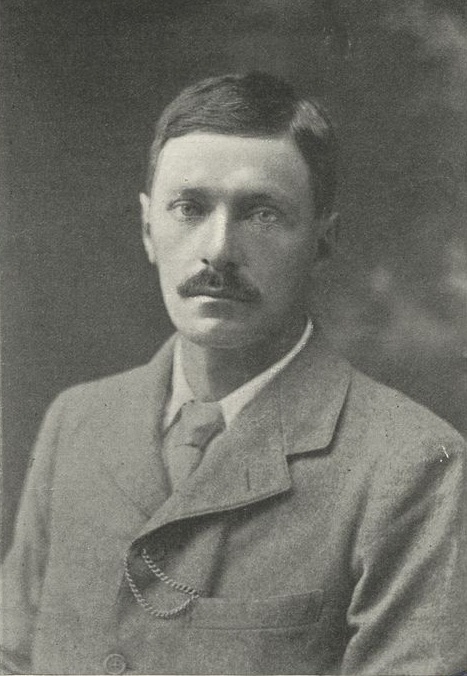
E.F. Benson

Benson's most famous work is the Mapp and Lucia series, a series of satirical novels about upper class people in a small town and their petty rivalries. I have to admit that I have never heard of those books, even though they spawned several sequels by other authors, two TV-adaptations, including one as late as 2014, and a lobster dish.

In addition to satirical novels about upper class people being jerks, Benson also wrote a lot of ghost stories and this is what brought him to the attention of H.P. Lovecraft, who wrote admiringly about Benson's work in "Supernatural Horror in Literature", and finally to Weird Tales.

But enough about the man. Let's talk about the story.

Warning! Spoilers beyond this point!

Compared to the other 1929 Weird Tales story featuring a hanging and interior art by Hugh Rankin, "The Hanging of Alfred Wadham" starts off slow with the unnamed first person narrator discussing a séance he attended with one Father Denys Hanbury. The medium conveyed some messages from a recently deceased friend of the narrator and the narrator is certain that the séance proves something, though whether it is communication with the dead or telepathy he is not sure. Father Denys, true to his profession, believes communication with the dead and impossible or demonic, though he is remarkably open-minded with regard to telepathy.

The narrator then explains that the medium talked about something that she could not have gotten from his mind, because the narrator did not know about it, but which was later confirmed by the dead friend's diary. Father Denys, however, still believes that communication with the dead is dangerous and shares a story of his own.

Such "take within a tale" framing devices were very common in the nineteenth and early twentieth century and pop up quite often in Weird Tales. What is notable about this one is that it's not only dull – we only ever get vague details about séance and what the medium said – but also written in a very stilted style. The (male) narrator also spends two paragraphs describing the beautiful hands of Father Denys. Even if I didn't know by this point that E.F. Benson was gay, that paragraph pretty much confirms it.
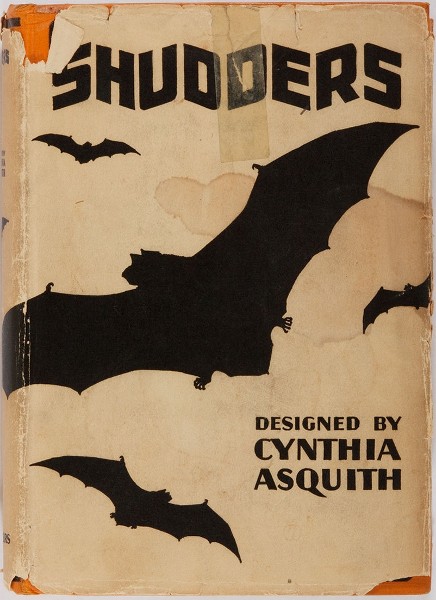
Shudders, edited by Cynthia Asquith

Once Father Denys of the beautiful hands starts his story, I hoped things were finally about to get good. Alas, Father Denys, who is a Catholic priest by the way, starts rambling on about the sacrament of confession, why it is important and why a priest may never ever repeat anything he heard in confession, even if remaining silent will have terrible consequences.

Next, we get an description of the crime allegedly committed by the titular Alfred Wadham. Alfred Wadham was the manservant of a "man of loose life" named Gerald Selfe. That "loose life" was the fact that Selfe was having an affair with a married woman. Someone found out about the affair and started blackmailing Selfe. Selfe went to the police, who investigated the case and quickly zeroed in on Alfred Wadham as a suspect.

The police have set a trap for Wadham, when Selfe is found with his throat slit one morning. Wadham is gone, but stains of human blood are found in his room. The police quickly apprehend him. Wadham proclaims his innocence of the murder, though he does admit to the blackmailing. Wadham declares that he realised that Selfe and the police were on to him and therefore fled. Alas, the judge and jury don't believe him and so Wadham is sentenced to death for murder.

Wadham is Catholic and so he meets Father Denys, who just happens to be the prison chaplain. True to his profession, Father Denys urges Wadham to confess to the murder and repent, but Wadham keeps insisting that he didn't do it. Since Wadham confesses plenty of other sins and crimes, Father Denys starts to believe him.

Father Denys is troubled by this case – not because an innocent man is about to be executed, but because he is not sure whether he should grant Wadham absolution for his other sins, since Wadham flat out refuses to confess to the murder.

More Spook Stories by E.F. Benson

Now it's worth remembering that E.F. Benson's father was an Anglican clergyman and Archbishop of Canterbury and that one of his brothers was an Anglican priest who converted to Catholicism, became a Catholic priest and wrote religious texts, so I probably shouldn't be surprised to see a theological argument in a story written by someone from such a background. However, as I've repeatedly said, I'm not religious, I dislike too much religion in my fiction and theological arguments literally make my eyes glaze over. And in this particular case, I had even less patience for theological arguments, because Alfred Wadham is about to be hanged for a crime he probably didn't commit, so who cares whether a priest absolves him from his sins or not? Never mind that granting absolution for sins is part of Father Denys' job.

On the night before the execution of Wadham, an former acquaintance named Horace Kennion visits Father Denys. Father Denys wants nothing to do with Kennion, because Kennion is a wicked man – more wicked than usual, because Father Denys reminds us that all humans are wicked and that "the life of us all is a tissue of misdeeds". Father Denys' hands must be very beautiful indeed for the narrator to willingly hang out with such a killjoy.

However, Kennion is very insistent to speak to Father Denys, because he needs to make a confession right now and his usual priest is not available. So Father Denys reluctantly hears his confession. Surprise: Kennion is the one who killed Gerald Selfe over a quarrel about a game of cards (though there was no mention of cards or a card table in the earlier description of the crime scene). After stabbing Selfe, Kennion went up to Wadham's room (Selfe had rung for Wadham earlier, but Wadham had already left, so Kennion knew the room would be empty) to wash off the blood – that's how the blood stains came to be found in Wadham's room.

Father Denys of course immediately entreats Kennion to go to the police and confess, so Wadham can be saved. However, Kennion has no intention of going to the police. And when Father Denys threatens that he will call the police, Kennion just grins and points out that he can't, because his faith forbids it. And besides, who would believe a priest who violated to sacrament of confession?

Father Denys now demands why Kennion felt the need to confess his sins at all and why to him specifically. Once again Kennion grins and tells Father Denys that he was very hurt when Father Denys broke off all contact with Kennion. And so he decided to get revenge by putting Father Denys in a terrible situation where there are no good choices. "I daresay I've got Sadie tastes, too, and they are being wonderfully indulged," Kennion says.

The Benson brothers
These are not actually the characters from this story, but E.F. Benson (on the right) and his brothers Arthur Christopher Benson (on the left, wrote the lyrics to "Land of Hope and Glory") and Robert Hugh Benson (the priest).

Now the vibes that I get from this exchange is that Father Denys and Kennion were lovers and that there may well have been some kink involved. But then Father Denys broke off the relationship and Kennion wants revenge. It's also notable that Kennion calls Father Denys by his first name, something which was extremely uncommon among upper class British men in the early twentieth century. Even Kennion's disdain for the doomed Alfred Wadham and his claim that Wadham has it coming for his other crimes – "Blackmail is a disgusting offence" – fits in with this, because gay men were often the target of blackmailers, back when gay relationships were still illegal. In fact, I wonder whether Kennion and his victim Gerald Selfe did not have a relationship, too. After all, it is explicitly stated that Kennion went up to Selfe's room.

I have to admit that though he is a murderer (double murderer to be exact) and generally horrible person, Horace Kennion is the most interesting character in this story. The narrator is a cypher, the victim Gerald Selfe is merely a prop required to get the story going and Alfred Wadham is more moral dilemma than character. As for Father Denys, he is an insufferably sanctimonious prick.

Case in point: Father Denys spends a few paragraphs detailing the terrible torment and suffering he experiences – a suffering that is not even "a needful and salutary experience to burn his sins away", but empty torment. Meanwhile, the actual victim here is not the moping priest with a crisis of conscience, but Alfred Wadham who is about to be executed for a crime he did not commit.

Though at least Father Denys does take some action rather than just sit around feeling sorry for himself. First, he goes to see the Cardinal, who basically tells him that he cannot violate the seal of confession. Then he goes to see the Home Secretary and tells him that Wadham is innocent, because the real murderer just confessed to him.

The Home Secretary is sympathetic, but tells Father Denys that he cannot pardon Wadham without more evidence. He also tells Father Denys to put the fear of God into the real murder to get him to confess and also gives the priest his phone number, just in case.

However, Father Denys doesn't need the phone number, because instead of putting the heat on Kennion, he goes straight to the prison, tells Wadham that he believes in his innocence and finally grants him absolution for all his other sins. Then we learn that Wadham went without flinching to his death. There is also a brief one sentence description of the trapdoor opening and the rope jumping and creaking. But otherwise, the hanging that Hugh Rankin drew so evocatively happens mostly off page.

This is rather disappointing, particularly compared to the visceral description of a hanging in Harold Markham's story "In a Dead Man's Shoes", published a few months before in the April 1929 issue of Weird Tales. Of course, Markham was describing a public hanging in the eighteenth century rather than a prison hanging in the early twentieth century, but there are plenty of much more evocative descriptions of twentieth century prison hanging than the single sentence that Benson gives us.

But then, the story isn't really about the hanging of Alfred Wadham at all, in spite of the title. It is about Father Denys and his moral dilemma. And now Father Denys finally comes to the point of his tale, namely why séances are bad and do not convey messages from the dead, but from some "evil and awful power impersonating them".

 After the execution, Father Denys goes home and Benson gives us more description of the weather than of the actual execution. However, mostly we get yet more musings from Father Denys. Even though he has just watched a man been hanged for a crime he did not commit, Father Denys feels serene and peaceful. After all, in Father Denys' view, it doesn't much matter that Alfred Wadham was hanged. After all, he had all his sins forgiven and still has his immortal soul and getting hanged for a crime he didn't commit is just like martyrdom.

Meanwhile, Father Denys makes it clear that the most important thing to him is that he kept his precious vow and did not commit the worst crime a Catholic priest can commit. This was the moment where I went from, "What sanctimonious bore" to "What a fucking arsehole – I hope something awful happens to him." Thankfully, something does.

Once he gets home, Father Denys lies down for a nap – after all, he has been up all night. He has a bad dream of Wadham screaming at him and begging him to save him. He wakes up to the sound of someone calling his name in Wadham's voice. Yes, apparently Wadham has returned to haunt Father Denys and highly deserved it is, too. Honestly, Wadham, haunt the shit out of that jerk of a priest.

Father Denys now keeps hearing Wadham calling his name, he feels Wadham's presence. he sees him on the street and once sees Wadham's body swinging in the wind outside his window, which is the scene Hugh Rankin's interior actually illustrates.

The haunting of Father Denys – which would be a much better title for this story, come to think of it – culminates when he sees Wadham – with the noose round his neck, face purple and eyes protruding – sitting in a pew at the front of the church, while Father Denys is preaching. However, Father Denys is still convinced that he made the right choice and concludes that the one sending the apparitions is the devil rather than one very pissed off ghost.

The story ends with the ghost of Alfred Wadham – or the devil pretending to be the ghost of Alfred Wadham – reappearing in front of the narrator's and Father Denys' eyes. We get some nice, if conventional description of a ghostly apparition such as the room growing chill and the lights turning dim and then we get a manifestation of Alfred Wadham's hanged body, complete with swollen and purple face and lolling tongue. Alas, Father Denys wards off the evil spirit with his crucifix and appears radiant as he has never seen another human being before to the smitten narrator.

Finally, almost as an afterthought, almost as if Benson had forgotten that Father Denys couldn't possibly tell this whole story to the narrator without breaking his vow, Father Denys reveals that Horace Kennion committed suicide that morning and that he left a full confession behind, which is why Father Denys is no longer bound by the seal of confession and can share his story with the narrator.
 

I have read a lot of stories from Weird Tales over the years, both for the Retro Reviews project or in general. But "The Hanging of Alfred Wadham" is definitely the worst Weird Tales story I have read to date.

This is a pity, because the seeds for a good story are all here. The scenario of a priest who hears about a crime during confession and struggles to find a way to expose the criminal or prevent the crime without violating the seal of confession is a well-worn one, but it can work, when done correctly. The fact that Alfred Wadham will be executed, if Father Denys can't find a way to bring Kennion to justice adds a ticking clock to the proceedings. This scenario might have made for a neat thriller – and indeed there have been many thrillers with this exact premise. Alfred Hitchcock's 1953 movie I Confess, which in turn is based on a French play from 1902, is probably the most famous example, but there are several others.

However, this isn't the story that Benson told. Of course, the story of a priest haunted by the ghost of an executed man he could have saved by breaking the seal of confession, but didn't, might have made for a compelling ghost story as well, but that's not really the story Benson tells either. Or at least, he doesn't tell it very well.

Instead, we get what appears to be a theological argument in the form of a short story. Which is probably my least favourite type of fiction, because as I said above, I'm not religious and theological debates make my eyes glaze over. Plus, I come from a majority Lutheran-Protestant area. And Lutherans, at least in Germany, have massive issues with the Catholic sacrament of confession, which they view as hypocrisy, because you can literally commit a murder and then be forgiven your sins, just because you confessed and said a few prayers. It all goes back to the sales of indulgences, which were one of the issues that caused Martin Luther to nail the ninety-five theses to the door of the Wittenberg castle church.

Of course, it's quite possible that Benson intended "The Hanging of Alfred Wadham" as a critique of the Catholic sacrament of confession and its inherent issues. After all, Benson's father was Archbishop of Canterbury and therefore Anglican, even though one brother converted to Catholicism. And Father Denys is not a likeable character. However, if criticising the issues inherent in the sacrament of confession was Benson's intention, he doesn't do it very well either.

Because "The Hanging of Alfred Wadham" also has massive craft issues. The framing device and the unnamed narrator are completely unnecessary – just let Father Denys narrate the story and maybe end with him seeing Alfred Wadham's executed corpse in the church pew. It would certainly have made for a stronger story.

The murder mystery is also sloppily executed (pun fully intended), because it seems the police ignored crucial clues such as the fact that Selfe and Kennion had played cards and that there was a card table set up, which would suggest that Selfe had a visitor on the night he was killed. The blood stains found in Wadham's room also don't add up. For starters, they're explicitly described as human blood stains, though I have no idea if 1920s forensic science could tell the difference between human and animal blood from a few traces. Also, there are any number of ways the blood could have gotten into Wadham's room such as Wadham accidentally cutting himself while shaving. This may sound nitpicky, but by 1928/29, the so-called Golden Age of Mystery was in full swing, most mysteries were so-called fair play mysteries and plenty of predominantly British authors knew how to plant clues and red herrings. So there is really no excuse for Benson's sloppiness. Read some Agatha Christie or Dorothy Sayers, will you.

The writing style is also stilted, ponderous and dull throughout. "The Hanging of Alfred Wadham" is short, only nine pages, but it feels much longer. Benson also has the tendency to overfocus on Father Denys' internal conflict and underdescribe the murder, the execution and the supernatural events, i.e. the sort of thing Weird Tales readers were probably far more interested in than in a theological argument and a priest's mental torment.

Furthermore, the story also feels very old-fashioned, more like something that might have appeared in the nineteenth century alongside a Sherlock Holmes or Edgar Allan Poe story than something that appeared alongside Robert E. Howard's "The Shadow Kingdom". Of course, Benson was not a young man, but already 61 when this story was published and so his style and sensibilities likely were more Victorian.

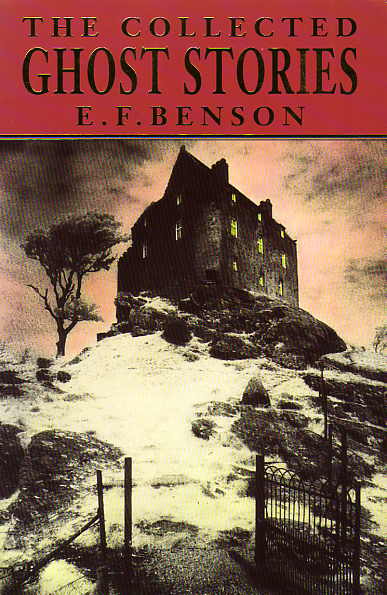
The cover of this fairly recent edition of E.F. Benson's collected ghost stories actually illustrates "The Hanging of Alfed Wadham"

The one thing about this story that is interesting is the glimpse into closeted gay life in the early twentieth century. Because make no mistake, this is a very gay story. Father Denys, the narrator, murderer Horace Kennion and his victim Gerald Selfe are implied to be closeted gay man, while wrongful execution victim turned vengeful ghost Alfred Wadham was a blackmailer who blackmailed men about their indiscretions. And yes, Gerald Selfe's sexual indiscretions are said to have been with a married woman, but I suspect Benson just added that tidbit to make the story more palatable in a world, where LGBTQ themes could only be hinted at.

Another thing that's notable is that this is a fairly rare example of a pulp story that's explicitly religious. Because contrary to what certain folks say, religion in general and Christianity in particular do not play a big role in pulp SFF and pulp fiction in general. Especially in pulp SFF, religion is either a scam or for aliens or it involves sacrificing nubile virgins to Cthulhu. Yes, there are exceptions such as Robert E. Howard's Solomon Kane, but they are few and far between.

And come to think of it, Solomon Kane, Howard's fanatical Puritan avenger and scourge of all that is evil, is a much more interesting and compelling portrait of an intensely religious person in moral distress, though in Kane's case is moral dilemma is that he is a violent man who kills a lot of people, believing himself to be on a mission from God. Only that both Kane's religious and moral  dilemma and his adventures are a lot more exciting and better written than "The Hanging of Alfred Wadham". This is particularly interesting since three Solomon Kane stories, "Red Shadows", "Skulls in the Stars" and "Rattle of Bones" had already been published by the time this story was published. So Weird Tales had already published much variations on the theme of "An intensely religious person is confronted by the supernatural and has their faith tested".

In fact, if you come across explicitly religious SFF from the 1930s and 1940s, it usually hails from Britain and was published outside the pulp magazine ecosystem. C.S. Lewis is probably the best known example, though E.F. Benson also fits the bill. Now I make no secret of the fact that I intensely dislike C.S. Lewis' fiction, but much as Lewis' religious blathering annoys me, there is no doubt that Lewis could write. E.F. Benson, at least based on this example, couldn't.

"The Hanging of Alfred Wadham" was my first exposure to E.F. Benson's work, but based on this story, I certainly won't go seeking out more of his work. In fact, I am baffled that Benson is famous enough to have a Wikipedia entry, plenty of reprints of his work and film and TV adaptations. Maybe his satirical small town tales are better or maybe this story is just a dud. It definitely is proof that even Weird Tales did publish duds on occasion, though they are still a lot more consistent than other pulp magazines.

If you want a Weird Tales story featuring an execution, read the much superior "In a Dead Man's Shoes" by Harold Markham. If you want a story about an intensely religious person having their faith and personal morality tested by encounters with the supernatural, read Robert E. Howard's Solomon Kane stories. If you want religious blathering but well written, read C.S. Lewis. If you want to read a great story from the August 1929 issue of Weird Tales, read "The Shadow Kingdom" by Robert E. Howard.

But don't bother with "The Hanging of Alfred Wadham", unless you are a fan of E.F. Benson's or really like religious blathering and theological arguments in your fiction or are doing a study of early LGBTQ speculative fiction.

Monday, 21 November 2022

Retro Review: "In a Dead Man's Shoes" by Harold Markham


Weird Tales April 1929 

"In a Dead Man's Shoes" is a historical short story by Harold Markham, which was first published in the April 1929 issue of Weird Tales. The story may be found online here.

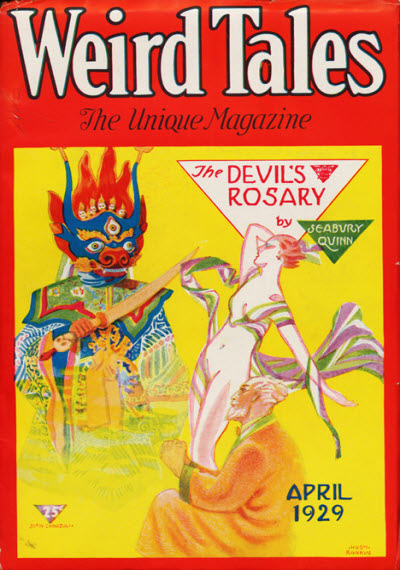
I came across this story via the striking interior artwork (see below) of an eighteenth century hanging by prolific Weird Tales interior and cover artist Hugh Rankin under his pseudonym Doak (Doak was Rankin's middle name), which intrigued me enough to read the story itself. Rankin also supplied the striking Art Deco cover, illustrating a Seabury Quinn Jules de Grandin story, for this issue of Weird Tales, by the way.

Harold Markham is one of the many pulp era authors about whom we know next to nothing. ISFDB lists only six stories by him, published between 1928 and 1936. Three of those stories were published in British horror anthologies, which leads me to believe that Markham may have been British. The remaining three appeared in Weird Tales.

The Fiction Mags Index lists a few non-fiction pieces by Markham that appeared in Boys' Life and Boy's Own Paper. Several of these non-fiction articles are about amateur theatre and indeed Harold Markham published a manual for staging amateur theatre productions in 1931. There also is a Harold Markham who ran a coconut plantation in the Solomon Islands from the 1930s into the 1960s and was a prolific letter writer and diarist, though it's not clear whether he is the Harold Markham who wrote "In a Dead Man's Shoes".

Warning: There will be spoilers in the following.

"In a Dead Man's Shoes" opens with a bang or rather the slamming of a gavel, as a judge sentences a young man named Jim O'Dale to death for highway robbery. O'Dale is remarkably sanguine about his fate. He readily admits that he is guilty and even boasts of a particularly daring heist, where he robbed a fellow highwayman who had previously robbed the actor David Garrick. David Garrick was a real person, by the way, a famous eighteenth century actor and director of the Drury Lane Theatre.

O'Dale only has three requests for the judge. He asks for a reasonably sober hangman to avoid a botched execution, that a certain lady be allowed to visit him in prison and that his old friend, the innkeeper Jacob Larkyn, come to see him hanged. After all, Larkyn paid for O'Dale's lawyer, though the lawyer never stood a chance in the face of overwhelming evidence. "See ye again at Tyburn," O'Dale calls out to Larkyn in what turns out to be a very ominous statement.

Larkyn has every intention to watch O'Dale's execution, since he was the one who tipped off the authorities and led the Bow Street Runners to O'Dale's hideout. As for why Larkyn sold out his old friend, it's a classic case of "cherchez le femme", since both O'Dale and Larkyn happen to be in love with the same woman, Barbara Challis. However, Barbara chose the handsome O'Dale over the unattractive Larkyn, so Larkyn decided to get his rival out of the way and then console the bereaved Barbara. He even paid for O'Dale's lawyer, because he knew that the evidence against O'Dale was so overwhelming that even the best of lawyers could not save him.

Next, we get the execution of Jim O'Dale at Tyburn, described from Larkyn's POV in grisly detail. We get plenty of description of the jeering, cheering crowd and of the handsome Jim O'Dale being driven to the gallows, dressed in fine new clothes. This is historically accurate, by the way, since condemned prisoners about the be hung in Tyburn would often wear particularly nice clothes to look their best during their execution.

Even on the way to his own hanging, Jim O'Dale is still charming and suave as ever. He doesn't have a dying speech, though he does have a final request. He asks to speak to Jacob Larkyn and asks that his fine and very distinctive shoes with wrought gold buckles be given to Larkyn as a final gift. This is contrary to custom, since the hangman gets the clothes of the executed victims as a sort of bonus, though the resale value is questionable considering that people executed by hanging tend to lose control of their bowels and bladder. However, O'Dale tells the hangman that he can have all his other clothes, including a very fine velvet coat, as long as Larkyn gets the shoes "in memory of what he did for Jim O'Dale".

What makes the shoe request even more strange is that earlier on the same page, it was explained that part of the reason Larkyn hates Jim O'Dale is that O'Dale is handsome and has dainty hands and feet, whereas Larkyn has the big paws and feet of a labourer. So given the difference in their shoe sizes, how will O'Dale's shoes even fit Larkyn?

The hangman agrees to let Larkyn have the shoes and so the execution proper begins. Charming, handsome and debonair as Jim O'Dale was in life, his death is brutal and unpleasant and he struggles a lot, before the hangman tugs on his legs to break his neck, a scene illustrated by Hugh Rankin in the interior art.

Interior art for "In a Dead Man's Shoes" by Hugh Rankin a.k.a. Doak 

The description of the hanging and of Jim O'Dale's twitching, struggling body is not only quite graphic, it is also accurate compared to descriptions of actual short drop hangings. The only thing that is not entirely accurate is that O'Dale is the only person to be hanged that day, since in the eighteenth century multiple prisoners were usually hanged at once. In fact, the description of the hanging was so accurate that I wondered whether Harold Markham had ever witnessed an execution by hanging. This is not completely unlikely, since the last public hanging execution in the US took place in Kentucky in 1936, i.e. seven years after "In a Dead Man's Shoes" was published. The UK no longer had public executions in the twentieth century, but Markham might still have witnessed a hanging in a professional capacity (journalist, lawyer, priest, prison warden) of some kind.

However, twentieth century hangings were long drop hangings, at least in the US and the UK and its former and current colonies. Short drop hangings such as the executions at Tyburn and the resulting violent death struggles were long a thing of the past by the early twentieth century, at least for official executions. Therefore, it's also quite possible that Markham used lurid reports about executions at Tyburn from old broadsheets or the Newgate Calendar as the basis for the graphic description of the hanging of Jim O'Dale.

The hanging of Jim O'Dale is such an unpleasant sight that Larkyn feels a little ashamed for what he's done, especially since he is obliged to wait and watch his rival swinging dead in the wind for an hour, until the body is cut down. We get another nice bit of period detail, as spectators try to snag a piece of a hangman's rope, which was a popular good luck talisman during the era. The hangman also keeps his word and gives Larkyn the late Jim O'Dale's shoes.

A drink at a nearby pub lifts Larkyn's spirit and he even wonders that since parts of the hangman's rope are considered good luck charms, whether O'Dale's shoes will not bring him luck. So Larkyn decides to try on the nice new shoes and lo and behold, they even fit, though they are a little tight.

Now Larkyn goes to see Barbara Challis, hoping to console her in her grief over Jim O'Dale. Barbara, who did not attend the execution, has clearly been crying, but she's also oddly triumphant, as she tells Larkyn that O'Dale asked her to make sure that Larkyn is rewarded for everything he did for them. Again, this sounds rather ominous, but Larkyn is too besotted by the pretty Barbara to notice.

Barbara hugs Larkyn and cries on his shoulder and reveals yet another last wish of Jim O'Dale. For O'Dale did not want Barbara to mourn him, but wanted her to move on. He specifically asked her to go to the Drury Lane Theatre on the night of his hanging to distract herself by watching celebrated actor David Garrett play Hamlet. And since a lady can hardly go to the theatre alone, Barbara asks Larkyn to accompany her. After all, it was Jim O'Dale's last wish.

After the play, Barbara asks Larkyn to take her to the stage door to see the great David Garrett himself. There is a crowd at the stage door, but Larkyn pushed his way through to David Garrett himself and asks the actor to talk to Barbara. Though used to fan requests, Garrett is uncommonly interested in Larkyn and particularly in his shoes – the very distinctive shoes with the gold buckles that Jim O'Dale bequeathed to Larkyn as a final gift.

Turns out that the shoes really belong to David Garrett and were stolen, when Garrett fell victim to a highwayman, a highwayman who was subsequently robbed by Jim O'Dale. Larkyn tries to explain that he came by the shoes honestly, that Jim O'Dale gave them to him, but suddenly Barbara calls out that Larkyn has the shoes, because he was O'Dale's fence and that they will find plenty of more stolen goods hidden in Larkyn's closet.

Now Larkyn finally realises that he has been tricked, but it's too late. He is arrested and taken to Newgate. The story ends with Larkyn having a vision of his own trial and hanging, while Barbara looks on in triumph.

"In a Dead Man's Shoes" is a neat, atmospheric and well-constructed historical crime story. However, even though the story was published in Weird Tales, it is not even remotely supernatural. Larkyn does not fall victim to a vengeful ghost, but to the carefully plotted revenge of Jim O'Dale and Barbara.

This isn't as unusual as you'd think, since Weird Tales did publish quite a few stories in the 1920s that were heavy on torture and physical brutality, but had no supernatural content. "The Copper Bowl" by George Fielding Eliot, published in the December 1928 issue of Weird Tales and reprinted several times since then, is probably the best known example. Even before either genre was fully codified, the lines between horror and thriller were fluid and so stories of non-supernatural horror like "The Copper Bowl" or "In a Dead Man's Shoes" could find a home in Weird Tales.

"The Copper Bowl" hasn't aged well, since it's a yellow peril story and very racist. In fact, I'm stunned that the last reprint of that story was in 2017. Meanwhile, "In a Dead Man's Shoes" has never been reprinted, even though it's a well plotted revenge story and manages to be not grossly offensive.

Indeed, it is notable how well executed (pun fully intended) this story is. Markham never mentions an exact date beyond the reign of George III (which lasted a whopping sixty years), yet Markham weaves plenty of details into the story that evoke the second half of the eighteenth century. The story is also well researched. But then, there was quite a lot of good and well researched historical fiction to be found in the pulps, particularly in Adventure. Sadly, comparatively little of it has been reprinted.

Markham's keen interest in theatre, which is evidenced by the fact that he wrote several articles and a whole book on staging amateur theatre productions, comes through in the story with regard to the David Garrick subplot. Though I wonder whether Garrick was better remembered in the 1920s, since this story was the first I'd heard of him, though I know I inadvertently visited his grave in Poet's Corner in Westminster Abbey.

The revenge plot is well crafted, too, especially considering how short the story is (only seven pages). Many of the utterances of Jim O'Dale and Barbara seem friendly and pleasant on the surface, but take on an ominous double meaning upon rereading the story. Markham also drops in the clue that Jim O'Dale robbed the man who robbed David Garrick into the very first scene in the courtroom and thus sets up the pay-off.

A well-plotted historical crime tale that really deserves more attention than it got.

Saturday, 28 August 2021

Retro Review: "The Green Huntsman" by Dorothea Gibbons

If this cover seems familiar, that's because the artwork by Harold De Lay originally appeared on the cover of the January 1944 issue of Weird Tales.

"The Green Huntsman" is a gothic short story by Dorothea Gibbons, which was first published in the July 1954 issue of Weird Tales. The story may be found online here. This review will also be crossposted to Retro Science Fiction Reviews.

I came across this story, while I was reviewing "More Than Shadow" by Dorothy Quick and was intrigued that there were two other new stories as well as one new poem and a reprint by women writers in the same issue of Weird Tales, proving once again that Weird Tales was the most woman-friendly SFF magazine of the pulp era.

The name Dorothea Gibbons will not mean anything to most people. However, Dorothea Gibbons is a very well known author, probably one of the most famous mainstream authors ever to publish in Weird Tales next to Tennessee Williams as a sixteen-year-old debut author (and I should really review his debut story some day). For Dorothea Gibbons was none other than British novelist, poet and journalist Stella Gibbons, author of Cold Comfort Farm (which is absolutely genre, even if most people don't realise it). As Dorothea Gibbons (her full name was Stella Dorothea Gibbons), she published three stories in Weird Tales in 1953 and 1954. None have ever been reprinted.

Warning: There will be spoilers in the following.

"The Green Huntsman" opens in the manor house of Scarth on a misty autumn morning dripping with gothic atmosphere. Here Richard Ayreton, lord of the manor, and his agent Nick Borrodale await the arrival of Ayreton's niece Francesca Newtownly, a penniless war widow with a seven-year-old son.

So we have the classic gothic set-up of a young woman coming to a creepy manor, from which she will eventually run clad only in her nightgown, at least if the covers of gothic romances from the 1960s are to be believed. But first, Nick has to pick up Francesca from the train station. He's instantly smitten with her, but also uneasy, because of something that haunts the nearby woods in autumn.

Nick warns Francesca and her son Paul not to go into the woods, so he won't say why, because the truth would either terrify Francesca or worse, she wouldn't believe it. So Nick males up a story about cutting down trees in the woods and that it's too dangerous to go there. Francesca, however, isn't having any of it. "If the men are felling trees, they're very quiet," she says.

Not long after, Nick gets a panicked message from Francesca that Paul and his dog Sebastian have gone missing and that Francesca fears they went into the woods. She also reveals that she knows that there was never any tree cutting work going on and begs Nick to tell her just what the matter is with those woods. Francesca also reveals that she's been in the woods and saw something green watching her from between the trees.

Paul and Sebastian eventually reappear at the manor safe and sound. Paul confesses that he went into the woods, even though Sebastian with his canine instincts for the supernatural tried to stop him. Paul also sees something green among the dead trees. When he investigates, he realises that it's a horseman clad all in green on a green horse. The horseman trains his hypnotic gaze on Paul and beckons him to come, but Sebastian, the heroic dog, intervenes and pulls Paul to the ground, saving the boy. When Paul looks up again, the green rider is gone.

Now Nick and Richard Ayreton finally share the story of the green huntsman with Francesca. It turns out that the huntsman was an evil man who hunted in those woods on a devilish horse hundreds of years ago and has been haunting the woods ever since, always appearing in autumn. According to legend, the only way to get rid of that evil spirit is when another four-legged creature will confront him to save a human life. And Sebastian, the faithful spaniel, saved Paul from the huntsman and thus exorcised the evil spirit for good.

This is a spooky gothic story that is dripping with atmosphere. The decaying manor and the misty, windswept woods are vividly described. The interior art by Virgil Finlay is also great.

I like that Francesca is not your average insipid gothic heroine who runs away from the spooky manor clad only in her nightgown. She never for a minute buys Nick's weak excuse about men felling trees in the woods and also confronts him about it.

My main criticism about "The Green Huntsman" is that it's way too short. After all the build-up, the confrontation with the evil huntsman is over in a few paragraphs. Furthermore, we don't see it happening on the page, but hear it recounted by Paul after the fact.

Also, I would have liked more details about the history of the huntsman and why he does what he does. He was an evil man and now he and his evil horse haunt the woods after his death is a weak explanation. Surely, there must be more to the story. Did the huntsman develop a taste for hunting "the most dangerous game" or was he himself hunted by villagers with pitchforks and swore vengeance from beyond the grave? Inquiring minds would like to know.

That said, I did like the solution that what broke the curse was the heroic act of a cocker spaniel. After Dorothy Quick's tale of an evil faery poodle, which appeared in the very same issue, this one makes a nice counterpoint.

The atmosphere and writing are great, but the story is flawed.

Thursday, 3 June 2021

Retro Review: "The God in the Bowl" by Robert E. Howard or Conan Does Agatha Christie


No, not that way. Get your mind out of the gutter!

Before I dig deeper into the science fiction and fantasy of 1946 (for more about Chicon's 1946 Retrospective project, see here), I want to go back to the early 1930s to revisit one of the more unusual Conan sword and sorcery stories. This review will also be crossposted to Retro Reviews.

"The God in the Bowl" is one of the first batch of Conan stories that Robert E. Howard wrote. According to Patrice Louinet's essay "Hyborian Genesis" in the back of the Del Rey edition of The Coming of Conan the Cimmerian, "The God in the Bowl" was written in March 1932 and was the third Conan story written, following "The Phoenix on the Sword" and "The Frost Giant's Daughter".

Unlike the two previous stories, "The God in the Bowl" remained unpublished during Howard's lifetime and appeared for the first time in the September 1952 issue of the short-lived magazine Space Science Fiction. Why on Earth editor Lester del Rey decided that a Conan story was a good fit for a magazine that otherwise published such Astounding stalwarts as George O. Smith, Clifford D. Simak and Murray Leinster will probably forever remain a mystery.

As for why I decided to review this particular Conan story rather than some of the better known adventures of our favourite Cimmerian adventurer (which I may eventually do), part of the reason is that the story just came up in a conversation I had with Bobby Derie on Twitter. Besides, I have been reading my way through the Del Rey Robert E. Howard editions of late and realised that there are a lot of layers to those stories that I missed when I read them the first time around as a teenager.

I don't think I read "The God in the Bowl" during my first go-around with Conan or at least I don't remember the story. And I'm pretty sure I would have remembered it, simply because it is such an unusual story. Because "The God in the Bowl" is a locked room – pardon, locked museum – mystery set in the Hyborian Age and features Conan as the prime suspect.

Warning: Spoilers beyond this point!


As was common during the so-called golden age of detective fiction (and once again, "golden age" is used not as a marker of quality but as a term to signify the traditional mystery fiction of the 1920s and 1930s), "The God in the Bowl" starts with the discovery of a body. In life, this body belonged to Kallian Publico, Nemedian aristocrat, collector of and dealer in antiquities, treasures and rare artefacts.

The body of Kallian Publico is found strangled in a corridor in the so-called Temple, the building in the city of Numalia where he keeps his treasures. The body is discovered not by Conan but Arus, who works as a night watchman at the Temple. Our favourite Cimmerian (though Conan's identity is not revealed until later and would not have meant much to Weird Tales readers after only two stories anyway) makes his entrance shortly thereafter, stumbling upon Arus just as Arus has stumbled upon the body of Kallian Publico.

Upon finding first the dead body of his boss and then someone in the Temple who clearly has no business being there, Arus understandably assumes that Conan must be the killer. "Why did you kill him?" he asks.

Conan replies that he did not kill the man and that he doesn't even know who the dead man is. However, when Arus informs him that the dead man is Kallian Publico, Conan recognises the name as the owner of the house. However, before Conan and Arus can engage in some more information exchange, Arus pulls a rope to sound the alarm.

"Why did you do that?" Conan asks, "It will fetch the watchman," whereupon Arus informs Conan that he is the watchman. Turns out that Conan had assumed Arus was a fellow thief who was after the same object Conan was after and that he only emerged from hiding to team up with Arus.

Robert E. Howard wrote the Conan stories out of order and the internal chronology of the stories has been debated for a long time now. However, "The God in the Bowl" is not just one of the first Conan stories written, it is also chronologically one of the first, maybe the first, of Conan's chronicled adventures. Personally, I think it is the first Conan adventure, though many people think that "The Frost Giant's Daughter" takes place before this one.

At any rate, the Conan we meet in "The God in the Bowl" is young, probably seventeen or eighteen. Howard explicitly refers to him as a "youth". For that matter, this is also one of the few stories where Conan wears the loincloth that is his signature garb in the comics and Frank Frazetta's covers for the paperback editions of the 1960s. Cause in most of the stories, Conan actually wears clothes and we get more description of his armour than we ever get of his loincloth.

This version of Conan is also still very inexperienced, naïve and clearly new to civilisation (and it is notable that Nemedia, the kingdom where this story is set, lies directly to the southeast of Conan's homeland of Cimmeria). And while he is a thief in this story, Conan clearly hasn't been a thief for very long at this point in his life. After all, he mistakes a watchman for a fellow thief and naturally assumes that a fellow thief would want to team up with him. Furthermore, Conan also doesn't grasp that being found in the same location as a dead body does not look good at all and assumes that if he says that he did not kill Kallian Publico, people will simply believe him.

This becomes a problem when the law shows up in the form of a squad of city guards led by an officer named Dionus. The guards are accompanied by a man in civilian clothes named Demetrio who turns out to be the chief inquisitor of Numalia. The names of the characters as well as the description of the city of Numalia all feel very Roman and indeed Patrice Louinet points out that Howard apparently borrowed a lot of the names in this story from Plutarch. That said, in the oft reproduced map where Howard traced the various countries of the Hyborian age over a map of Europe and Northern Africa, Nemedia corresponds roughly to what is now Germany, so the Roman feel is a bit jarring. But then Howard's historical influences are all over the place anyway, ranging from Assyria, Babylonia and ancient Egypt via classical Greece and Rome via  medieval Europe to the American West of the pioneer days and the colonial wars in the Middle East of the 19th century. Besides, "The God in the Bowl" was written before Howard codified his worldbuilding in his essay "The Hyborian Age".

Demetrio immediately takes over the investigation and begins by establishing the facts of the case and questioning the two still living people on the scene, Arus and Conan. The whole scene plays out very much like a standard murder mystery. Demetrio – and the reader – learns that Kallian Publico was not even supposed to be at the Temple, since he had already gone home for the night. Arus never saw Kallian Publico return and only noticed that something was amiss when he found the padlock which secures the door to that part of the temple open. Only Kallian Publico has the key to that padlock and it is still on his dead body. However, the door was still barred and Kallian Publico and Arus were the only ones who had keys to open the bar. So this story is indeed a locked room mystery in the best golden age tradition.

If the Temple was locked and only Kallian Publico and Arus had keys, this begets the question how Conan got in. And indeed, Arus is quick to point the finger at Conan and accuse him of killing Kallian Publico. Come to think of it, it's interesting that Arus never once comes under suspicion – even though he has as much of a motive, maybe more so, as we learn later – to kill his boss.

So Demetrio begins to question Conan. He gets his name and that he is from Cimmeria, another clue that this story happens early in Conan's career, because in later stories he stops introducing himself as a Cimmerian and instead becomes Conan or rather Amra of the black corsairs, Conan of the Barachan pirates, Conan, the Kozaki hetman, Conan, chief of the Afghuli hill tribes, or Conan, King of Aquilonia.

Demetrio also quite quickly gets Conan to admit that he broke into the Temple to steal something. Initially, Conan claims that he only wanted to steal food, but it quickly becomes clear that he was after something else, though he refuses to say what it is. On the other hand, Conan is quite open about how he got into the Temple, namely by scaling a wall ("Impossible", Arus exclaims, whereupon Conan points out that the carved ornaments on the wall actually made it quite easy for his Cimmerian climbing skills) and climbing in through a window after hacking through the bolt with his sword. Conan also admits that he knows the interior layout of the Temple, something which only Kallian Publico's servants or wealthy clients would know. Finally, Conan insists that he did not kill Kallian Publico, though he would have done it, if Kallian had interrupted him. Once again, Conan's straightforwardness is quite refreshing, as is his assumption that Demetrio will just believe him and let him go.

But while the set-up of an impossible murder committed in a locked building is straight out of a golden age mystery, Demetrio and Dionus are no soft-boiled Hercule Poirot types. On the contrary, Dionus and the only other named police officer Posthumo are violent thugs who don't even want to bother with investigating the murder, but simply want to beat a confession out of Conan. Conan informs them that if they try, they'll soon greet their ancestors in hell.

Conan's quick temper and the fact that he will kill anybody who offends him is another indicator that this story happens very early in his career. For while Conan's temper flares up in later stories as well – in The Hour of the Dragon, widely assumed to be the last chronicled Conan adventure, Conan kills a ship captain and starts a slave revolt, because the captain was rude to him – the older Conan is less likely to kill people over a mere slight – also in The Hour of the Dragon, he spares the Nemedian king Tarascus, though he has every reason not to – whereas the young Conan absolutely will. Also see "The Tower of the Elephant", another story which takes place during this period of Conan's life, where Conan kills a man in a tavern, just because he was rude to him.

Demetrio is put off by Conan's insolence, but he also recognises that Conan is dangerous, when provoked, and so tries not to provoke him. And while Dionus and Posthumo are merely thugs with badges, Demetrio is a detective who actually makes an attempt to solve the case. And so Demetrio does have some doubts about Conan's guilt, because a lot of facts about the case simply don't add up. For starters, Kallian Publico is still wearing his rings. But if a thief had killed him, he would certainly have taken the rings. Besides, Kallian Publico was strangled with a very thick rope. However, Conan has a sword, so why would he strangle Kallian Publico? Finally, the estimated time of Kallian's murder doesn't fit in with Conan's account.


Just as Demetrio is about to hit a wall in his investigation, they hear the sound of a chariot in the street, a chariot that brings two more suspects, namely Promero, Kallian Publico's chief clerk, and Enaro, his charioteer. Enaro is a black man – and indeed the only character other than Conan and the murder victim of whom we get a physical description. He is also a slave, the implications of which are problematic. However, the story makes it clear that Enaro is not a slave, because he's black, but that he's a debt slave. There are problematic racial stereotypes in Robert E. Howard's work, including some of the Conan stories, but Enaro is not one of them.

Enaro resented Kallian Publico and does not mourn him. However, he also declares that he did not kill him, even though he wanted to. Unlike Conan, Demetrio actually believes Enaro, but then Enaro had no opportunity to commit the murder due to being nowhere near the Temple when Kallian Publico was killed.

Promero, meanwhile, clearly has something to hide, though he very emphatically declares that he knows nothing. However, Promero is no Conan and so he quickly spills the beans once Posthumo slaps him around a little. The whole thing is also intended as a demonstration for Conan, who is very much not impressed.

Turns out that Kallian Publico had an object in his custody, a gift that was sent from Stygia (the Hyborian age's Egypt equivalent) to one Kalanthes of Hanumar, priest of Ibis. This object was a sarcophagus shaped like a giant bowl, which supposedly contained a priceless relic. Kallian was only supposed to keep the sarcophagus safe until Kalanthes could send someone to fetch it. However, the greedy Kallian snuck back into the Temple to examine the bowl, open it and steal the relic, which he believed to be the bejewelled diadem of a dead giant. Then, on the next day, Kallian planned to report that dastardly thieves had broken into the Temple and stolen the diadem.

"What of the watchman?" Demetrio asks. Promero explained that Kallian planned to sneak in, while the watchman was in another part of the building. He also planned to accuse Arus of being in league with the thieves and to have him crucified. Coincidentally, this gives Arus an excellent motive to kill Kallian Publico, but Demetrio never follows up on it.

Instead, Demetrio now wants to see the bowl, which just happens to be located in a nearby room, where signs of a struggle (torn drapes, a knocked over bust) indicate that that is the place where Kallian Publico was attacked, even if he was killed in the corridor.

So Demetrio, the guards, Arus, Promero, Enaro and Conan check out the murder room and find the bowl open and empty. Demetrio asks Conan if the bowl is what he came to steal, whereupon Conan points out that it is way too heavy for one man to carry.

Next to the bowl, there is a chisel and a hammer and there are chisel marks on the lid, suggesting that Kallian opened it in haste. There is also a curious design on the lid of the bowl, which Kallian took for a diadem, but which Promero insists is the sign of the Stygian snake god Set. And Kalanthes of Hanumar is an enemy of the cult of Set, just as Ibis, the god Kalanthes serves, is the sworn enemy of Set. So why would someone in Stygia sent Kalanthes a bowl with the sign of Set on the lid as a gift?

Promero turns out to be a fount of knowledge about ancient Stygian cults. And so he also insists that the bowl is old, older than the human world, and that it dates from the time when Set walked the Earth and mated with humans. His children were laid to rest in just such bowls. Just how Promero knows all this is never explained. He basically serves as a walking, quivering infodump.

Demetrio declares that all this is irrelevant anyway, since the mouldering bones of a child of Set hardly rose up, strangle Kallian and then walked away. Interestingly, Demetrio has not just almost cracked the case at this point, the scenario he paints is also the plot of another classic sword and sorcery story, "Thieves' House" by Fritz Leiber. Though Leiber couldn't have known "The God in the Bowl", because while he did correspond with H.P. Lovecraft, Leiber never corresponded with Robert E. Howard. And "The God in the Bowl" did not see print until 1952, nine years after "Thieves' House" was published in 1943.


Instead, Demetrio and Dionus decide to do something they should have done before, namely search the Temple to see if the real killer is still hiding out somewhere. Though Dionus is convinced that they already have the killer, namely Conan. And who cares if Conan really is guilty – he certainly looks the part.

We now also get a brief explanation of how justice works in the city of Numalia. Because it turns out that murder is not always murder in Numalia and some victims or more equal than others. Killing a commoner as well as breaking and entering carries a sentence of ten years of hard labour in the mines. Killing a merchant will get you hanged. And for killing an aristocrat or other prominent person, the murderer will get burned at the stake, which is the fate that awaits Conan, should he be found guilty..

This little offhand remark is not only a great bit of worldbuilding, it also explains why Aquilonia got lucky – or rather will get lucky – in getting Conan as a king who believes in equality before the law. And since Robert E. Howard wrote "The Phoenix on the Sword", one of the three stories featuring Conan as King of Aquilonia, before this one, one can assume that he intended to show the discrepancy between the relatively fair and benign rule of Conan in Aquilonia and the outright corruption and inequality in its neighbouring kingdom Nemedia.

Demetrio, who is convinced at this point that Conan is innocent, uses the threat of being burnt at the stake to get Conan to tell him what he planned to steal. I strongly suspect that anybody who tried to burn Conan at the stake would swiftly regret it, but nonetheless Conan does admit that he was hired to steal a Zamorian diamond goblet by a man who gave him a floorplan of the Temple and explained where the goblet is hidden. Promero stops quivering long enough to confirm that yes, there is a diamond goblet hidden in that place, though he didn't think anybody other than Kallian and himself knew about that. Promero is really great at incriminating himself.

Conan, meanwhile, steadfastly refuses to name the person who hired him to steal the goblet. And when Dionus insinuates that Conan was going to keep the goblet for himself, Conan replies that of course he was going to keep his word, because he is no dog.

The fact that Conan does not rat out accomplices and remains true to his word is a character trait that reoccurs throughout the stories. In "Rogues in the House", another story which takes place during this period of Conan's life, Conan finds himself in jail, awaiting execution, after murdering a duplicitous priest/fence for betraying his accomplice to the police. He is offered freedom in exchange for killing someone, manages to escape from prison on his own and still goes on to fulfil his mission, because he gave his word, even though escaping would be the smarter thing to do. And "Queen of the Black Coast" starts out with Conan on the run after another memorable brush with the law, where Conan refuses to betray a friend who is accused of killing an officer of the city watch. When the judge does not accept Conan's explanation that he cannot possibly betray his friend and threatens to throw Conan into jail to make him talk, Conan kills the judge and bailiff "because they were all mad" and goes on the run. Given Conan's experiences with the law, I'm surprised that Robert E. Howard left out the part about smashing outdated laws with a battle axe, when he rewrote the Kull story "By This Axe I Rule" as the first Conan story "The Phoenix on the Sword".

In fact, Conan's loyalty to people he considers friends or he considers himself responsible for is one of his most enduring traits. That's also why German SFF writer Hans Joachim Alpers' famous quote that "Conan has the mercenary mentality of Kongo Müller [a then infamous West German mercenary fighting in Africa]" infuriates me so much, because it's simply not true. For while Conan may have been a mercenary for many years of his life, he cares about others and is utterly loyal to those he cares about, whether it's a friend or accomplice, the soldiers under his command or later the Kingdom of Aquilonia. He does occasionally oust another man from a position of leadership, e.g. Olgerd Vladislav in "A Witch Shall Be Born" and the pirate captain in "Pool of the Black One", but in both cases it is obvious from the start that Conan is not loyal to either Olgerd or the pirate captain. They're also both awful people, so no one really cares what happens to them.


Demetrio's interrogation of Conan is interrupted, when the guardsmen return from their search of the house. They did find the window through which Conan entered, but they found no killer. However, one guardsman claims to have found the murder weapon, a thick mottled cable tied around the top of a marble column, so high that no one except Conan could have reached it. However, when Demetrio, Dionus and the rest of the gang go to investigate, the supposed murder weapon is gone. Dionus accuses Conan of taking the cable, but Demetrio points out that Conan didn't have the opportunity, because he was always with Demetrio and Dionus ever since his arrest.

But even though Demetrio is convinced that Conan is innocent, he's still perfectly willing to pin the crime on Conan, because – so he says – justice must be satisfied. Never mind that convicting and executing an innocent man is very much the opposite of satisfying justice. As Bob Byrne points out in his review of "The God in the Bowl" at Black Gate, this is the point where Demetrio goes from decent person and competent investigator to just as bad as Dionus and Posthumo.

However, before Demetrio can officially arrest Conan, Promero shows up again to share another infodump about Stygia and the cult of Set. For while everybody else was either searching the house or trying to figure out how to blame Conan for the murder, Promero examined the bowl and found the sign of the Stygian sorcerer Thoth-Amon etched into the bottom of the bowl. And Thoth-Amon is the sworn enemy of Kalanthes of Hanumar, intended recipient of the bowl. Promero also explains that the children of Set do not die, but fall into a centuries long slumber. And Thoth-Amon sent such a sleeping child of Set to Kalanthes to kill him, only that Kallian intercepted the bowl and opened it first, getting himself killed in the process. Again, it's not clear how Promero comes to know so much about Stygia and the cult of Set.

Thoth-Amon, meanwhile, is a name that readers of the Conan stories will recognise, because he is one of the comparatively few recurring characters and the only recurring villain, who appears also in "The Phoenix on the Sword", the very first Conan story written before this one, and is mentioned in The Hour of the Dragon, a much later story. Thoth-Amon's ring, the source of his power, also appears in a Solomon Kane story and "The Haunter of the Ring", a contemporary set Cthulhu mythos story by Robert E. Howard, featuring an occult investigator named John Kirowan. Thoth-Amon's ring certainly gets around. However, it's notable that Thoth-Amon and Conan never directly interact and likely don't even know of each other's existence, even though their fates are interlinked. That said, Thoth-Amon strikes me as rather naïve when he believes that Kalanthes, a man who has devoted his life to fighting the cult of Set, would just open the bowl without taking precautions.

No sooner has Promero delivered his latest infodump – and solved the murder – that Conan calls out that he has seen something move across the floor in a room that was previously empty, which sets off a new round of hysterics from Promero. Dionus and Posthumo have no intention to search the room again – after all, they believe they have already found their man – so Posthumo tells Promero to search the room and thrusts him inside.

Conan's impending arrest is interrupted once again, when a guardsman drags in a well-dressed young aristocrat he found lurking outside the Temple. Dionus quickly tells the guard to unhand the young man, for this is Aztrias Petanius, nephew of the city governor. Aztrias claims that he was on his way home from a night of wine and revels and just happened to pass by the Temple. However, he is also uncommonly interested in the murder investigation.

Dionus, who is suddenly very servile when faced with someone of influence, brings Aztrias up to speed. Yes, it was murder, but we've got the killer and we'll burn him at the stake. Aztrias takes one look at Conan and declares that he's never seen such a villainous countenance before.

This is the moment where Conan has had enough. "Yes, you have", he tells Aztrias and reveals that Aztrias was the one who hired him to steal the diamond goblet and was waiting for Conan to reappear and give him the goblet, when the watch seized him. And now would Aztrias please tell Demetrio that he saw Conan climb the wall and that Conan didn't have time to commit the murder. Conan's faith the honesty of others, even in the face of overwhelming evidence to the contrary, is almost endearing.

Demetrio now asks Aztrias if this is true. He also points out that Conan will be executed, if Aztrias does not admit to arranging the theft, and that Demetrio is willing to overlook the theft – after all, he knows that young noblemen often find themselves in financial troubles – and will even let Conan escape to hush up the whole embarrassing affair, if Aztrias but says the word.

Conan clearly is still expecting his accomplice to exonerate him, but of course Aztrias is not willing to say the word. Instead, he insists that he doesn't know Conan and even has the impunity to suggest that ten years of hard labour will do Conan good.

By now, Conan has well and truly had enough of the corruption and dishonesty of civilization. He draws his sword and chops off Aztrias' head, before anybody can stop him. He then tries to stab Demetrio in the groin, but Demetrio manages to deflect the blow and gets stabbed in the thigh instead. Next Conan cuts off Dionus' ear, rips out one of Posthumo's eyes (poetic justice, since Posthumo had gouged out a woman's eye for refusing to implicate her lover in a crime) and kicks Arus in the teeth. It is notable that he leaves Enaro, the black charioteer, alone.

Conan's righteous fury is interrupted by the reappearance of Mr. Exposition, Promero himself. He blabbers something about a god with a long neck and drops dead. This as well as the very angry Cimmerian with the bloody sword in his hand freaks out the survivors so much that they run or crawl away (Posthumo gets trampled in the process, too), leaving Conan alone in the Temple with a bunch of bodies and the unknown killer.

Sword in hand, Conan ventures into the room, from which Promero had emerged before dying. Half hidden behind a gilded screen, he sees an inhumanly beautiful face that beckons to him in a language older than mankind. However, Conan is still smart enough to realise that this inhumanly beautiful face must be that of the murderer who already killed two people that night, so he chops off the beautiful head and realises that the thrashing body behind the screen is not human, but that of a snake. Conan has killed one of the children of Set, which – along with being blamed for two murders, one of which he actually did commit – is enough to send even the bravest Cimmerian running for the border.

The snake monster with a beautiful human face might well have seemed familiar to Weird Tales readers, for a very similar creature appeared in the 1925 Cthulhu mythos story "The Were-Snake" by Frank Belknap Long, which Bobby Derie reviewed here. And indeed, it was a discussion on Twitter about Bobby Derie's post, which prompted me to tackle "The God in the Bowl" for my next Retro Review. It's not known whether Robert E. Howard ever read "The Were-Snake", but he likely was familiar with the artwork, since the ever thrifty Farnsworth Wright reused it a couple of times. And the similarities between the two snake creatures are certainly notable.

As for why Farnsworth Wright rejected "The God in the Bowl", even though he had the perfect artwork to accompany the story lying around, that will likely forever remain a mystery. After all, Weird Tales published a lot of occult and supernatural detective stories, most notably Seabury Quinn's Jules de Grandin stories, so "The God in the Bowl" would not have seemed out of place. It's certainly better than the few Jules de Grandin stories I've read.


"The God in the Bowl" is one of the lesser known Conan stories and opinions about it are mixed. Bob Byrne and The Cromcast seem to like the story, while Howard Andrew Jones and Bill Ward don't particularly care for it. Personally, I find the story flawed, but I still like it, simply because it is such an atypical Conan story. Though at the point this story was written, there was no such thing as a typical Conan story, since the first few Conan stories are all wildly different from each other. The string of similar stories where Conan and a beautiful, scantily clad woman find themselves dealing with sinister going-ons in some kind of lost city all came later.

Sword and sorcery and mystery are two genres, which go well together, because both are in essence about figuring out what the hell is going on. The clearest example of sword and sorcery mysteries are Simon R. Green's Hawk and Fisher stories from the 1990s. The Fafhrd and Gray Mouser stories occasionally veer into that direction as well. Last but not least, some of my own efforts are sword and sorcery mysteries, too. "The God in the Bowl", however, is the only Conan story that is also very explicitly a murder mystery.

So how does "The God in the Bowl" hold up as a mystery? Not too badly. There is some decent detective work courtesy of Demetrio. The story also plays fair, because the reader is given all the clues they need to solve the mystery. That said, some of the clues are a bit contrived, e.g. the sheer amount of information about Stygia and the Set cult that Promero just happens to have. Promero's involvement is also a bit contrived. Far better, if he had stumbled onto the scene, attracted by the alarm, then having the guards arrest him, because Kallian's chariot stopped in front of his house. Finally, Demetrio completely neglects a likely suspect, namely Arus the watchman. The main weakness of the story, however, is that it is very wordy with lots of scenes of people standing around a dead body, while talking and gathering information. Furthermore, Conan is very much a supporting character in this story, whereas Demetrio is the true protagonist.

"The God in the Bowl" is also a curious mix of different crime fiction and mystery influences. The locked room murder and the clue based investigation are straight from the traditional mysteries of the so-called "golden age of mystery", as is the talkiness. Meanwhile, the portrayal of the police as violent bullies and the general corruption that pervades the city of Numalia are straight out of hardboiled crime fiction, which was just taking off around the time Howard was creating Conan. And though Howard is on record as being not a great fan of detective fiction, we know that he was familiar with the genre both in its traditional (August Derleth, creator of Solar Pons, was one of his regular correspondents) and hardboiled forms thanks to this extensive list of books and authors that we know Howard read. Though according to that list, Howard never read Agatha Christie, though he did mention her American counterpart Mary Roberts Rinehart. He was not a fan apparently.

Finally, the "an animal did it" solution to the mystery goes all the way back to Edgar Allan Poe's "The Murders in the Rue Morgue" (and thanks to the list above, we know that he did read Poe), though I guess we should be grateful that Howard chose to make his killer creature a snake with a humanoid face and not a giant ape. Though Conan would repeatedly tangle with giant apes throughout his career and in "Rogues in the House", a giant ape actually does turn out to be the killer.

This mix of disparate mystery influences is probably also why the story feels a little off at times, because the fair play, present all the clues approach of the traditional mystery does not really mesh well with the more hardboiled and cynical attitude. Robert E. Howard did write a few hardboiled detective stories starring a character named Steve Harrison later in his career without much success, but "The God in the Bowl" seems to have been his first attempt at experimenting with the mystery genre and therefore he doesn't quite have the form down yet.

Besides, Howard uses the form of the murder mystery less as an end to itself and more as a vehicle to discuss a topic that was near and dear to his heart, namely the conflict between barbarism and civilisation. This theme runs throughout the entire Conan series as well as the Kull stories, but it is very pronounced in "The God in the Bowl", which contrasts the honest barbarian thief Conan with the corrupt representatives of the law. But even though "The God in the Bowl" takes place in the fictional kingdom of Nemedia many millennia ago, the rampant police brutality, inequality and corruption depicted in this story were something Howard borrowed from much closer to home.

Police brutality is still an issue in the US (and not only there either), as the events of the last year have shown. It was even more of an issue in the 1920s and 1930s, as were corruption and inequality before the law. Indeed, what happens to Conan in the story – getting accused of a crime he did not commit, police officers who don't care about the truth, but just need to present a suitable culprit, being threatened with violence and facing either a lengthy sentence of hard labour or brutal execution – happened to many people in the US South during the time the story was written. The hard labour in the mines, which awaits Conan, if he's lucky, recalls the chain gangs that were a common sight in the Southern US at the time (and indeed the prison memoir I Am a Fugitive From a Georgia Chain Gang by Robert Elliott Burns, upon which the eponymous movie was based, came out the year before, though there is no evidence that Howard was familiar with the text), while the burning at the stake, which awaits him, if he's unlucky, recalls the electric chair. And the victims of police brutality and railroading were often outsiders, drifters and those perceived as other, just like Conan.

It is very likely that these issues were on Howard's mind, when he wrote "The God in the Bowl", especially since Howard was engaged in an exchange (quoted here) about police brutality with H.P. Lovecraft a few months after he wrote "The God in the Bowl". I do think that Howard's view of the lawmen of the Old West was a bit too rosy, but it's notable that what he describes would happen if the bullying policeman of the 1930s were to try their tactics on an Old West outlaw is exactly what happens when the bullies of the Numalian city guard try those tactics on Conan.

By now, this review is almost longer than the story itself. But then, one thing that struck me upon rereading the Conan stories is that while they are kickass adventure stories on the surface, they have a lot of hidden layers, which only become apparent, when one rereads them as an adult.

Wednesday, 23 September 2020

Retro Review: "Blue and Silver Brocade" by Dorothy Quick


This cover illustrates not "Blue and Silver Brocade", but the rather lacklustre novel "The Elder Gods" by Don A. Stuart a.k.a. John W. Campbell
 

I'm taking a bit of a break from Jirel of Joiry, because in my experience, those stories are best, when not read directly one after another. And so I decided to take a look at another underrated woman author of the golden age, Dorothy Quick.

Comrade-in-arms Steve J. Wright recently came across the gothic horror story "Blue and Silver Brocade" by Dorothy Quick in the October 1939 issue of Unknown. The premise sounded interesting, so I decided to review it myself. The story may be read online here

Warning: Spoilers beyond this point!

In true gothic fashion, "Blue and Silver Brocade" starts on a cold night in a spooky mansion on the Scottish moors. The narrator, a young woman named Alice, cannot sleep, because she's cold. Alice would love to have another blanket, but she is loath to wake her Aunt Annabel, owner of the mansion, or the servants.

So Alice searches her room for something that will keep her warm. In a closet, she finds several boxes and looks through them in search of a blanket. In the last box, finally, she finds a patchwork quilt and decides that this will do just fine to keep her warm for the night.

The quilt is quite unusual. For starters, the patches are quite large and made from vastly different materials – velvet, silk, brocade, wool, ancient linen, some kind of parchment that might also be human skin – whereas quilt patches are normally made of the same material, usually cotton, because otherwise the quilt won't properly fit together (ask me how I know). What is more, the edges of the squares are embroidered and the embroidery seems to spell out words in what looks like runes.

One square made from blue brocade with silver embroidery and tiny crowns particularly fascinates Alice, because the material is so beautiful. And so she falls asleep with her hand resting on the blue and silver brocade square. This turns out to be a big mistake.

Alice suddenly finds herself in an unfamiliar room and equally unfamiliar body, wearing a gown made from the same silver and blue brocade as the quilt square. It quickly becomes clear that Alice is now inhabiting the body of a young woman named Jeanne in seventeenth century France. Alice can see and feel everything Jeanne experiences, but she cannot influence events nor does she know anything about what's going on apart from what she directly witnesses.

Jeanne is quickly joined by a beautiful woman named Francoise with whom she is about to embark on some kind of dangerous venture, which will put Francoise ahead of her rival, a mysterious woman only known as "the lady". Jeanne is apparently an attendant of this mysterious lady and wears the lady's silver and blue brocade livery, though her loyalty is to Francoise. Jeanne and Francoise both put on black hooded cloaks and leave through a secret passage. Outside the passage, they are met by Jeanne's lover Raoul.

A carriage takes Jeanne, Francoise and Raoul to a shabby house, where a rat-faced, toothless woman awaits them. Alice knows that Jeanne is terrified, though she has no idea of what.

Inside the shabby house, Jeanne and Raoul are taken to a ritual chamber where other cloaked and hooded figures are already waiting. Alice finally realises that she is about to witness a black mass.

Francoise is lying naked on the altar, while the ritual goes on around her. Raoul supplies some helpful dialogue explaining that Francoise – though already beautiful like a Greek statue – is attending the black mass in search of even more beauty, because she wishes to regain the affection of the king – Louis XIV of France – who has transferred his attention from Francoise to the mysterious lady.

We are now treated to a graphic description of the black mass, complete with a blood sacrifice that is initially implied to be a baby, but thankfully turns out to be only a black rooster whose blood is splattered all over the naked Francoise.

Before the black mass can reach its climax and more blood sacrifices can be made, the cultists are interrupted by a patrol of the king's men who break down the door on the orders of the mysterious lady. The satanic priest commits suicide, Raoul throws his cloak over Francoise's head and tells her to play dead.

Then the guards break down the door. The guard captain recognises Raoul and is clearly surprised to see him attending a black mass (I can't even blame him, since I would be surprised to see any acquaintance of mine attending a black mass, particularly one with blood-splattering sacrifices). Raoul claims that it was just curiosity which brought him there. However, the guard captain informs Raoul that he has to arrest everybody present, including Raoul.

Raoul asks if the captain if he could at least let Jeanne go and sweeps aside her black cloak to reveal the silver and blue brocade livery of the lady. The captain, however, insists that he has to arrest everybody - king's orders and the lady's will – and that there will be no exceptions for anybody, not even an attendant of the lady.

So Raoul, Jeanne and the rest of the cultists are arrested. Jeanne is glad that at least Francoise will be able to escape, since the guard captain thought she was dead, because her naked body was covered in (chicken) blood, and left her behind.

The captain grants Raoul and Jeanne a few minutes alone in a cell. Raoul says that this is good-bye for both of them. For the lady will be furious that Francoise escaped the trap she set for her and will have everybody who was arrested at the black mass tortured. However, of all the cultists, only Jeanne and Raoul know Francoise's name. Raoul also casually drops Francoise's full name, so Alice is able to use her knowledge of history to piece everything together. Francoise is Madame de Montespan, mistress of Louis XIV. The "lady" is her successor, Madame Scarron a.k.a. the Marquise of Maintenon. So Francoise's attempts to regain the king's favour by satanic means were ultimately futile.

Raoul now asks Jeanne if she is strong enough to withstand torture. Jeanne says that she hopes she will be strong enough, but she is afraid. However, Jeanne also declares that she would rather die than betray Francoise. So she begs Raoul to kill her. Raoul kisses Jeanne and strangles her. We get another quite graphic description of Jeanne being throttled to death, while a desperate Alice wonders what will happen to her, when Jeanne dies.

However, Alice does not die. Instead, she wakes up screaming, while her Aunt Annabel and Annabel's maid Hester stand over her bed. Both Annabel and Hester are horrified to see that Alice has found the quilt. Hester says that the quilt should have been burned long ago, while Aunt Annabel finally tells Alice the story of the quilt.

The quilt, it turns out, was made by an old witch who collected scraps of fabric with terrible histories connected to them. She pieced the scraps together with her magic, so that if someone falls asleep with their hand touching one of the squares, they will relive whatever terrible memory has been encoded in the square.

The quilt ended up with an ancestor of Aunt Annabel's late husband who put it in a guestroom and then waited for his guests to tell him about their nightmares. But then, one guest went mad and another died and the quilt was packed away. Aunt Annabel's husband showed her the quilt and Annabel slept with it for two nights, until she could not stand it anymore. However, she could never bring herself to destroy the quilt either.

Aunt Annabel wants to destroy the quilt now, but Alice won't let her. She wants to try sleeping under it again and she also has just the square picked out that she wants to try, the one which looks like parchment or human skin…


A portrait of the historical Madame de Montespan by an unknown artist.

"Blue and Silver Brocade" is a highly effective and – by the standards of the time – remarkably graphic story of gothic horror. It's yet another example of the "tale within a tale" stories that were popular during the golden age and that particularly Dorothy Quick was clearly fond of. But unlike other "tale within a tale" stories, here we don't have people sitting around a fireplace or dinner table telling a spooky story. Instead, there is a unique delivery vehicle, a haunted patchwork quilt that transports those who sleep under it into other eras and lives.

I have to admit that I love the idea of a haunted patchwork quilt that contains spooky stories and not just because I have been known to make quilts myself (not haunted, though). And making a real world replica of Dorothy Quick's fictional quilt – hopefully not haunted – sounds like a great craft project. Maybe an idea for a future Worldcon.

However, the haunted quilt is simply a great premise for a series of interconnected stories, though keeping the quilt in a box in a room where guests can stumble upon it unaware of the danger does strike me as very negligent. And indeed, Dorothy Quick wrote two more stories about the haunted patchwork quilt, which I will eventually review, if only because I love the premise.

While the framing story offers a standard gothic spooky mansion on the moors set-up, the dream story takes us into a completely different genre, namely that of historical fiction. Francoise de Montespan and her romantic rival, Francoise, Marquise de Maintenon a.k.a. "the lady" (probably because Luis XIV going for two women with such similar names would have been very confusing for readers) are both actual historical figures, though Jeanne and Raoul are fictional. There even is a portrait of Madame de Montespan wearing a dress of golden brocade like the one she wears in the story.

Madame de Montespan really was rumoured to have been involved in black masses where a rogue priest named Étienne Guiborg pouring blood over her naked body. She was also rumoured to have been a client of Catherine Monvoisin a.k.a. La Voisin (implied to be the rat-faced woman mentioned in the story), poisoner, abortionist and sorceress to the French aristocracy, who implicated Madame de Montespan after her arrest. Historical fiction generally is not kind to Madame de Montespan and tends to portray her as a villainess of the worst kind, even though we cannot be sure how many of the terrible stories told about her are really true and how many are the result of people arrested in connection with Catherine Monvoisin during the so-called affaire des poisons in 1677 (the story is implied to be set during this time) giving false confessions under torture. Interestingly, both history and fiction are much kinder to the Marquise de Maintenon who is generally considered to have been a good influence on Louis XIV, to have treated his legitimate wife well (unlike Madame de Montespan) and who founded a school for impoverished aristocratic girls.

So it's interesting that Dorothy Quick turns Francoise de Montespan into a semi-sympathetic character who commands loyalty unto death from Raoul and Jeanne, though it's never clear just why these two would be willing to die for her, while Madame de Maintenon is portrayed as the villainess of the story.


The tragic adventures of the doomed lovers Jeanne and Raoul in seventeenth century France reminded me very much of the Angélique series by Serge and Anne Golon, which my teenaged self devoured with great glee. Not just because of the setting – seventeenth century France during the reign of Louis XIV – but also because of the quite graphic violence and bloody happenings. And trust me, the Angélique series has a lot of that and is full of torture, executions, murders, sexual violence, pirates, harems, the inquisition, etc... Madame de Montespan actually does appear as a supporting character in some of the Angelique novels (as does Louis XIV), once again engaged in black masses, poisonings and other mischief. Though the first Angelique novel, Angélique, the Marquise of the Angels, did not appear until 1957, eighteen years after "Blue and Silver Brocade" was published, so it can't possibly have inspired this story.

Which begets the question, what did inspire this story? For while there are a lot of historical sagas full of romance and quite graphic violence with female protagonists, the examples that come to mind – the Angelique novels, the Lymond Chronicles by Dorothy Dunnett, the Outlander series by Diana Gabaldon, Forever Amber by Kathleen Winsor – all postdate "Blue and Silver Brocade". And the historical fiction of the era, works by writers like Raphael Sabatini, Georgette Heyer, Talbot Mundy, Harold Lamb, Margaret Mitchell, Hervey Allen, etc… is quite different from the historical scenes in "Blue and Silver Brocade". The rivalry between Madame de Montespan and the Marquise de Maintenon and the affaire des poisons has been frequently chronicled, often in a quite sensational manner, so Dorothy Quick may well have come across the story. The graphic violence may have been inspired by the Theatre du Grand-Guignol, but the blood-drenched horror plays presented at that famous Paris theatre were usually not historical. So was Dorothy Quick the first to merge romantic historical drama with graphic violence? This is certainly a mystery to be explored further.

Steve J. Wright was quite shocked at how graphic the violence in "Blue and Silver Brocade" was. And indeed, the story is remarkably graphic by 1930s standards. We not only get a graphic description of a blood-drenched black mass and an equally graphic description of a woman being strangled to death from the POV of the victim, we also have nudity and several passionate and thrilling kisses, including one kiss which happens as Jeanne is strangled to death (which hints at erotic asphyxiation). By 1930s standards, this is strong stuff.

What makes this even more remarkable is that "Blue and Silver Brocade" was not published in the fairly liberal Weird Tales, where graphic violence, satanic rituals, passionate kisses and hints of sex all showed up more or less frequently, but in John W. Campbell's much more prudish Unknown, which was focussed more on proto-urban fantasy, humorous fantasy and Arabian Nights type adventures than on gothic horror. I'm not surprised that Dorothy Quick chose to submit this story to Unknown. After all, Campbell paid better and much more promptly than Weird Tales, which was notoriously slow to pay, particularly under Farnsworth Wright. However, I'm surprised that Campbell bought it, because "Blue and Silver Brocade" is so very much not a John W. Campbell type story and would seem much more at home in Weird Tales or even the likes of Spicy Mystery or Spicy Adventure.

"Blue and Silver Brocade" is also a depressing story, because the actions of the characters in the historical flashback are ultimately futile. Jeanne dies by the hand of Raoul, it is strongly implied that Raoul will be executed for his part in the conspiracy (and for killing Jeanne) and Francoise does not regain the affections of the King, but will be banished from court. It's very much a downer ending, which also heightens the impact of the graphic violence.

"Blue and Silver Brocade" passes the Bechdel test with flying colours, something which is exceedingly rare for golden age SFF stories. What's even more remarkable is that except for Raoul, all named characters are female. The other Dorothy Quick story I reviewed for the Retro Reviews project also passed the Bechdel test, which shows that Quick centered women characters and their experiences in her fiction.

Next to Fritz Leiber's justly beloved Fafhrd and Grey Mouser stories, Dorothy Quick's Patchwork Quilt series is certainly one of the most interesting and unusual works to appear in Unknown. Dorothy Quick is vastly underrated and I for one will be very interested to read the other two stories in this series.