Showing posts with label historical fiction. Show all posts

Monday, 21 November 2022

Retro Review: "In a Dead Man's Shoes" by Harold Markham


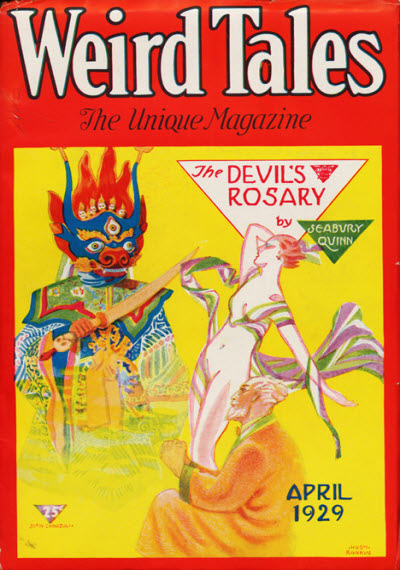
Weird Tales April 1929 

"In a Dead Man's Shoes" is a historical short story by Harold Markham, which was first published in the April 1929 issue of Weird Tales. The story may be found online here.

I came across this story via the striking interior artwork (see below) of an eighteenth century hanging by prolific Weird Tales interior and cover artist Hugh Rankin under his pseudonym Doak (Doak was Rankin's middle name), which intrigued me enough to read the story itself. Rankin also supplied the striking Art Deco cover, illustrating a Seabury Quinn Jules de Grandin story, for this issue of Weird Tales, by the way.

Harold Markham is one of the many pulp era authors about whom we know next to nothing. ISFDB lists only six stories by him, published between 1928 and 1936. Three of those stories were published in British horror anthologies, which leads me to believe that Markham may have been British. The remaining three appeared in Weird Tales.

The Fiction Mags Index lists a few non-fiction pieces by Markham that appeared in Boys' Life and Boy's Own Paper. Several of these non-fiction articles are about amateur theatre and indeed Harold Markham published a manual for staging amateur theatre productions in 1931. There also is a Harold Markham who ran a coconut plantation in the Solomon Islands from the 1930s into the 1960s and was a prolific letter writer and diarist, though it's not clear whether he is the Harold Markham who wrote "In a Dead Man's Shoes".

Warning: There will be spoilers in the following.

"In a Dead Man's Shoes" opens with a bang or rather the slamming of a gavel, as a judge sentences a young man named Jim O'Dale to death for highway robbery. O'Dale is remarkably sanguine about his fate. He readily admits that he is guilty and even boasts of a particularly daring heist, where he robbed a fellow highwayman who had previously robbed the actor David Garrick. David Garrick was a real person, by the way, a famous eighteenth century actor and director of the Drury Lane Theatre.

O'Dale only has three requests for the judge. He asks for a reasonably sober hangman to avoid a botched execution, that a certain lady be allowed to visit him in prison and that his old friend, the innkeeper Jacob Larkyn, come to see him hanged. After all, Larkyn paid for O'Dale's lawyer, though the lawyer never stood a chance in the face of overwhelming evidence. "See ye again at Tyburn," O'Dale calls out to Larkyn in what turns out to be a very ominous statement.

Larkyn has every intention to watch O'Dale's execution, since he was the one who tipped off the authorities and led the Bow Street Runners to O'Dale's hideout. As for why Larkyn sold out his old friend, it's a classic case of "cherchez le femme", since both O'Dale and Larkyn happen to be in love with the same woman, Barbara Challis. However, Barbara chose the handsome O'Dale over the unattractive Larkyn, so Larkyn decided to get his rival out of the way and then console the bereaved Barbara. He even paid for O'Dale's lawyer, because he knew that the evidence against O'Dale was so overwhelming that even the best of lawyers could not save him.

Next, we get the execution of Jim O'Dale at Tyburn, described from Larkyn's POV in grisly detail. We get plenty of description of the jeering, cheering crowd and of the handsome Jim O'Dale being driven to the gallows, dressed in fine new clothes. This is historically accurate, by the way, since condemned prisoners about the be hung in Tyburn would often wear particularly nice clothes to look their best during their execution.

Even on the way to his own hanging, Jim O'Dale is still charming and suave as ever. He doesn't have a dying speech, though he does have a final request. He asks to speak to Jacob Larkyn and asks that his fine and very distinctive shoes with wrought gold buckles be given to Larkyn as a final gift. This is contrary to custom, since the hangman gets the clothes of the executed victims as a sort of bonus, though the resale value is questionable considering that people executed by hanging tend to lose control of their bowels and bladder. However, O'Dale tells the hangman that he can have all his other clothes, including a very fine velvet coat, as long as Larkyn gets the shoes "in memory of what he did for Jim O'Dale".

What makes the shoe request even more strange is that earlier on the same page, it was explained that part of the reason Larkyn hates Jim O'Dale is that O'Dale is handsome and has dainty hands and feet, whereas Larkyn has the big paws and feet of a labourer. So given the difference in their shoe sizes, how will O'Dale's shoes even fit Larkyn?

The hangman agrees to let Larkyn have the shoes and so the execution proper begins. Charming, handsome and debonair as Jim O'Dale was in life, his death is brutal and unpleasant and he struggles a lot, before the hangman tugs on his legs to break his neck, a scene illustrated by Hugh Rankin in the interior art.

Interior art for "In a Dead Man's Shoes" by Hugh Rankin a.k.a. Doak 

The description of the hanging and of Jim O'Dale's twitching, struggling body is not only quite graphic, it is also accurate compared to descriptions of actual short drop hangings. The only thing that is not entirely accurate is that O'Dale is the only person to be hanged that day, since in the eighteenth century multiple prisoners were usually hanged at once. In fact, the description of the hanging was so accurate that I wondered whether Harold Markham had ever witnessed an execution by hanging. This is not completely unlikely, since the last public hanging execution in the US took place in Kentucky in 1936, i.e. seven years after "In a Dead Man's Shoes" was published. The UK no longer had public executions in the twentieth century, but Markham might still have witnessed a hanging in a professional capacity (journalist, lawyer, priest, prison warden) of some kind.

However, twentieth century hangings were long drop hangings, at least in the US and the UK and its former and current colonies. Short drop hangings such as the executions at Tyburn and the resulting violent death struggles were long a thing of the past by the early twentieth century, at least for official executions. Therefore, it's also quite possible that Markham used lurid reports about executions at Tyburn from old broadsheets or the Newgate Calendar as the basis for the graphic description of the hanging of Jim O'Dale.

The hanging of Jim O'Dale is such an unpleasant sight that Larkyn feels a little ashamed for what he's done, especially since he is obliged to wait and watch his rival swinging dead in the wind for an hour, until the body is cut down. We get another nice bit of period detail, as spectators try to snag a piece of a hangman's rope, which was a popular good luck talisman during the era. The hangman also keeps his word and gives Larkyn the late Jim O'Dale's shoes.

A drink at a nearby pub lifts Larkyn's spirit and he even wonders that since parts of the hangman's rope are considered good luck charms, whether O'Dale's shoes will not bring him luck. So Larkyn decides to try on the nice new shoes and lo and behold, they even fit, though they are a little tight.

Now Larkyn goes to see Barbara Challis, hoping to console her in her grief over Jim O'Dale. Barbara, who did not attend the execution, has clearly been crying, but she's also oddly triumphant, as she tells Larkyn that O'Dale asked her to make sure that Larkyn is rewarded for everything he did for them. Again, this sounds rather ominous, but Larkyn is too besotted by the pretty Barbara to notice.

Barbara hugs Larkyn and cries on his shoulder and reveals yet another last wish of Jim O'Dale. For O'Dale did not want Barbara to mourn him, but wanted her to move on. He specifically asked her to go to the Drury Lane Theatre on the night of his hanging to distract herself by watching celebrated actor David Garrett play Hamlet. And since a lady can hardly go to the theatre alone, Barbara asks Larkyn to accompany her. After all, it was Jim O'Dale's last wish.

After the play, Barbara asks Larkyn to take her to the stage door to see the great David Garrett himself. There is a crowd at the stage door, but Larkyn pushed his way through to David Garrett himself and asks the actor to talk to Barbara. Though used to fan requests, Garrett is uncommonly interested in Larkyn and particularly in his shoes – the very distinctive shoes with the gold buckles that Jim O'Dale bequeathed to Larkyn as a final gift.

Turns out that the shoes really belong to David Garrett and were stolen, when Garrett fell victim to a highwayman, a highwayman who was subsequently robbed by Jim O'Dale. Larkyn tries to explain that he came by the shoes honestly, that Jim O'Dale gave them to him, but suddenly Barbara calls out that Larkyn has the shoes, because he was O'Dale's fence and that they will find plenty of more stolen goods hidden in Larkyn's closet.

Now Larkyn finally realises that he has been tricked, but it's too late. He is arrested and taken to Newgate. The story ends with Larkyn having a vision of his own trial and hanging, while Barbara looks on in triumph.

"In a Dead Man's Shoes" is a neat, atmospheric and well-constructed historical crime story. However, even though the story was published in Weird Tales, it is not even remotely supernatural. Larkyn does not fall victim to a vengeful ghost, but to the carefully plotted revenge of Jim O'Dale and Barbara.

This isn't as unusual as you'd think, since Weird Tales did publish quite a few stories in the 1920s that were heavy on torture and physical brutality, but had no supernatural content. "The Copper Bowl" by George Fielding Eliot, published in the December 1928 issue of Weird Tales and reprinted several times since then, is probably the best known example. Even before either genre was fully codified, the lines between horror and thriller were fluid and so stories of non-supernatural horror like "The Copper Bowl" or "In a Dead Man's Shoes" could find a home in Weird Tales.

"The Copper Bowl" hasn't aged well, since it's a yellow peril story and very racist. In fact, I'm stunned that the last reprint of that story was in 2017. Meanwhile, "In a Dead Man's Shoes" has never been reprinted, even though it's a well plotted revenge story and manages to be not grossly offensive.

Indeed, it is notable how well executed (pun fully intended) this story is. Markham never mentions an exact date beyond the reign of George III (which lasted a whopping sixty years), yet Markham weaves plenty of details into the story that evoke the second half of the eighteenth century. The story is also well researched. But then, there was quite a lot of good and well researched historical fiction to be found in the pulps, particularly in Adventure. Sadly, comparatively little of it has been reprinted.

Markham's keen interest in theatre, which is evidenced by the fact that he wrote several articles and a whole book on staging amateur theatre productions, comes through in the story with regard to the David Garrick subplot. Though I wonder whether Garrick was better remembered in the 1920s, since this story was the first I'd heard of him, though I know I inadvertently visited his grave in Poet's Corner in Westminster Abbey.

The revenge plot is well crafted, too, especially considering how short the story is (only seven pages). Many of the utterances of Jim O'Dale and Barbara seem friendly and pleasant on the surface, but take on an ominous double meaning upon rereading the story. Markham also drops in the clue that Jim O'Dale robbed the man who robbed David Garrick into the very first scene in the courtroom and thus sets up the pay-off.

A well-plotted historical crime tale that really deserves more attention than it got.

Wednesday, 23 September 2020

Retro Review: "Blue and Silver Brocade" by Dorothy Quick


This cover illustrates not "Blue and Silver Brocade", but the rather lacklustre novel "The Elder Gods" by Don A. Stuart a.k.a. John W. Campbell
 

I'm taking a bit of a break from Jirel of Joiry, because in my experience, those stories are best, when not read directly one after another. And so I decided to take a look at another underrated woman author of the golden age, Dorothy Quick.

Comrade-in-arms Steve J. Wright recently came across the gothic horror story "Blue and Silver Brocade" by Dorothy Quick in the October 1939 issue of Unknown. The premise sounded interesting, so I decided to review it myself. The story may be read online here

Warning: Spoilers beyond this point!

In true gothic fashion, "Blue and Silver Brocade" starts on a cold night in a spooky mansion on the Scottish moors. The narrator, a young woman named Alice, cannot sleep, because she's cold. Alice would love to have another blanket, but she is loath to wake her Aunt Annabel, owner of the mansion, or the servants.

So Alice searches her room for something that will keep her warm. In a closet, she finds several boxes and looks through them in search of a blanket. In the last box, finally, she finds a patchwork quilt and decides that this will do just fine to keep her warm for the night.

The quilt is quite unusual. For starters, the patches are quite large and made from vastly different materials – velvet, silk, brocade, wool, ancient linen, some kind of parchment that might also be human skin – whereas quilt patches are normally made of the same material, usually cotton, because otherwise the quilt won't properly fit together (ask me how I know). What is more, the edges of the squares are embroidered and the embroidery seems to spell out words in what looks like runes.

One square made from blue brocade with silver embroidery and tiny crowns particularly fascinates Alice, because the material is so beautiful. And so she falls asleep with her hand resting on the blue and silver brocade square. This turns out to be a big mistake.

Alice suddenly finds herself in an unfamiliar room and equally unfamiliar body, wearing a gown made from the same silver and blue brocade as the quilt square. It quickly becomes clear that Alice is now inhabiting the body of a young woman named Jeanne in seventeenth century France. Alice can see and feel everything Jeanne experiences, but she cannot influence events nor does she know anything about what's going on apart from what she directly witnesses.

Jeanne is quickly joined by a beautiful woman named Francoise with whom she is about to embark on some kind of dangerous venture, which will put Francoise ahead of her rival, a mysterious woman only known as "the lady". Jeanne is apparently an attendant of this mysterious lady and wears the lady's silver and blue brocade livery, though her loyalty is to Francoise. Jeanne and Francoise both put on black hooded cloaks and leave through a secret passage. Outside the passage, they are met by Jeanne's lover Raoul.

A carriage takes Jeanne, Francoise and Raoul to a shabby house, where a rat-faced, toothless woman awaits them. Alice knows that Jeanne is terrified, though she has no idea of what.

Inside the shabby house, Jeanne and Raoul are taken to a ritual chamber where other cloaked and hooded figures are already waiting. Alice finally realises that she is about to witness a black mass.

Francoise is lying naked on the altar, while the ritual goes on around her. Raoul supplies some helpful dialogue explaining that Francoise – though already beautiful like a Greek statue – is attending the black mass in search of even more beauty, because she wishes to regain the affection of the king – Louis XIV of France – who has transferred his attention from Francoise to the mysterious lady.

We are now treated to a graphic description of the black mass, complete with a blood sacrifice that is initially implied to be a baby, but thankfully turns out to be only a black rooster whose blood is splattered all over the naked Francoise.

Before the black mass can reach its climax and more blood sacrifices can be made, the cultists are interrupted by a patrol of the king's men who break down the door on the orders of the mysterious lady. The satanic priest commits suicide, Raoul throws his cloak over Francoise's head and tells her to play dead.

Then the guards break down the door. The guard captain recognises Raoul and is clearly surprised to see him attending a black mass (I can't even blame him, since I would be surprised to see any acquaintance of mine attending a black mass, particularly one with blood-splattering sacrifices). Raoul claims that it was just curiosity which brought him there. However, the guard captain informs Raoul that he has to arrest everybody present, including Raoul.

Raoul asks if the captain if he could at least let Jeanne go and sweeps aside her black cloak to reveal the silver and blue brocade livery of the lady. The captain, however, insists that he has to arrest everybody - king's orders and the lady's will – and that there will be no exceptions for anybody, not even an attendant of the lady.

So Raoul, Jeanne and the rest of the cultists are arrested. Jeanne is glad that at least Francoise will be able to escape, since the guard captain thought she was dead, because her naked body was covered in (chicken) blood, and left her behind.

The captain grants Raoul and Jeanne a few minutes alone in a cell. Raoul says that this is good-bye for both of them. For the lady will be furious that Francoise escaped the trap she set for her and will have everybody who was arrested at the black mass tortured. However, of all the cultists, only Jeanne and Raoul know Francoise's name. Raoul also casually drops Francoise's full name, so Alice is able to use her knowledge of history to piece everything together. Francoise is Madame de Montespan, mistress of Louis XIV. The "lady" is her successor, Madame Scarron a.k.a. the Marquise of Maintenon. So Francoise's attempts to regain the king's favour by satanic means were ultimately futile.

Raoul now asks Jeanne if she is strong enough to withstand torture. Jeanne says that she hopes she will be strong enough, but she is afraid. However, Jeanne also declares that she would rather die than betray Francoise. So she begs Raoul to kill her. Raoul kisses Jeanne and strangles her. We get another quite graphic description of Jeanne being throttled to death, while a desperate Alice wonders what will happen to her, when Jeanne dies.

However, Alice does not die. Instead, she wakes up screaming, while her Aunt Annabel and Annabel's maid Hester stand over her bed. Both Annabel and Hester are horrified to see that Alice has found the quilt. Hester says that the quilt should have been burned long ago, while Aunt Annabel finally tells Alice the story of the quilt.

The quilt, it turns out, was made by an old witch who collected scraps of fabric with terrible histories connected to them. She pieced the scraps together with her magic, so that if someone falls asleep with their hand touching one of the squares, they will relive whatever terrible memory has been encoded in the square.

The quilt ended up with an ancestor of Aunt Annabel's late husband who put it in a guestroom and then waited for his guests to tell him about their nightmares. But then, one guest went mad and another died and the quilt was packed away. Aunt Annabel's husband showed her the quilt and Annabel slept with it for two nights, until she could not stand it anymore. However, she could never bring herself to destroy the quilt either.

Aunt Annabel wants to destroy the quilt now, but Alice won't let her. She wants to try sleeping under it again and she also has just the square picked out that she wants to try, the one which looks like parchment or human skin…


A portrait of the historical Madame de Montespan by an unknown artist.

"Blue and Silver Brocade" is a highly effective and – by the standards of the time – remarkably graphic story of gothic horror. It's yet another example of the "tale within a tale" stories that were popular during the golden age and that particularly Dorothy Quick was clearly fond of. But unlike other "tale within a tale" stories, here we don't have people sitting around a fireplace or dinner table telling a spooky story. Instead, there is a unique delivery vehicle, a haunted patchwork quilt that transports those who sleep under it into other eras and lives.

I have to admit that I love the idea of a haunted patchwork quilt that contains spooky stories and not just because I have been known to make quilts myself (not haunted, though). And making a real world replica of Dorothy Quick's fictional quilt – hopefully not haunted – sounds like a great craft project. Maybe an idea for a future Worldcon.

However, the haunted quilt is simply a great premise for a series of interconnected stories, though keeping the quilt in a box in a room where guests can stumble upon it unaware of the danger does strike me as very negligent. And indeed, Dorothy Quick wrote two more stories about the haunted patchwork quilt, which I will eventually review, if only because I love the premise.

While the framing story offers a standard gothic spooky mansion on the moors set-up, the dream story takes us into a completely different genre, namely that of historical fiction. Francoise de Montespan and her romantic rival, Francoise, Marquise de Maintenon a.k.a. "the lady" (probably because Luis XIV going for two women with such similar names would have been very confusing for readers) are both actual historical figures, though Jeanne and Raoul are fictional. There even is a portrait of Madame de Montespan wearing a dress of golden brocade like the one she wears in the story.

Madame de Montespan really was rumoured to have been involved in black masses where a rogue priest named Étienne Guiborg pouring blood over her naked body. She was also rumoured to have been a client of Catherine Monvoisin a.k.a. La Voisin (implied to be the rat-faced woman mentioned in the story), poisoner, abortionist and sorceress to the French aristocracy, who implicated Madame de Montespan after her arrest. Historical fiction generally is not kind to Madame de Montespan and tends to portray her as a villainess of the worst kind, even though we cannot be sure how many of the terrible stories told about her are really true and how many are the result of people arrested in connection with Catherine Monvoisin during the so-called affaire des poisons in 1677 (the story is implied to be set during this time) giving false confessions under torture. Interestingly, both history and fiction are much kinder to the Marquise de Maintenon who is generally considered to have been a good influence on Louis XIV, to have treated his legitimate wife well (unlike Madame de Montespan) and who founded a school for impoverished aristocratic girls.

So it's interesting that Dorothy Quick turns Francoise de Montespan into a semi-sympathetic character who commands loyalty unto death from Raoul and Jeanne, though it's never clear just why these two would be willing to die for her, while Madame de Maintenon is portrayed as the villainess of the story.


The tragic adventures of the doomed lovers Jeanne and Raoul in seventeenth century France reminded me very much of the Angélique series by Serge and Anne Golon, which my teenaged self devoured with great glee. Not just because of the setting – seventeenth century France during the reign of Louis XIV – but also because of the quite graphic violence and bloody happenings. And trust me, the Angélique series has a lot of that and is full of torture, executions, murders, sexual violence, pirates, harems, the inquisition, etc... Madame de Montespan actually does appear as a supporting character in some of the Angelique novels (as does Louis XIV), once again engaged in black masses, poisonings and other mischief. Though the first Angelique novel, Angélique, the Marquise of the Angels, did not appear until 1957, eighteen years after "Blue and Silver Brocade" was published, so it can't possibly have inspired this story.

Which begets the question, what did inspire this story? For while there are a lot of historical sagas full of romance and quite graphic violence with female protagonists, the examples that come to mind – the Angelique novels, the Lymond Chronicles by Dorothy Dunnett, the Outlander series by Diana Gabaldon, Forever Amber by Kathleen Winsor – all postdate "Blue and Silver Brocade". And the historical fiction of the era, works by writers like Raphael Sabatini, Georgette Heyer, Talbot Mundy, Harold Lamb, Margaret Mitchell, Hervey Allen, etc… is quite different from the historical scenes in "Blue and Silver Brocade". The rivalry between Madame de Montespan and the Marquise de Maintenon and the affaire des poisons has been frequently chronicled, often in a quite sensational manner, so Dorothy Quick may well have come across the story. The graphic violence may have been inspired by the Theatre du Grand-Guignol, but the blood-drenched horror plays presented at that famous Paris theatre were usually not historical. So was Dorothy Quick the first to merge romantic historical drama with graphic violence? This is certainly a mystery to be explored further.

Steve J. Wright was quite shocked at how graphic the violence in "Blue and Silver Brocade" was. And indeed, the story is remarkably graphic by 1930s standards. We not only get a graphic description of a blood-drenched black mass and an equally graphic description of a woman being strangled to death from the POV of the victim, we also have nudity and several passionate and thrilling kisses, including one kiss which happens as Jeanne is strangled to death (which hints at erotic asphyxiation). By 1930s standards, this is strong stuff.

What makes this even more remarkable is that "Blue and Silver Brocade" was not published in the fairly liberal Weird Tales, where graphic violence, satanic rituals, passionate kisses and hints of sex all showed up more or less frequently, but in John W. Campbell's much more prudish Unknown, which was focussed more on proto-urban fantasy, humorous fantasy and Arabian Nights type adventures than on gothic horror. I'm not surprised that Dorothy Quick chose to submit this story to Unknown. After all, Campbell paid better and much more promptly than Weird Tales, which was notoriously slow to pay, particularly under Farnsworth Wright. However, I'm surprised that Campbell bought it, because "Blue and Silver Brocade" is so very much not a John W. Campbell type story and would seem much more at home in Weird Tales or even the likes of Spicy Mystery or Spicy Adventure.

"Blue and Silver Brocade" is also a depressing story, because the actions of the characters in the historical flashback are ultimately futile. Jeanne dies by the hand of Raoul, it is strongly implied that Raoul will be executed for his part in the conspiracy (and for killing Jeanne) and Francoise does not regain the affections of the King, but will be banished from court. It's very much a downer ending, which also heightens the impact of the graphic violence.

"Blue and Silver Brocade" passes the Bechdel test with flying colours, something which is exceedingly rare for golden age SFF stories. What's even more remarkable is that except for Raoul, all named characters are female. The other Dorothy Quick story I reviewed for the Retro Reviews project also passed the Bechdel test, which shows that Quick centered women characters and their experiences in her fiction.

Next to Fritz Leiber's justly beloved Fafhrd and Grey Mouser stories, Dorothy Quick's Patchwork Quilt series is certainly one of the most interesting and unusual works to appear in Unknown. Dorothy Quick is vastly underrated and I for one will be very interested to read the other two stories in this series.